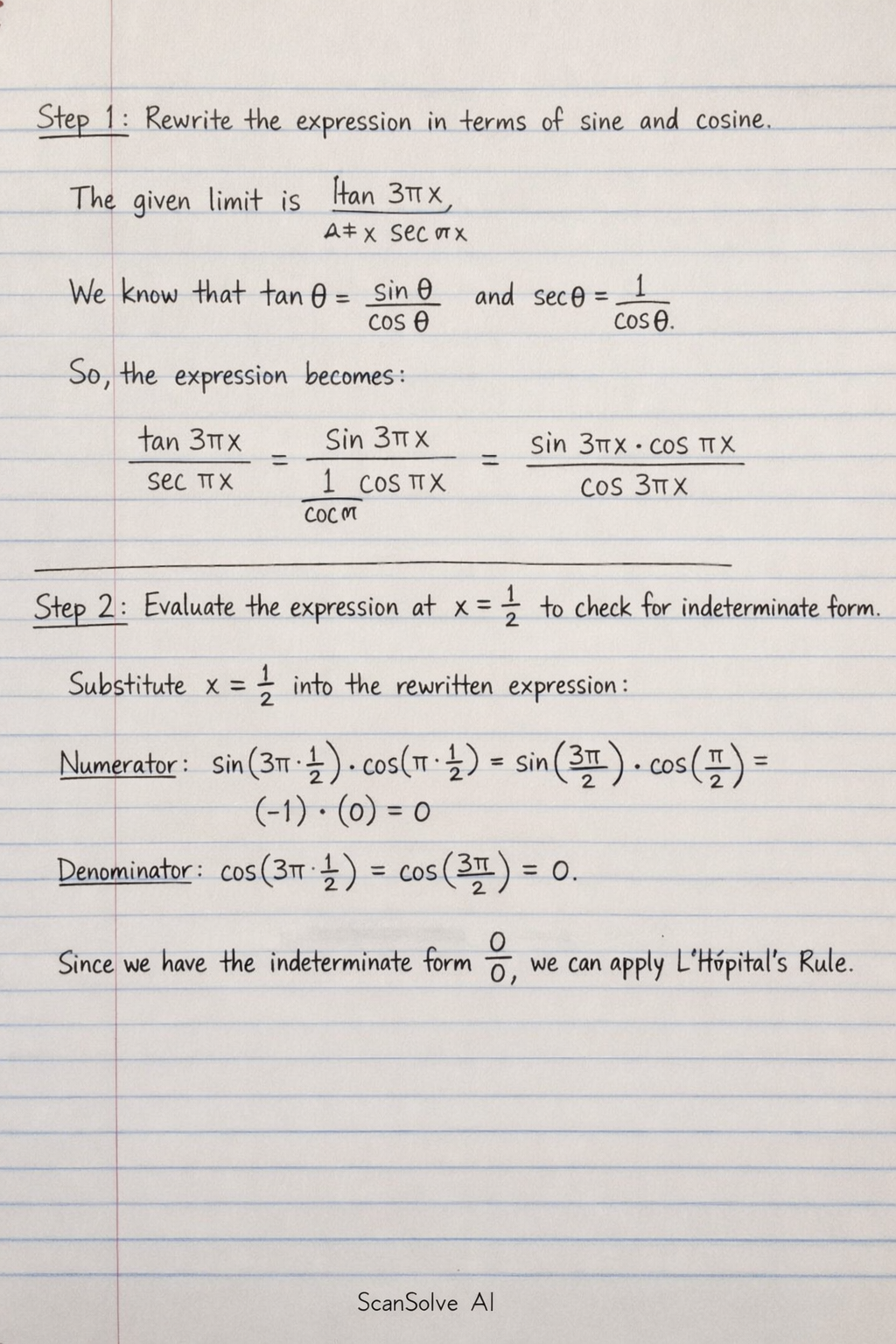
Step 1: Rewrite the expression in terms of sine and cosine.
The given limit is limx→1/2secπxtan3πx.
We know that tanθ=cosθsinθ and secθ=cosθ1.
So, the expression becomes:
secπxtan3πx=cosπx1cos3πxsin3πx=cos3πxsin3πx⋅cosπx
Step 2: Evaluate the expression at x=1/2 to check for indeterminate form.
Substitute x=1/2 into the rewritten expression:
Numerator: sin(3π⋅21)⋅cos(π⋅21)=sin(23π)⋅cos(2π)=(−1)⋅(0)=0.
Denominator: cos(3π⋅21)=cos(23π)=0.
Since we have the indeterminate form 00, we can apply L'Hôpital's Rule.
Step 3: Apply L'Hôpital's Rule.
L'Hôpital's Rule states that if limx→cg(x)f(x) is of the form 00 or ∞∞, then limx→cg(x)f(x)=limx→cg′(x)f′(x).
Let f(x)=sin3πx⋅cosπx and g(x)=cos3πx.
Find the derivative of f(x) using the product rule (uv)′=u′v+uv′:
f′(x)=dxd(sin3πx⋅cosπx)
f′(x)=(3πcos3πx)(cosπx)+(sin3πx)(−πsinπx)
f′(x)=3πcos3πxcosπx−πsin3πxsinπx.
Find the derivative of g(x):
g′(x)=dxd(cos3πx)
g′(x)=−3πsin3πx.
Step 4: Evaluate the limit of the derivatives at x=1/2.
Substitute x=1/2 into f′(x):
f′(21)=3πcos(23π)cos(2π)−πsin(23π)sin(2π)
f′(21)=3π(0)(0)−π(−1)(1)
f′(21)=0−(−π)=π.
Substitute x=1/2 into g′(x):
g′(21)=−3πsin(23π)
g′(21)=−3π(−1)=3π.
Now, calculate the limit:
limx→1/2g′(x)f′(x)=g′(1/2)f′(1/2)=3ππ=31
The value of the limit is 31. This corresponds to option b.
The final answer is b.31.
Send me the next one 📸