
We read your photo as:
Write the rule for fractions with a denominator of 2 to change them to whole numbers and provide a reason. Also, find the rule for the number of sunflowers planted in each row based on the provided pa
ScanSolve AI Answer
Answers
2 partsStep-by-step solution
7 stepshere are the solutions to the next questions.
Part 3
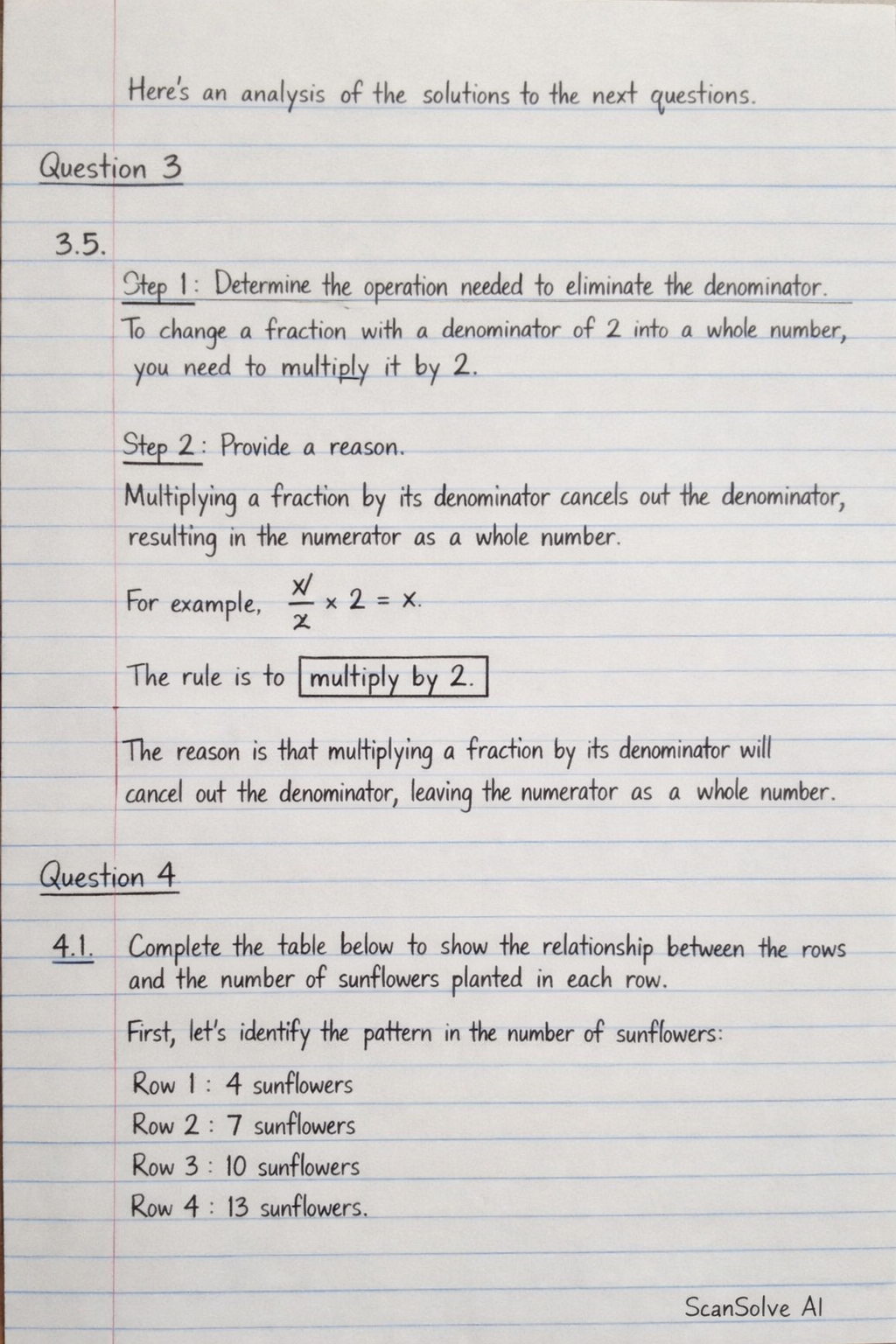
Part 3.5
Write the rule that should be applied to a list of inputs that are fractions with a denominator of 2 to change them to whole numbers. Provide a reason for your answer.
Determine the operation needed to eliminate the denominator.
To change a fraction with a denominator of 2 into a whole number, you need to multiply it by 2.
Provide a reason.
Multiplying a fraction by its denominator cancels out the denominator, resulting in the numerator as a whole number. For example, .
The rule is to .
The reason is that multiplying a fraction by its denominator will cancel out the denominator, leaving the numerator as a whole number.
Part 4
Part 4.1· 3 steps
Complete the table below to show the relationship between the rows and the number of sunflowers planted in each row.
First, let's identify the pattern in the number of sunflowers:
Row 1: 4 sunflowers
Row 2: 7 sunflowers
Row 3: 10 sunflowers
Row 4: 13 sunflowers
Find the common difference between consecutive terms.
The number of sunflowers increases by 3 for each subsequent row. This is an arithmetic sequence.Determine the rule for the -th row.
The general formula for an arithmetic sequence is , where is the number of sunflowers in row , is the number of sunflowers in the first row, and is the common difference.
Here, and .
So,
Calculate the number of sunflowers for Row 7.
For : .
The completed table is:
Row Number 1 2 3 4 7 n Number of Sunflowers 4 7 10 13 22
Part 4.2
Which row will have 106 sunflowers? Show your calculations.
Use the rule and set .
Solve for .
The will have 106 sunflowers.
Try one yourself
A new problem that tests the same skill.
Still stuck on this one?
Ask a follow-up, and the answer starts from this question.
More Mathematics Questions
Handwritten Step-by-Step Solution
Get this as a handwritten image on WhatsApp — like a tutor wrote it for you.
Try on WhatsApp