
We read your photo as:
SECTION A (52 Marks) Answer all questions in this section a) Express 3 2 - 2 2 as a single fraction. b) Evaluate 1 (1-4x+3x) dx.
ScanSolve AI Answer
Answers
3 partsStep-by-step solution
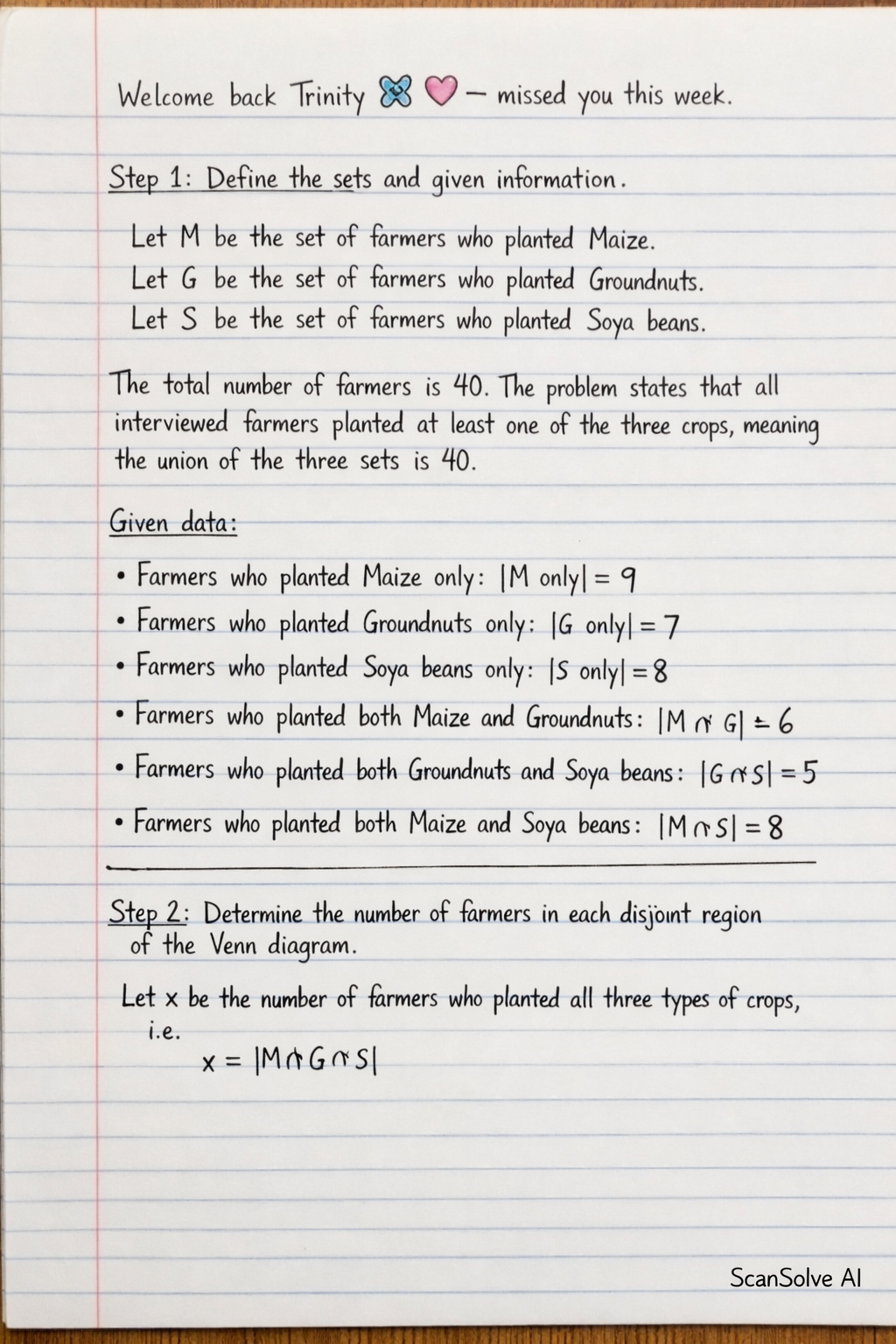
6 stepsDefine the sets and given information.
Let M be the set of farmers who planted Maize.
Let G be the set of farmers who planted Groundnuts.
Let S be the set of farmers who planted Soya beans.
The total number of farmers is 40. The problem states that all interviewed farmers planted at least one of the three crops, meaning the union of the three sets is 40.Given data:
- Farmers who planted Maize only:
- Farmers who planted Groundnuts only:
- Farmers who planted Soya beans only:
- Farmers who planted both Maize and Groundnuts:
- Farmers who planted both Groundnuts and Soya beans:
- Farmers who planted both Maize and Soya beans:
Determine the number of farmers in each disjoint region of the Venn diagram.
Let be the number of farmers who planted all three types of crops, i.e., .
The number of farmers in each unique region is:
- Maize only: 9
- Groundnuts only: 7
- Soya beans only: 8
- Maize and Groundnuts only (not Soya beans):
- Groundnuts and Soya beans only (not Maize):
- Maize and Soya beans only (not Groundnuts):
- All three crops:
Calculate the value of .
Since all 40 farmers planted at least one crop, the sum of all these disjoint regions must equal the total number of farmers:
Combine the constant terms:
Combine the terms:
So the equation becomes:
Subtract 43 from both sides:
Divide by -2:
Note: The number of farmers must be an integer. The result of indicates an inconsistency in the problem's given data. We will proceed with this value as calculated.
Calculate the number of farmers for each specific region using .
- Maize only: 9
- Groundnuts only: 7
- Soya beans only: 8
- Maize and Groundnuts only (not Soya beans):
- Groundnuts and Soya beans only (not Maize):
- Maize and Soya beans only (not Groundnuts):
- All three crops: 1.5
Draw a Venn diagram to illustrate this information.
(i) A Venn diagram would show three overlapping circles labeled M (Maize), G (Groundnuts), and S (Soya Beans). The numbers in each region would be:
- Region M only: 9
- Region G only: 7
- Region S only: 8
- Region M and G (but not S): 4.5
- Region G and S (but not M): 3.5
- Region M and S (but not G): 6.5
- Region M, G, and S (the center intersection): 1.5
Find how many farmers planted
(ii)
(a) All three types of crops.
This is the value of .
The number of farmers who planted all three types of crops is .(b) Two types of crops.
This is the sum of farmers who planted exactly two types of crops (i.e., not all three).The number of farmers who planted exactly two types of crops is .
(c) Maize and groundnuts but not soya beans.
This is the region .The number of farmers who planted Maize and groundnuts but not soya beans is .
Try one yourself
A new problem that tests the same skill.
Still stuck on this one?
Ask a follow-up, and the answer starts from this question.
More Mathematics Questions
Handwritten Step-by-Step Solution
Get this as a handwritten image on WhatsApp — like a tutor wrote it for you.
Try on WhatsApp