

This history question requires analysis of historical events, causes, and consequences. The detailed answer below provides context, evidence, and a well-structured explanation.
ScanSolve AI Answer
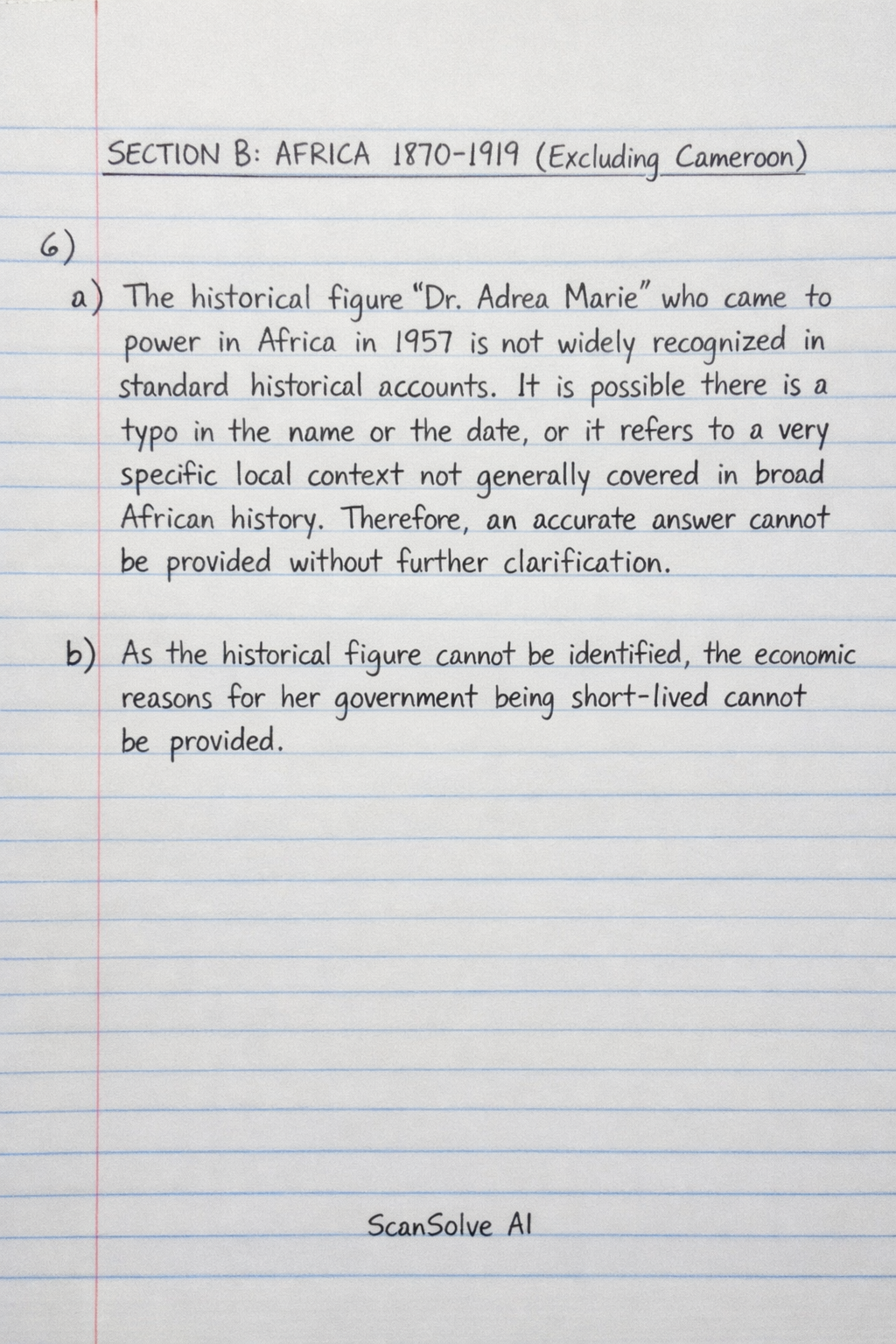
SECTION B: AFRICA 1870-1919 (Excluding Cameroon) 6) a) The historical figure "Dr. Adrea Marie" who came to power in Africa in 1957 is not widely recognized in standard historical accounts. It is possible there is a typo in the name or the date, or it refers to a very specific local context not generally covered in broad African history. Therefore, an accurate answer cannot be provided without further clarification. b) As the historical figure cannot be identified, the economic reasons for her government being short-lived cannot be provided. 7) a) A UN-supervised plebiscite was organized in British Cameroon in 1961 because British Cameroons was a United Nations Trust Territory administered by Britain, and the UN mandated a plebiscite to determine its future: either joining independent Nigeria or independent Cameroon. The United Nations Organization (UNO) played a crucial role by supervising the entire process, including voter registration, campaigning, and the actual voting, to ensure fairness and transparency. It also set the terms of the plebiscite. b) Two factors that worked in favour of reunification between Southern Cameroons and the Republic of Cameroon were: • Shared cultural and historical ties: Many ethnic groups straddled the border, sharing common languages and traditions, fostering a sense of shared identity. • Economic considerations: Southern Cameroons felt economically neglected by Nigeria and saw potential benefits in joining a larger,