
We read your photo as:
Select the false statements. Also, as a project work, take a universal set and write all its possible subsets.
ScanSolve AI Answer
Step-by-step solution
5 stepsHere are the solutions for the questions from the image:
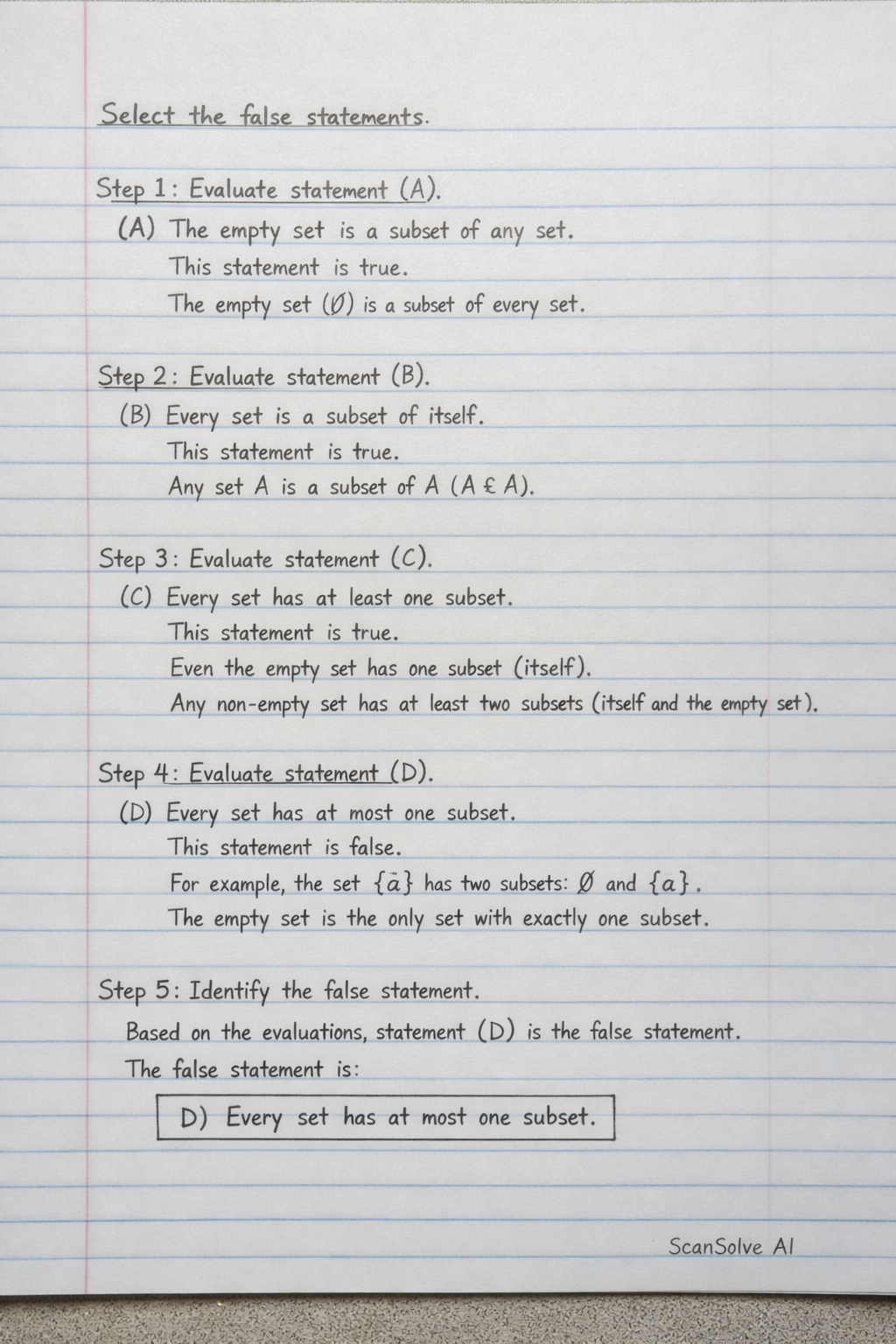
Select the false statements.
Evaluate statement (A).
(A) The empty set is a subset of any set. This statement is true. The empty set () is a subset of every set.
Evaluate statement (B).
(B) Every set is a subset of itself. This statement is true. Any set A is a subset of A ().
Evaluate statement (C).
(C) Every set has at least one subset. This statement is true. Even the empty set has one subset (itself). Any non-empty set has at least two subsets (itself and the empty set).
Evaluate statement (D).
(D) Every set has at most one subset. This statement is false. For example, the set has two subsets: and . The empty set is the only set with exactly one subset.
Identify the false statement.
Based on the evaluations, statement (D) is the false statement.
The false statement is:
Project work and Activity Section
-
a) Let's take a universal set under your consideration. Then, write all subsets as possible from your universal set. This is an activity for you to perform. You need to choose a universal set (e.g., ) and then list all its possible subsets (e.g., ).
-
b) Let's conduct a survey inside your classroom among your friends and make separate sets in the following ways: This is a survey-based activity. You need to collect data from your friends to form the sets and answer sub-questions (i) through (vi). As an AI, I cannot conduct a survey or provide specific answers to these questions without the collected data.
-
c) Is there any possibility to form overlapping sets of the sets of teachers who are teaching different subjects in your school? If so, make them and show in diagrams. Yes, it is possible to form overlapping sets. This occurs if one or more teachers teach multiple subjects. For example: Let Let If a teacher, say Mr. Sharma, teaches both Math and Science, then Mr. Sharma would be an element in both and . This would result in an overlapping set: .
Here is a conceptual Venn diagram:
\begin{tikzpicture}
\begin{scope}
    \draw (-1,0) circle (1.5cm) node[above] {$S_1$ (Math Teachers)};
    \draw (1,0) circle (1.5cm) node[above] {$S_2$ (Science Teachers)};
    \node at (0,0) {Mr. Sharma};
    \node at (-2,0) {Ms. Gupta};
    \node at (2,0) {Mrs. Khan};
\end{scope}
\end{tikzpicture}
In this diagram, Ms. Gupta only teaches Math, Mrs. Khan only teaches Science, and Mr. Sharma teaches both.
-
Still stuck on this one?
Ask a follow-up, and the answer starts from this question.
More Mathematics Questions
Handwritten Step-by-Step Solution
Get this as a handwritten image on WhatsApp — like a tutor wrote it for you.
Try on WhatsApp