
We read your photo as:
Set up the system of linear equations based on the principle that the total traffic entering an intersection must equal the total traffic leaving it.
ScanSolve AI Answer
Answer
Step-by-step solution
3 stepsSet up the system of linear equations based on the principle that the total traffic entering an intersection must equal the total traffic leaving it.
-
Intersection A: Traffic in: Traffic out: Equation 1:
-
Intersection B: Traffic in: Traffic out: Equation 2:
-
Intersection C: Traffic in: Traffic out: Equation 3:
-
Intersection D: Traffic in: Traffic out: Equation 4:
-
Solve the system of linear equations.
We have the system:
\begin{align*} x_1 + x_4 &= 475 \quad &(1) \ x_1 - x_2 &= 175 \quad &(2) \ x_2 - x_3 &= -550 \quad &(3) \ x_4 - x_3 &= 300 \quad &(4)\end{align*}
From (2), .
From (3), .
From (4), .Substitute and in terms of and into (1):
x_2 + x_3 = 0 \quad &(5)Now we have a system with and :
\begin{align*} x_2 - x_3 &= -550 \quad &(3) \ x_2 + x_3 &= 0 \quad &(5)\end{align*}
Add (3) and (5):
Substitute into (5):
Substitute into :
Substitute into :
The average hourly traffic values are:
The negative values for and indicate that the actual traffic flow is in the opposite direction to what was initially assumed for those specific segments.
The values are:
Write down the balanced equation with coefficients $x_1, x_2, x_3, x_4
Try one yourself
A new problem that tests the same skill.
Still stuck on this one?
Ask a follow-up, and the answer starts from this question.
More Mathematics Questions
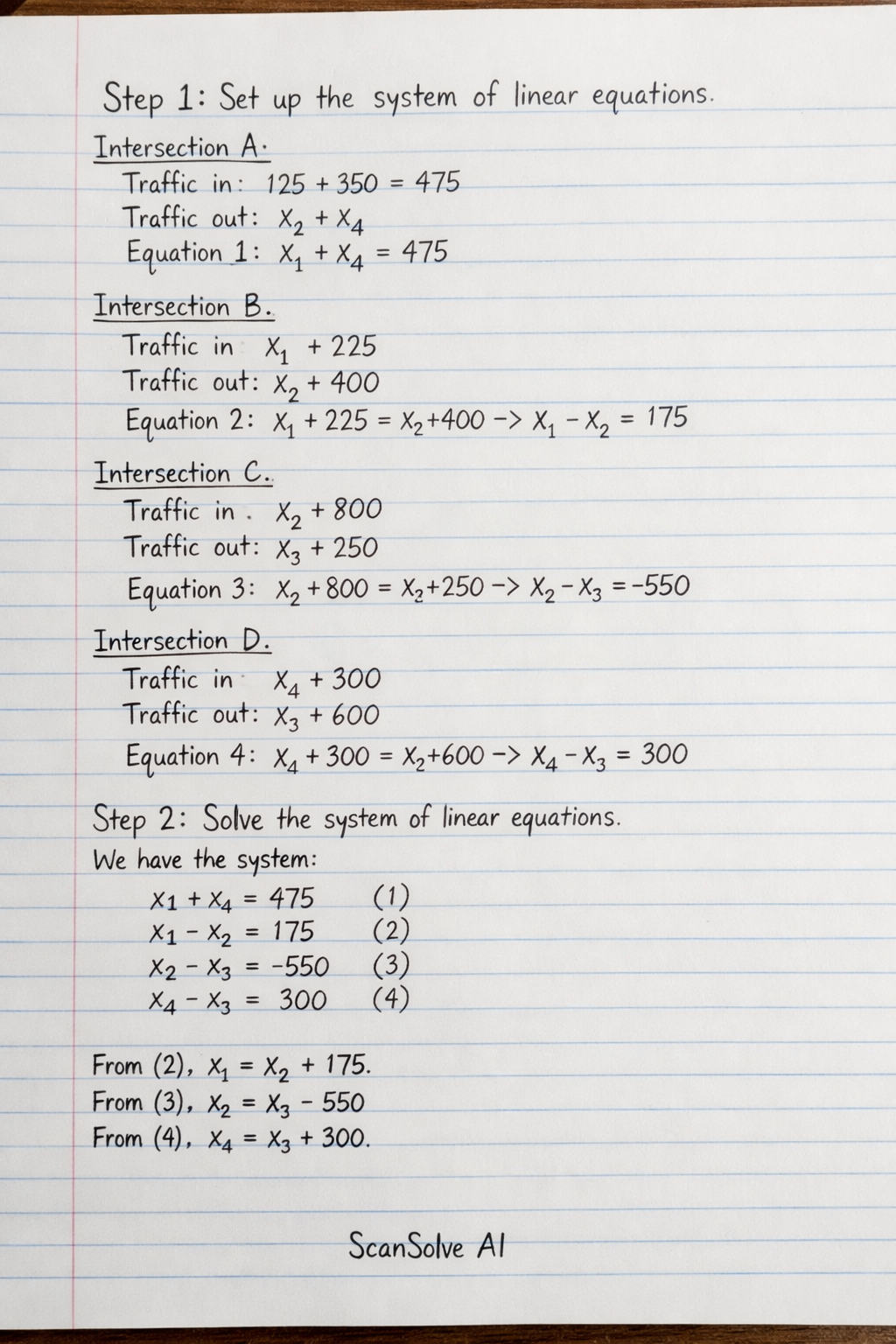
Handwritten Step-by-Step Solution
Get this as a handwritten image on WhatsApp — like a tutor wrote it for you.
Try on WhatsApp