We read your photo as:

Calculate simple interest for investments and loans. Problem 1: Lisa invests R5000 at 7.5% for 6 years. Problem 2: Jack buys a car for R120000 with a 20% deposit, loan at 10.5% for 5 years. Find total

Mathematics

ScanSolve AI Answer

Step-by-step solution

13 steps

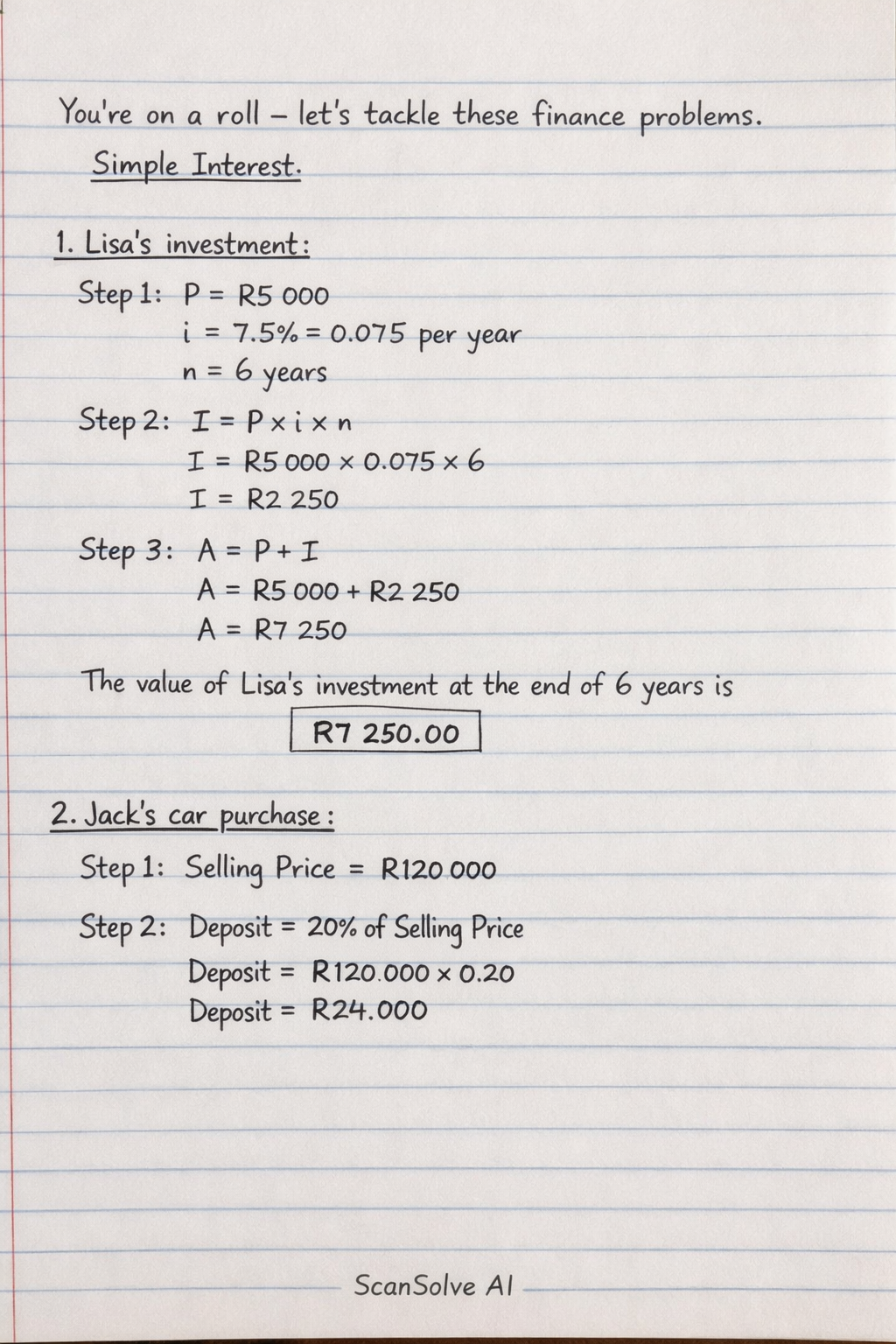
let's tackle these finance problems.

Simple Interest

1. Lisa's investment

  1. Identify the principal amount (PP), interest rate (ii), and time (nn).

    P=R5 000P = \text{R}5\,000
    i=7.5%=0.075i = 7.5\% = 0.075 per year
    n=6 yearsn = 6 \text{ years}

  2. Calculate the simple interest earned using the formula I=P⋅i⋅nI = P \cdot i \cdot n.

    I=R5 000×0.075×6I = \text{R}5\,000 \times 0.075 \times 6 I=R2 250I = \text{R}2\,250
  3. Calculate the total value of the investment (AA) by adding the principal and the interest.

    A=P+IA = P + I A=R5 000+R2 250A = \text{R}5\,000 + \text{R}2\,250 A=R7 250A = \text{R}7\,250

    The value of Lisa's investment at the end of 6 years is R7 250.00\boxed{\text{R7 250.00}}.

    2. Jack's car purchase

  4. Identify the selling price of the car.

    Selling Price = R120 000

  5. Calculate the deposit amount (20% of the selling price).

    Deposit=R120 000×0.20\text{Deposit} = \text{R}120\,000 \times 0.20 Deposit=R24 000\text{Deposit} = \text{R}24\,000
  6. Calculate the loan amount (principal PP) after the deposit.

    Loan Amount=Selling Price−Deposit\text{Loan Amount} = \text{Selling Price} - \text{Deposit} Loan Amount=R120 000−R24 000\text{Loan Amount} = \text{R}120\,000 - \text{R}24\,000 Loan Amount=R96 000\text{Loan Amount} = \text{R}96\,000
  7. Calculate the simple interest on the loan amount.

    P=R96 000P = \text{R}96\,000
    i=10.5%=0.105i = 10.5\% = 0.105 per year
    n=5 yearsn = 5 \text{ years}

    I=P⋅i⋅nI = P \cdot i \cdot n I=R96 000×0.105×5I = \text{R}96\,000 \times 0.105 \times 5 I=R50 400I = \text{R}50\,400
  8. Calculate the total amount Jack pays for the car (Deposit + Loan Amount + Interest on Loan).

    Total Paid=Deposit+Loan Amount+Interest on Loan\text{Total Paid} = \text{Deposit} + \text{Loan Amount} + \text{Interest on Loan} Total Paid=R24 000+R96 000+R50 400\text{Total Paid} = \text{R}24\,000 + \text{R}96\,000 + \text{R}50\,400 Total Paid=R170 400\text{Total Paid} = \text{R}170\,400

    The total amount Jack pays for the car is R170 400.00\boxed{\text{R170 400.00}}.

    Compound Interest

    1. R130 000 investment
    P=R130 000P = \text{R}130\,000
    Annual interest rate = 12% = 0.12
    Time (nn) = 3 years
    Compounded annually.

    a) Calculate the total interest earned.

  9. Calculate the future value (AA) using the compound interest formula A=P(1+i)nA = P(1 + i)^n.

    A=R130 000(1+0.12)3A = \text{R}130\,000(1 + 0.12)^3 A=R130 000(1.12)3A = \text{R}130\,000(1.12)^3 A=R130 000×1.404928A = \text{R}130\,000 \times 1.404928 A=R182 640.64A = \text{R}182\,640.64
  10. Calculate the total interest earned (I=A−PI = A - P).

    I=R182 640.64−R130 000I = \text{R}182\,640.64 - \text{R}130\,000 I=R52 640.64I = \text{R}52\,640.64

    The total interest earned is R52 640.64\boxed{\text{R52 640.64}}.

    b) Determine the value of the investment after three years.
    The value of the investment after three years is the future value calculated in part (a).
    The value of the investment after three years is R182 640.64\boxed{\text{R182 640.64}}.

    2. Jason's R400 000 investment
    P=R400 000P = \text{R}400\,000
    Time = 1.5 years
    Annual interest rate = 10% = 0.10
    Compounded quarterly.

    a) Determine the value of the investment after 1.5 years.

  11. Determine the interest rate per compounding period (ii) and the total number of compounding periods (nn).

    Since it's compounded quarterly, there are 4 compounding periods per year.

    i=Annual RateNumber of Compounding Periods per Year=0.104=0.025i = \frac{\text{Annual Rate}}{\text{Number of Compounding Periods per Year}} = \frac{0.10}{4} = 0.025 n=Years×Number of Compounding Periods per Year=1.5×4=6 periodsn = \text{Years} \times \text{Number of Compounding Periods per Year} = 1.5 \times 4 = 6 \text{ periods}
  12. Calculate the future value (AA) using the compound interest formula A=P(1+i)nA = P(1 + i)^n.

    A=R400 000(1+0.025)6A = \text{R}400\,000(1 + 0.025)^6 A=R400 000(1.025)6A = \text{R}400\,000(1.025)^6 A=R400 000×1.159693418A = \text{R}400\,000 \times 1.159693418 A=R463 877.37A = \text{R}463\,877.37

    The value of the investment after 1.5 years is R463 877.37\boxed{\text{R463 877.37}}.

    b) What is the total amount of interest earned?

  13. Calculate the total interest earned (I=A−PI = A - P).

    I=R463 877.37−R400 000I = \text{R}463\,877.37 - \text{R}400\,000 I=R63 877.37I = \text{R}63\,877.37

    The total amount of interest earned is R63 877.37\boxed{\text{R63 877.37}}.

Was this helpful?

Still stuck on this one?

Ask a follow-up, and the answer starts from this question.

Got a different question?Ask your own question
Handwritten step-by-step solution preview

Handwritten Step-by-Step Solution

Get this as a handwritten image on WhatsApp — like a tutor wrote it for you.

Try on WhatsApp