
We read your photo as:
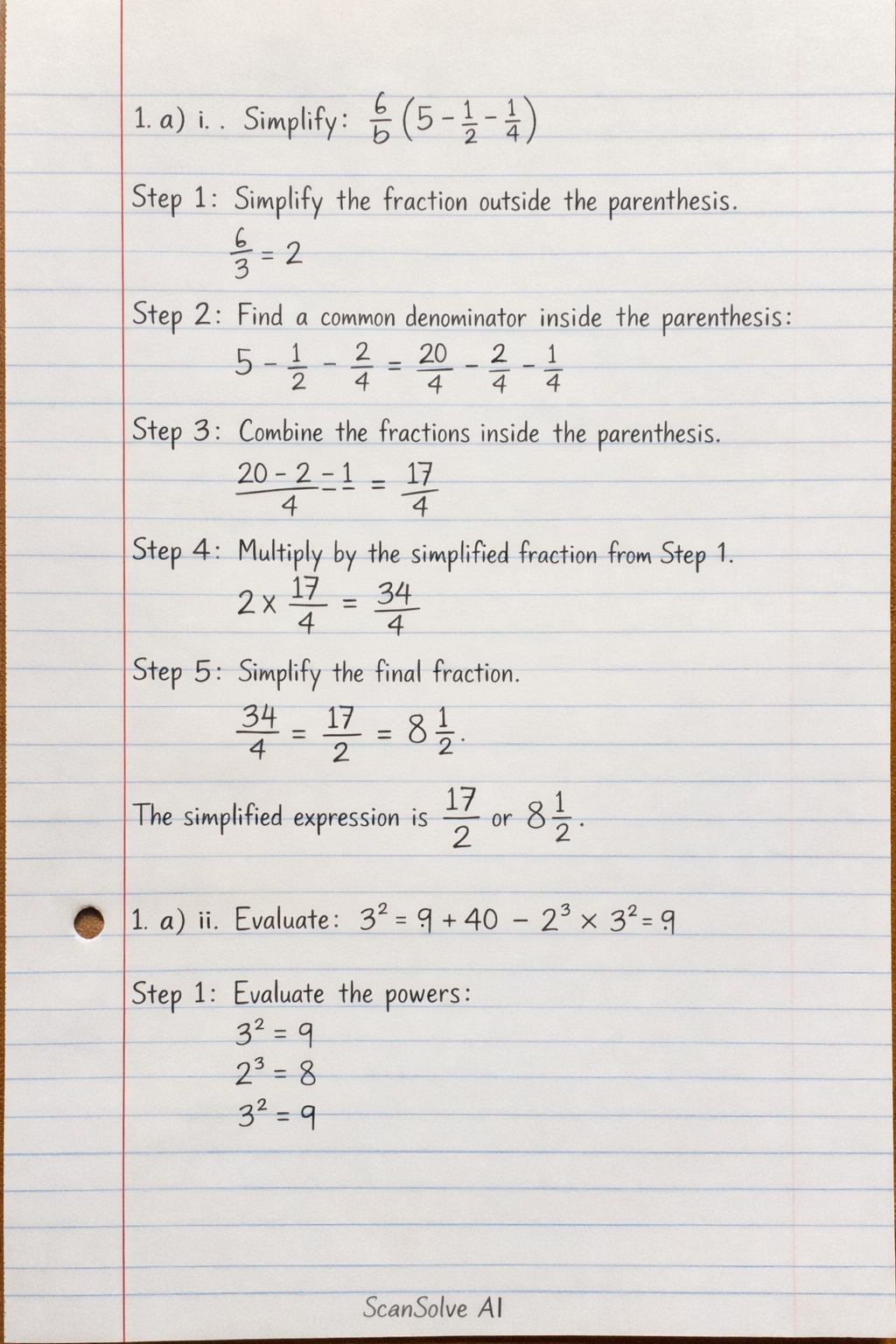
Simplify: rac63 (5 - rac12 - rac14) and Evaluate: 32 / 9 + 40 - 23 x 32 / 9
ScanSolve AI Answer
Step-by-step solution
27 stepshere are the solutions to all the questions in the picture:
1. a) i. Simplify:
Simplify the fraction outside the parenthesis.
Find a common denominator for the terms inside the parenthesis.
The common denominator for 1 (from ), 2, and 4 is 4.
Combine the fractions inside the parenthesis.
Multiply the result by the simplified fraction from Step 1.
Simplify the final fraction.
The simplified expression is .
1. a) ii. Evaluate:
Evaluate the powers.
Substitute the powers back into the expression.
Perform divisions and multiplications from left to right.
Substitute these results back into the expression.
Perform additions and subtractions from left to right.
The evaluated expression is .
1. b) A financial analyst calculates a company's revenue as GHC23,365,752.198. How should this value be rounded for presentation in a financial report with:
i. four significant figures.
ii. two decimal places.i. Rounding to four significant figures:
The first four significant figures are 2, 3, 3, 6. The fifth digit is 5, so we round up the fourth digit.The revenue rounded to four significant figures is .
ii. Rounding to two decimal places:
The first two decimal places are .19. The third decimal place is 8, so we round up the second decimal place.The revenue rounded to two decimal places is .
2. a) i. Akua has enough money to buy exercise books at GHC4.50 each. How many pens costing GHC6.00 each can be bought with the same amount of money?
This question is incomplete as the amount of money Akua has is not provided. Assuming Akua has enough money to buy one exercise book, then the amount of money is GHC4.50.
Determine the amount of money Akua has.
Assuming Akua has enough money to buy one exercise book, the amount is GHC4.50.
Calculate how many pens can be bought with this amount.
Since you cannot buy a fraction of a pen, Akua can buy .
Self-correction: The question implies Akua has enough money to buy exercise books. This usually means she has a specific amount. If the question implies she has exactly enough money to buy one exercise book, then the above answer is correct. If it implies she has a larger, unspecified amount, the question is unanswerable without more information. Given the phrasing, the most reasonable interpretation is that the amount of money is the cost of one exercise book.
2. a) ii. On Adwoa's birthday, the father bought her a pack of chocolate containing 250 bars. If Adwoa took 90 bars of the chocolates and gave the rest to her four friends to share equally, how many bars of chocolates did each receive?
Calculate the number of bars remaining after Adwoa took her share.
Divide the remaining bars equally among her four friends.
Each friend received .
2. b) Use the expanded and the box method to solve:
Expanded Method:
Break down the numbers into their place values.
Multiply each part of the first number by each part of the second number.
Add all the partial products.
The product using the expanded method is .
Box Method (Grid Method):
Draw a grid and write the expanded forms of the numbers along the top and side.
600 20 8 30 9 Multiply the numbers for each cell.
600 20 8 30 9 Add all the products inside the boxes.
The product using the box method is .
2. c) Simplify:
Find a common denominator for the fractions.
The least common multiple of 3 and 2 is 6.
Distribute the numbers in the numerators.
Combine the numerators over the common denominator.
Be careful with the subtraction sign.
Combine like terms in the numerator.
The simplified expression is .
3. a) i. Using a pair of compass and a ruler only, construct triangle ABC such that /AB/ = 8cm, angle BAC = 60° and angle ABC = 45°.
ii. Measure /BC/Construction Steps (description, as I cannot draw here):
i. Construction of Triangle ABC:
- Draw a straight line and mark a point A on it.
- Using a ruler, measure 8 cm from A along the line and mark point B. So, AB = 8 cm.
- Place the compass at point A and draw an arc. Without changing the compass width, place the compass on the intersection of the arc and line AB, and draw another arc to intersect the first arc. Draw a line from A through this intersection point. This creates an angle of 60° at A (angle BAC).
- To construct a 45° angle at B (angle ABC):
- First, construct a 90° angle at B. Draw an arc centered at B intersecting line AB. From these intersection points, draw two more arcs that intersect above B. Draw a line from B through this intersection.
- Bisect the 90° angle. Place the compass at the intersection of the 90° line and an arc from B. Draw an arc. Repeat from the intersection of line AB and an arc from B. Draw a line from B through the intersection of these two new arcs. This line forms a 45° angle with AB.
- Extend the 60° line from A and the 45° line from B until they intersect. Label the intersection point C. Triangle ABC is now constructed.
ii. Measure /BC/:
- Using a ruler, measure the length of the side BC from your constructed triangle.
- (Since I cannot perform the physical construction, I will calculate the approximate length using the Sine Rule for verification. This is for my internal check and not part of the required answer for a "measure" question.)
- Angle ACB = .
- Using the Sine Rule:
- .
- Therefore, when measured from a precise construction, /BC/ should be approximately 7.2 cm (to one decimal place).
3. b) Solve:
Gather all terms with on one side and constant terms on the other side.
Subtract from both sides:
Subtract 5 from both sides.
Divide both sides by -3.
Remember to reverse the inequality sign when dividing by a negative number.
The solution is .
3. c) The diameter of a circular lid is 14cm. Find
i. the circumference of the lid
ii. the area of the lid (take )Given: Diameter .
Radius .
.i. Circumference of the lid:
The formula for circumference is or .
Using :The circumference of the lid is .
ii. Area of the lid:
The formula for the area of a circle is .The area of the lid is .
Still stuck on this one?
Ask a follow-up, and the answer starts from this question.
More Mathematics Questions
Handwritten Step-by-Step Solution
Get this as a handwritten image on WhatsApp — like a tutor wrote it for you.
Try on WhatsApp