
We read your photo as:
Simplify sqrt(27) x sqrt(15)
ScanSolve AI Answer
Answer
Step-by-step solution
17 stepsHere are the solutions to the problems:
: Simplify
Simplify each square root.
Multiply the simplified terms.
The correct option is D.
: Find the radius of a circle whose area is the same as that of a rectangle of sides 4cm by 11cm. (take )
Calculate the area of the rectangle.
Set the area of the circle equal to the area of the rectangle.
Substitute the value of and solve for .
Approximate the value of and compare with options.
The closest option is B.
: Find an expression for the nth term, , of the sequence -2, 3, -4, 5, ...
Analyze the sequence.
The absolute values of the terms are 2, 3, 4, 5, ..., which corresponds to for .
The signs alternate: negative, positive, negative, positive, ...
For , the term is negative. For , the term is positive.
This pattern of signs can be represented by or .
If , (negative).
If , (positive).
So, the sign factor is .Combine the absolute value and sign factor.
The nth term is .
The correct option is C.
: Find the area of an equilateral triangle whose sides are 6cm.
Recall the formula for the area of an equilateral triangle.
The area () of an equilateral triangle with side length is given by:
Substitute the given side length cm.
The correct option is D.
: How many terms are in an Arithmetic Progression whose third term is 6 and the common difference and last term are 2 and 100 respectively?
Identify the given information.
Third term () = 6
Common difference () = 2
Last term () = 100Use the formula for the nth term of an AP, , to find the first term ().
For the third term:
Use the first term, common difference, and last term to find the number of terms ().
The correct option is A.
: Find the perimeter of a parallelogram whose adjacent sides are of lengths 8cm and 12cm.
Recall the formula for the perimeter of a parallelogram.
A parallelogram has two pairs of equal adjacent sides. If the lengths of the adjacent sides are and , the perimeter () is given by:
Substitute the given side lengths.
Given cm and cm.
The correct option is D.
: Let P and Q represent the statements: P = Olu is brilliant, Q = Sola is lazy. Which of the following does p q represent?
Understand the logical connective .
The symbol represents the logical operator "AND".
Combine the statements P and Q using "AND".
P: Olu is brilliant
Q: Sola is lazy
p q means "Olu is brilliant AND Sola is lazy".The correct option is C.
Try one yourself
A new problem that tests the same skill.
Still stuck on this one?
Ask a follow-up, and the answer starts from this question.
More Mathematics Questions
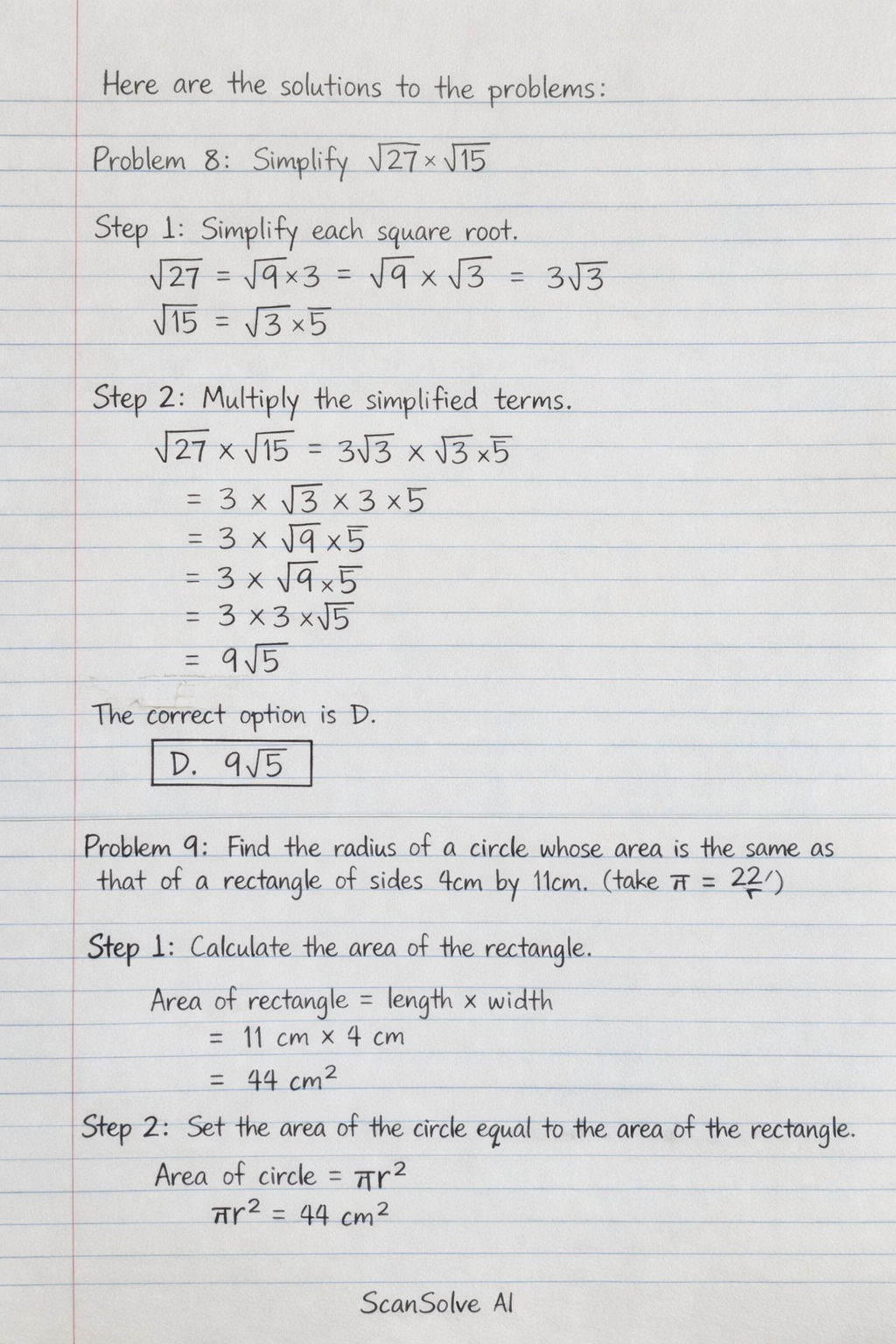
Handwritten Step-by-Step Solution
Get this as a handwritten image on WhatsApp — like a tutor wrote it for you.
Try on WhatsApp