
We read your photo as:
Simplify the denominator of the expression.
Mathematics
ScanSolve AI Answer
Answer
Step-by-step solution
4 stepsSimplify the denominator of the expression.
The denominator is . Since , is approaching 1 but is not equal to 1. Therefore, .
For any , . So, .
The limit expression simplifies to:Evaluate the argument of the exponential function.
Let .
As approaches 1 from the left side (), the term approaches 0 from the negative side ().
Therefore, approaches , which is .Substitute the new limit variable into the expression.
The limit becomes:
Evaluate the limit.
As approaches , the value of approaches 0.
Was this helpful?
Try one yourself
A new problem that tests the same skill.
Still stuck on this one?
Ask a follow-up, and the answer starts from this question.
Got a different question?Ask your own question
More Mathematics Questions
QSimplify the numerator of the fraction.QSimplify the expression in the numerator on the left side.QRationalize the denominator of the given expression.QSimplify the expression inside the square root in the numerator.QSimplify the fraction on the right side.
Browse by topic:Algebra
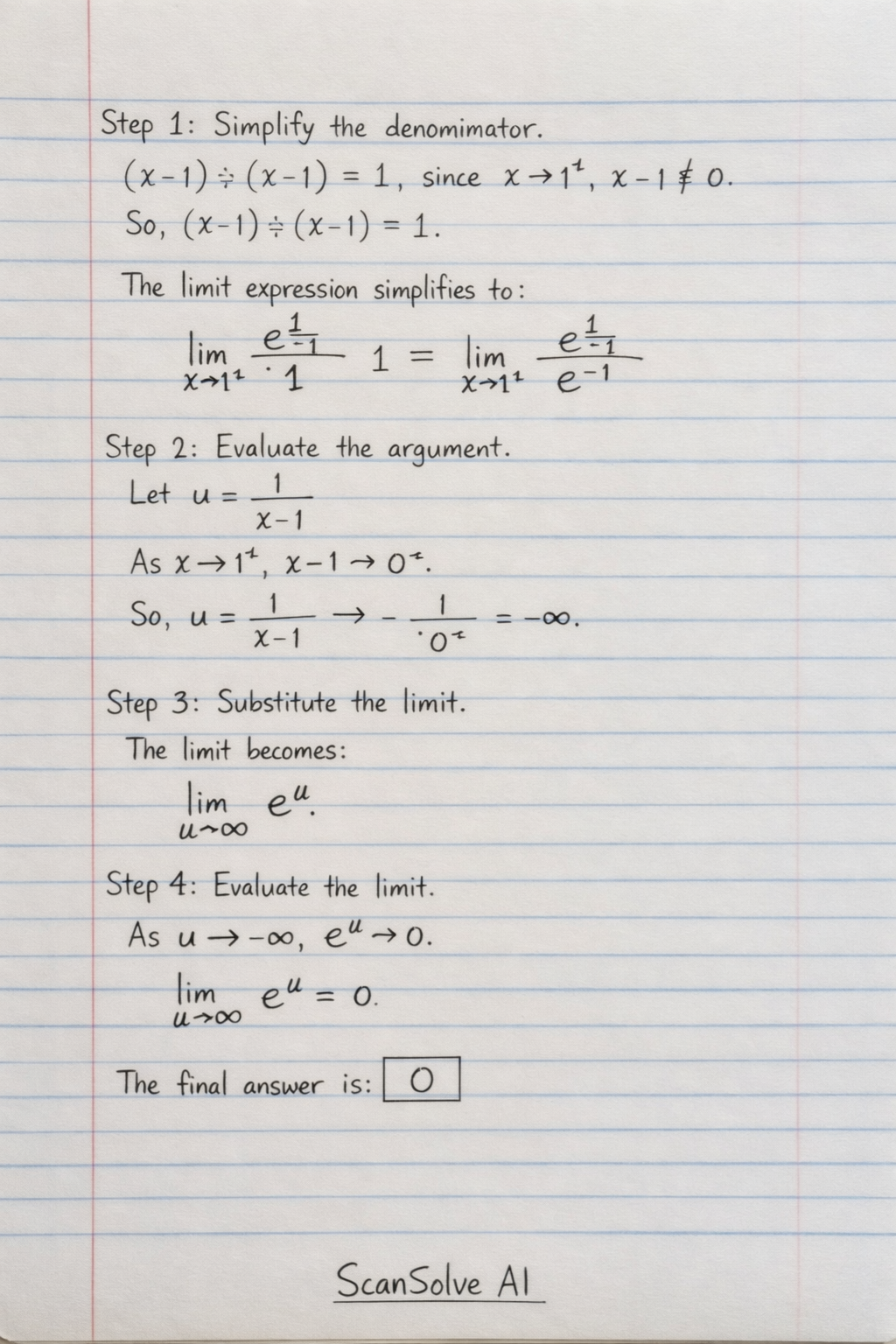
Handwritten Step-by-Step Solution
Get this as a handwritten image on WhatsApp — like a tutor wrote it for you.
Try on WhatsApp