
We read your photo as:
Solve the simultaneous equations and set theory problems: 1) x + 2y = 7 and 2x − 2y = 2. 2) P = primes < 15, Q = even numbers < 15. Find P U Q and if P, Q are disjoint.
ScanSolve AI Answer
Step-by-step solution
4 stepsHere's the solution to question 3:
3a. To solve the simultaneous equations:
Add equation (1) and equation (2) to eliminate .
Solve for .
Substitute the value of into equation (1).
Solve for .
The solution is .
3b. Consider the sets:
i) List all the elements of sets P and Q:
Prime numbers less than 15 are numbers greater than 1 that are only divisible by 1 and themselves.Even numbers less than 15 are integers divisible by 2.
ii) Find P U Q:
The union of P and Q includes all elements present in either set, without repetition.iii) State whether P and Q are disjoint sets:
Disjoint sets have no common elements (their intersection is an empty set).
The intersection of P and Q is , since 2 is in both sets.
Since , the sets P and Q are not disjoint.
Still stuck on this one?
Ask a follow-up, and the answer starts from this question.
More Mathematics Questions
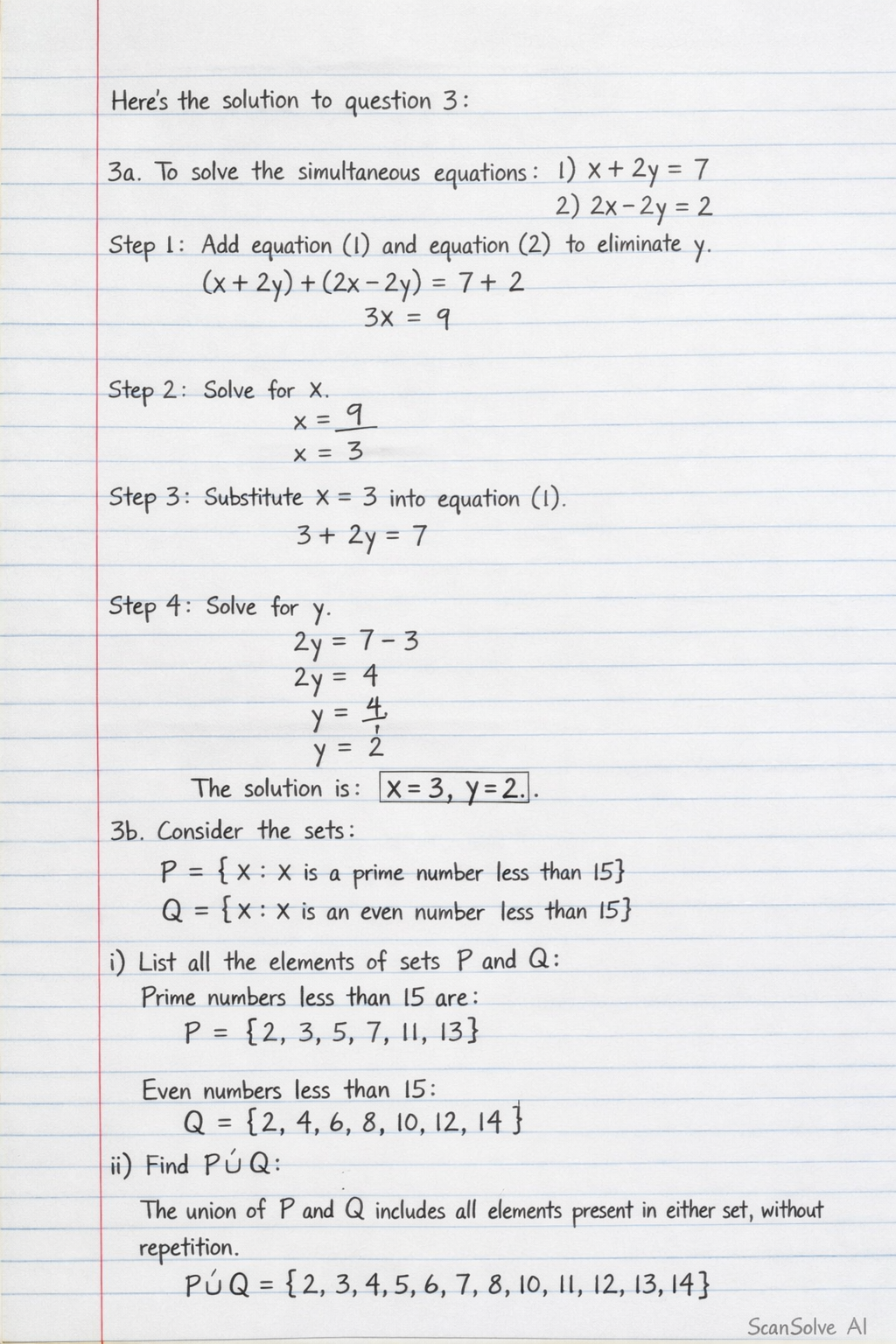
Handwritten Step-by-Step Solution
Get this as a handwritten image on WhatsApp — like a tutor wrote it for you.
Try on WhatsApp