
We read your photo as:
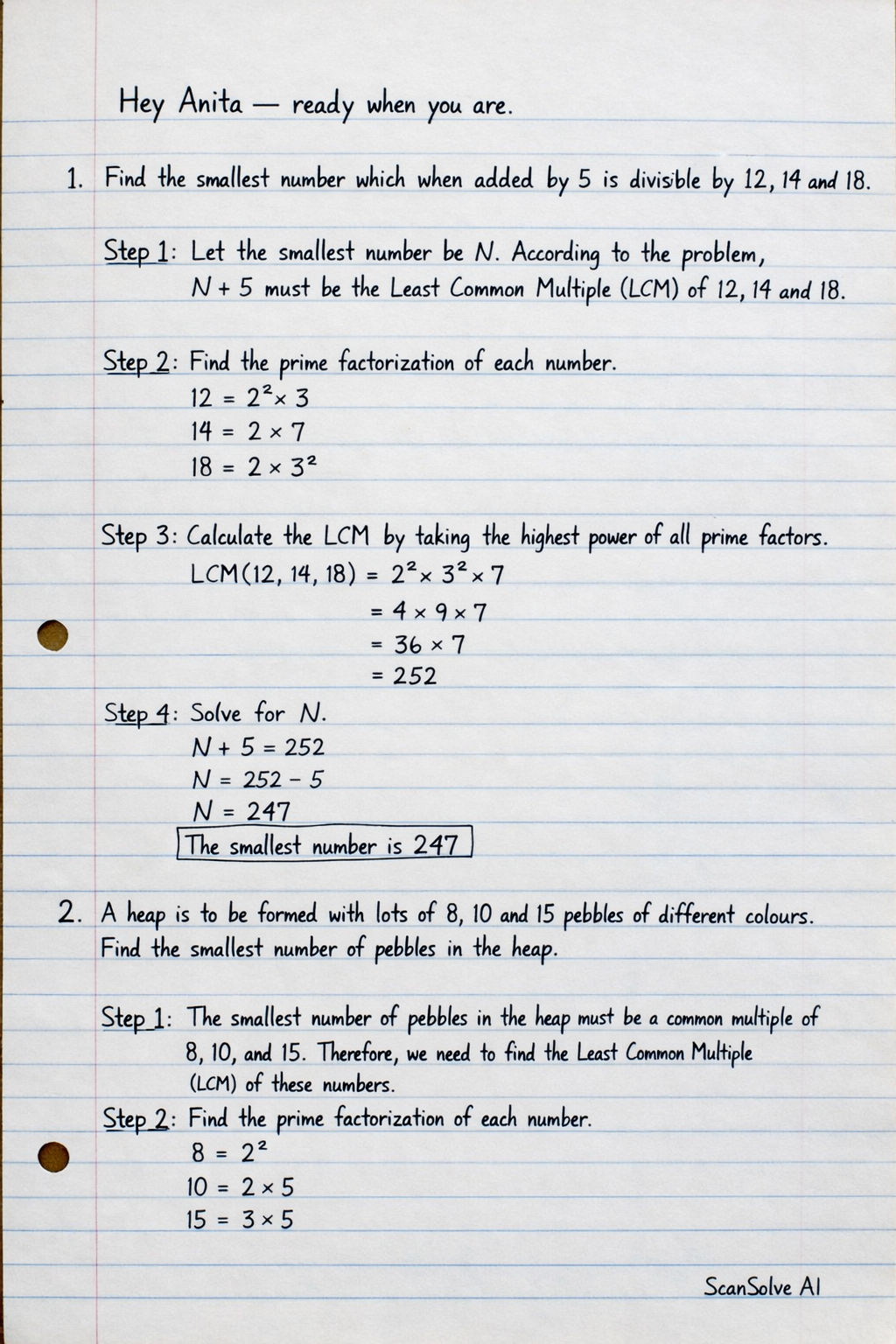
Find the smallest number which when added by 5 is divisible by 12, 14 and 18.
ScanSolve AI Answer
This answer stops before the end.
It was cut off when it was first written. Ask ScanSolve this question again for the full working.
1. Find the smallest number which when added by 5 is divisible by 12, 14 and 18.
Step 1: Let the smallest number be . According to the problem, must be the Least Common Multiple (LCM) of 12, 14, and 18.
Step 2: Find the prime factorization of each number.
Step 3: Calculate the LCM by taking the highest power of all prime factors.
Step 4: Solve for .
The smallest number is .
2. A heap is to be formed with lots of 8, 10 and 15 pebbles of different colours. Find the smallest number of pebbles in the heap.
Step 1: The smallest number of pebbles in the heap must be a common multiple of 8, 10, and 15. Therefore, we need to find the Least Common Multiple (LCM) of these numbers.
Step 2: Find the prime factorization of each number.
Step 3: Calculate the LCM by taking the highest power of all prime factors.
The smallest number of pebbles in the heap is .
3. Three measuring tapes are 64 cm, 72 cm and 96 cm. What is the shortest length that can be measured by any one of the tapes exactly?
Step 1: The shortest length that can be measured exactly by any of the tapes must be a common multiple of their lengths. We need to find the Least Common Multiple (LCM) of 64, 72, and 96.
Step 2: Find the prime factorization of each number.
Step 3: Calculate the LCM by taking the highest power of all prime factors.
The shortest length is .
4. Find the greatest number that will exactly divide 73 and 117.
Step 1: We need to find the Greatest Common Divisor (GCD) or Highest Common Factor (HCF) of 73 and 117.
Step 2: Find the prime factorization of each number.
Step 3: Identify common prime factors.
There are no common prime factors between 73 and 117.
Step 4: When there are no common prime factors, the HCF is 1.
The greatest number is .
5. Two ropes of length 28 m and 36 m are to be cut into bits of same length. Find the greatest possible length for each bit.
Step 1: The greatest possible length for each bit must be a common divisor of both 28 m and 36 m. We need to find the Greatest Common Divisor (GCD) or Highest Common Factor (HCF) of 28 and 36.
Step 2: Find the prime factorization of each number.
Step 3: Calculate the HCF by taking the lowest power of common prime factors.
The greatest possible length for each bit is .
6. Find the largest size of handkerchiefs which can be cut from a cloth having length 2.75 m and breadth 75 cm.
Step 1: Convert all measurements to the same unit. Convert meters to centimeters.
Still stuck on this one?
Ask a follow-up, and the answer starts from this question.
More Mathematics Questions
Handwritten Step-by-Step Solution
Get this as a handwritten image on WhatsApp — like a tutor wrote it for you.
Try on WhatsApp