We read your photo as:

Soit g la fonction définie sur [0, +∞[ par g(x) = e^x + 2 ln x et soit f la fonction définie sur [0, +∞[ telles que pour tout x ∈ [0, +∞[, f(x) = e^x + 2x ln x - 2x et f(0) = 1. On désigne par (C) la courbe représentative de f dans le plan muni d'un repère orthonormé (O,I,J) d'unité graphique 4 cm.

Mathematics

ScanSolve AI Answer

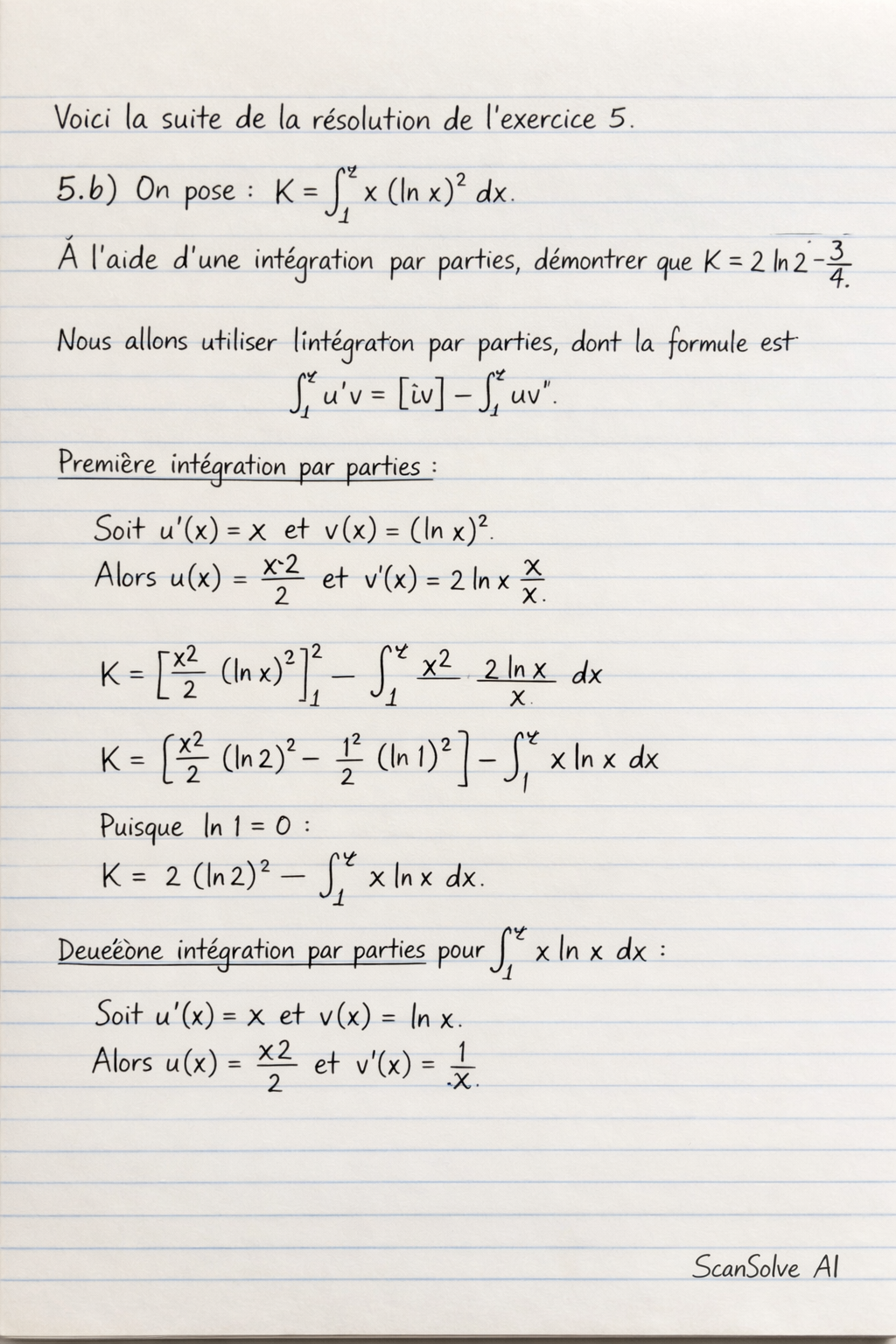
Voici la suite de la résolution de l'exercice 5.

5.b) On pose : K=∫12x(ln⁡x)2dxK = \int_{1}^{2} x (\ln x)^2 dx. À l'aide d'une intégration par parties, démontrer que K=2ln⁡2−34K = 2 \ln 2 - \frac{3}{4}.

Nous allons utiliser l'intégration par parties, dont la formule est ∫u′v=[uv]−∫uv′\int u'v = [uv] - \int uv'.

  • Première intégration par parties : Soit u′(x)=xu'(x) = x et v(x)=(ln⁡x)2v(x) = (\ln x)^2. Alors u(x)=x22u(x) = \frac{x^2}{2} et v′(x)=2ln⁡x⋅1x=2ln⁡xxv'(x) = 2 \ln x \cdot \frac{1}{x} = \frac{2 \ln x}{x}.

    K=[x22(ln⁡x)2]12−∫12x22⋅2ln⁡xx dxK = \left[ \frac{x^2}{2} (\ln x)^2 \right]_{1}^{2} - \int_{1}^{2} \frac{x^2}{2} \cdot \frac{2 \ln x}{x} \, dx K=(222(ln⁡2)2−122(ln⁡1)2)−∫12xln⁡x dxK = \left( \frac{2^2}{2} (\ln 2)^2 - \frac{1^2}{2} (\ln 1)^2 \right) - \int_{1}^{2} x \ln x \, dx

    Puisque ln⁡1=0\ln 1 = 0:

    K=2(ln⁡2)2−∫12xln⁡x dxK = 2 (\ln 2)^2 - \int_{1}^{2} x \ln x \, dx
  • Deuxième intégration par parties pour ∫12xln⁡x dx\int_{1}^{2} x \ln x \, dx : Soit u′(x)=xu'(x) = x et v(x)=ln⁡xv(x) = \ln x. Alors u(x)=x22u(x) = \frac{x^2}{2} et v′(x)=1xv'(x) = \frac{1}{x}.

    ∫12xln⁡x dx=[x22ln⁡x]12−∫12x22⋅1x dx\int_{1}^{2} x \ln x \, dx = \left[ \frac{x^2}{2} \ln x \right]_{1}^{2} - \int_{1}^{2} \frac{x^2}{2} \cdot \frac{1}{x} \, dx ∫12xln⁡x dx=(222ln⁡2−122ln⁡1)−∫12x2 dx\int_{1}^{2} x \ln x \, dx = \left( \frac{2^2}{2} \ln 2 - \frac{1^2}{2} \ln 1 \right) - \int_{1}^{2} \frac{x}{2} \, dx ∫12xln⁡x dx=2ln⁡2−[x24]12\int_{1}^{2} x \ln x \, dx = 2 \ln 2 - \left[ \frac{x^2}{4} \right]_{1}^{2} ∫12xln⁡x dx=2ln⁡2−(224−124)\int_{1}^{2} x \ln x \, dx = 2 \ln 2 - \left( \frac{2^2}{4} - \frac{1^2}{4} \right) ∫12xln⁡x dx=2ln⁡2−(1−14)\int_{1}^{2} x \ln x \, dx = 2 \ln 2 - \left( 1 - \frac{1}{4} \right) ∫12xln⁡x dx=2ln⁡2−34\int_{1}^{2} x \ln x \, dx = 2 \ln 2 - \frac{3}{4}
  • Substitution du résultat dans l'expression de KK :

    K=2(ln⁡2)2−(2ln⁡2−34)K = 2 (\ln 2)^2 - \left( 2 \ln 2 - \frac{3}{4} \right) K=2(ln⁡2)2−2ln⁡2+34K = 2 (\ln 2)^2 - 2 \ln 2 + \frac{3}{4}

    Le résultat de notre calcul est K=2(ln⁡2)2−2ln⁡2+34K = 2 (\ln 2)^2 - 2 \ln 2 + \frac{3}{4}. Ce résultat ne correspond pas à la valeur attendue dans l'énoncé (2ln⁡2−342 \ln 2 - \frac{3}{4}). Il y a une incohérence dans l'énoncé de la question 5.b).

5.c) Calculer A\mathcal{A}.

L'aire A\mathcal{A} en cm2^2 est la partie du plan délimitée par la courbe (C)(C), l'axe (OI)(OI) (qui est y=0y=0) et les droites d'équations x=1x=1 et x=2x=2.
D'après la question 5.a), la courbe (C)(C) est au-dessus de l'axe (OI)(OI) sur l'intervalle [1;+∞[[1;+\infty[, donc f(x)≥0f(x) \ge 0 sur [1;2][1;2].
L'aire A\mathcal{A} en unités d'aire est donnée par l'intégrale :

Au.a.=∫12f(x) dx\mathcal{A}_{u.a.} = \int_{1}^{2} f(x) \, dx

Nous avons f(x)=ex+2xln⁡x−2xf(x) = e^x + 2x \ln x - 2x.

Au.a.=∫12(ex+2xln⁡x−2x) dx\mathcal{A}_{u.a.} = \int_{1}^{2} (e^x + 2x \ln x - 2x) \, dx Au.a.=∫12ex dx+2∫12xln⁡x dx−∫122x dx\mathcal{A}_{u.a.} = \int_{1}^{2} e^x \, dx + 2 \int_{1}^{2} x \ln x \, dx - \int_{1}^{2} 2x \, dx

Calculons chaque intégrale :

  1. ∫12ex dx=[ex]12=e2−e\int_{1}^{2} e^x \, dx = [e^x]_{1}^{2} = e^2 - e
  2. D'après la question 5.b), nous avons calculé ∫12xln⁡x dx=2ln⁡2−34\int_{1}^{2} x \ln x \, dx = 2 \ln 2 - \frac{3}{4}. Donc, 2∫12xln⁡x dx=2(2ln⁡2−34)=4ln⁡2−322 \int_{1}^{2} x \ln x \, dx = 2 \left( 2 \ln 2 - \frac{3}{4} \right) = 4 \ln 2 - \frac{3}{2}
  3. ∫122x dx=[x2]12=22−12=4−1=3\int_{1}^{2} 2x \, dx = [x^2]_{1}^{2} = 2^2 - 1^2 = 4 - 1 = 3

Maintenant, combinons ces résultats pour trouver Au.a.\mathcal{A}_{u.a.} :

Au.a.=(e2−e)+(4ln⁡2−32)−3\mathcal{A}_{u.a.} = (e^2 - e) + \left( 4 \ln 2 - \frac{3}{2} \right) - 3 Au.a.=e2−e+4ln⁡2−32−62\mathcal{A}_{u.a.} = e^2 - e + 4 \ln 2 - \frac{3}{2} - \frac{6}{2} Au.a.=e2−e+4ln⁡2−92\mathcal{A}_{u.a.} = e^2 - e + 4 \ln 2 - \frac{9}{2}

L'unité graphique est de 4 cm. Cela signifie qu'une unité d'aire correspond à 4 cm×4 cm=16 cm24 \text{ cm} \times 4 \text{ cm} = 16 \text{ cm}^2.
Pour obtenir l'aire en cm2^2, nous multiplions Au.a.\mathcal{A}_{u.a.} par 16 :

A=(e2−e+4ln⁡2−92)×16\mathcal{A} = \left( e^2 - e + 4 \ln 2 - \frac{9}{2} \right) \times 16 A=16e2−16e+16×4ln⁡2−16×92\mathcal{A} = 16e^2 - 16e + 16 \times 4 \ln 2 - 16 \times \frac{9}{2} A=16e2−16e+64ln⁡2−72\mathcal{A} = 16e^2 - 16e + 64 \ln 2 - 72

L'aire est : A=16e2−16e+64ln⁡2−72 cm2\boxed{\mathcal{A} = 16e^2 - 16e + 64 \ln 2 - 72 \text{ cm}^2}.

Was this helpful?

Still stuck on this one?

Ask a follow-up, and the answer starts from this question.

Got a different question?Ask your own question
Handwritten step-by-step solution preview

Handwritten Step-by-Step Solution

Get this as a handwritten image on WhatsApp — like a tutor wrote it for you.

Try on WhatsApp