
We read your photo as:
What are some common misconceptions about place value in mathematics?
Mathematics
ScanSolve AI Answer
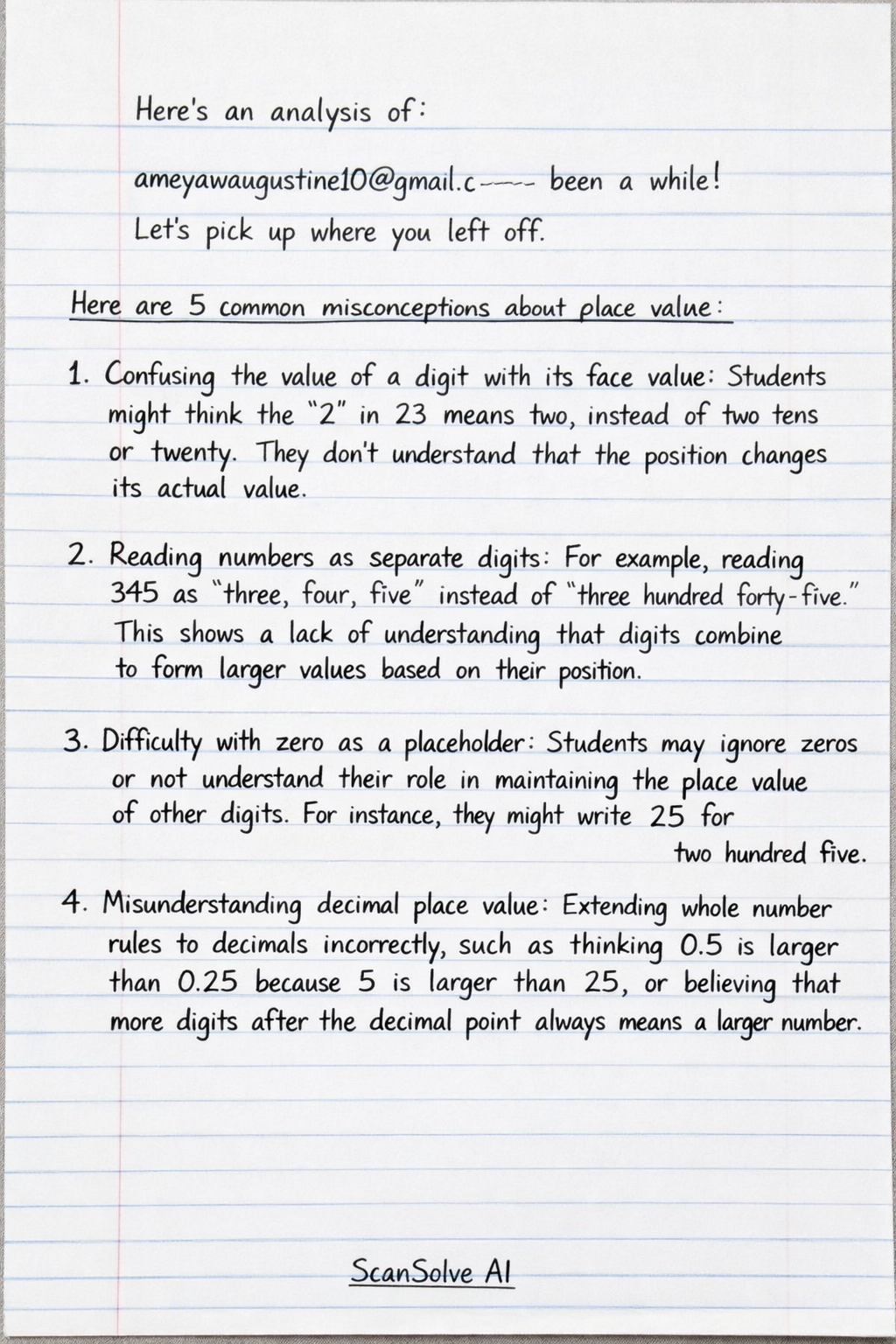
Here are 5 common misconceptions about place value:
- Confusing the value of a digit with its face value: Students might think the '2' in 23 means two, instead of two tens or twenty. They don't understand that the position changes its actual value.
- Reading numbers as separate digits: For example, reading 345 as "three, four, five" instead of "three hundred forty-five." This shows a lack of understanding that digits combine to form larger values based on their position.
- Difficulty with zero as a placeholder: Students may ignore zeros or not understand their role in maintaining the place value of other digits. For instance, they might write 25 for two hundred five.
- Misunderstanding decimal place value: Extending whole number rules to decimals incorrectly, such as thinking 0.5 is larger than 0.25 because 5 is larger than 25, or believing that more digits after the decimal point always means a larger number.
- Inability to regroup or bundle: When performing operations, students might struggle with carrying over or borrowing because they don't grasp that 10 ones make 1 ten, or 10 tens make 1 hundred.
Was this helpful?
Still stuck on this one?
Ask a follow-up, and the answer starts from this question.
Got a different question?Ask your own question
More Mathematics Questions
Q1a. (i) Two common misconceptions in learning number and algebra are:QIdentify common misconceptions in number and algebra, and classify numbers from a given set.QLack of resources of place value because I have many learners who struggle to grasp.QWhat is the value of a digit based on its place in a number?QIdentify the place value of digits in given numbers. Examples: a) In 23751, 3 is in the _ place and…
Browse by topic:Pre-Algebra
Handwritten Step-by-Step Solution
Get this as a handwritten image on WhatsApp — like a tutor wrote it for you.
Try on WhatsApp