
We read your photo as:
Calculate the standard deviation for the given frequency distribution of study hours.
ScanSolve AI Answer
Answer
Step-by-step solution
5 stepsTo calculate the standard deviation from a frequency distribution, we use the formula:
where represents the number of hours, represents the number of students (frequency), is the total number of students, and is the sum of (hours frequency).
First, let's organize the data and calculate the necessary sums:
| Number of hours () | Number of students () | |||
|---|---|---|---|---|
| 0 | 1 | 0 | 0 | 0 |
| 1 | 3 | 3 | 1 | 3 |
| 2 | 3 | 6 | 4 | 12 |
| 3 | 3 | 9 | 9 | 27 |
| 4 | 5 | 20 | 16 | 80 |
| 5 | 6 | 30 | 25 | 150 |
| 6 | 2 | 12 | 36 | 72 |
| 7 | 1 | 7 | 49 | 49 |
| Total |
Calculate the total number of students ().
Calculate the sum of (hours frequency) ().
Calculate the sum of (hours squared frequency) ().
Calculate the mean ().
Substitute the values into the standard deviation formula.
Rounding to three decimal places:
The standard deviation is 1.798.
Try one yourself
A new problem that tests the same skill.
Still stuck on this one?
Ask a follow-up, and the answer starts from this question.
More Mathematics Questions
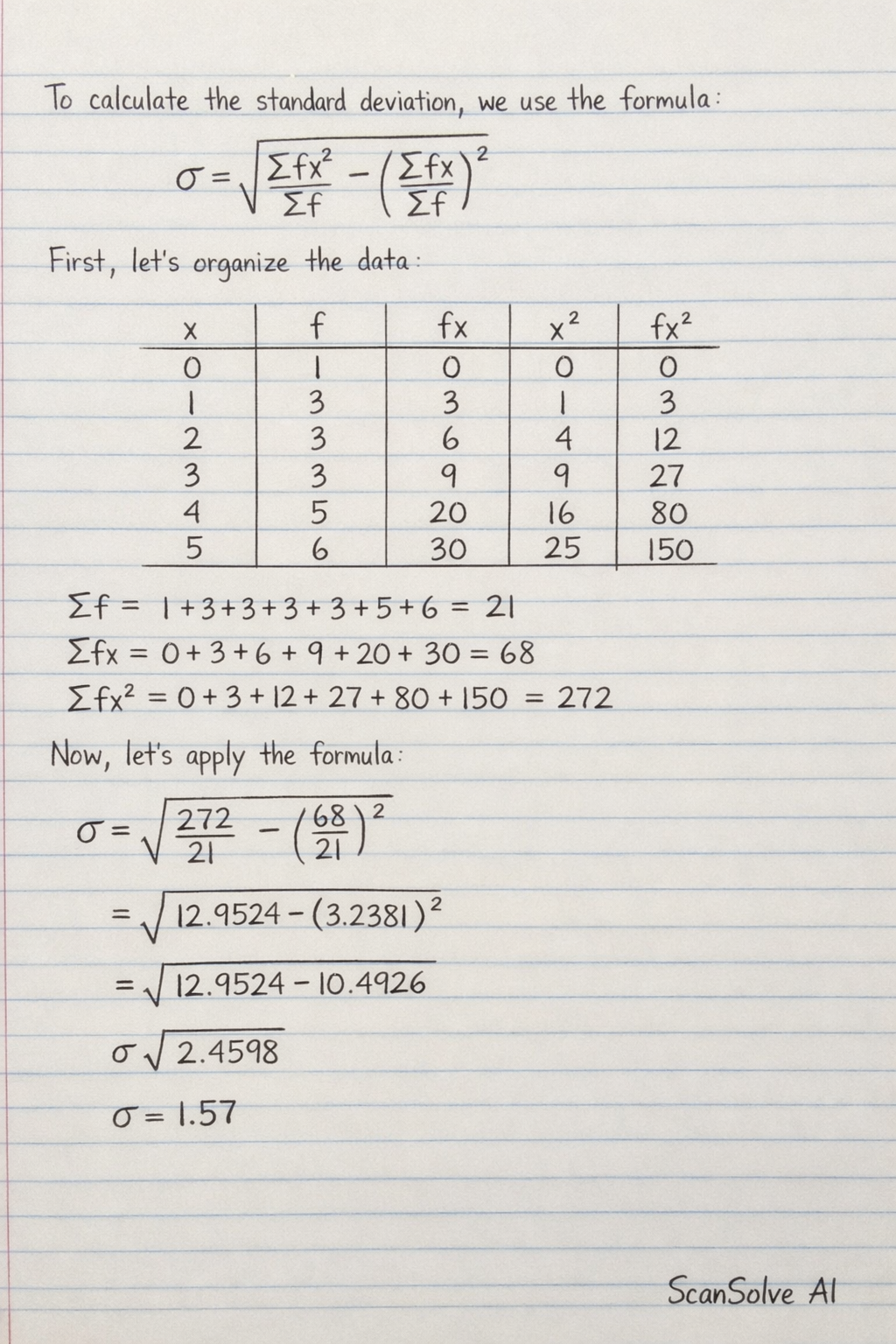
Handwritten Step-by-Step Solution
Get this as a handwritten image on WhatsApp — like a tutor wrote it for you.
Try on WhatsApp