
We read your photo as:
Determine The Standard Deviation of Scores correct to 2 decimal places.
ScanSolve AI Answer
Answer
Step-by-step solution
9 stepsLet's check your work for the standard deviation and then complete the circle problem.
Standard Deviation Problem
The scores are .
The assumed mean .
The deviations are:
Calculate the sum of deviations .
Your calculation is correct for , which is a correction factor for the mean, not the mean itself. The actual mean . However, this does not affect the standard deviation calculation using the assumed mean method.
Calculate the sum of squared deviations .
Your calculation is correct for .
Calculate the variance using the formula .
Rounding to two decimal places, . Your calculation is correct.
Calculate the standard deviation .
Rounding to two decimal places, . Your calculation is correct.
The standard deviation is .
9. The equation of a circle
The equation of the circle is given as .
Group the terms and terms, and move the constant to the right side.
Complete the square for the terms and terms.
To complete the square for , add .
To complete the square for , add .
Add these values to both sides of the equation.Rewrite the expressions in squared form.
Your work matches this step perfectly.
Identify the center and radius of the circle.
The standard form of a circle's equation is , where is the center and is the radius.
Comparing this to :
The center of the circle is .
The radius of the circle is .Describe how to draw the circle on a grid.
To draw the circle:
- Plot the center point at on the grid.
- From the center, measure 3 units in all four cardinal directions (up, down, left, right) to mark points , , , and .
- Sketch a smooth curve connecting these points to form the circle.
The center of the circle is and the radius is .
Try one yourself
A new problem that tests the same skill.
Still stuck on this one?
Ask a follow-up, and the answer starts from this question.
More Mathematics Questions
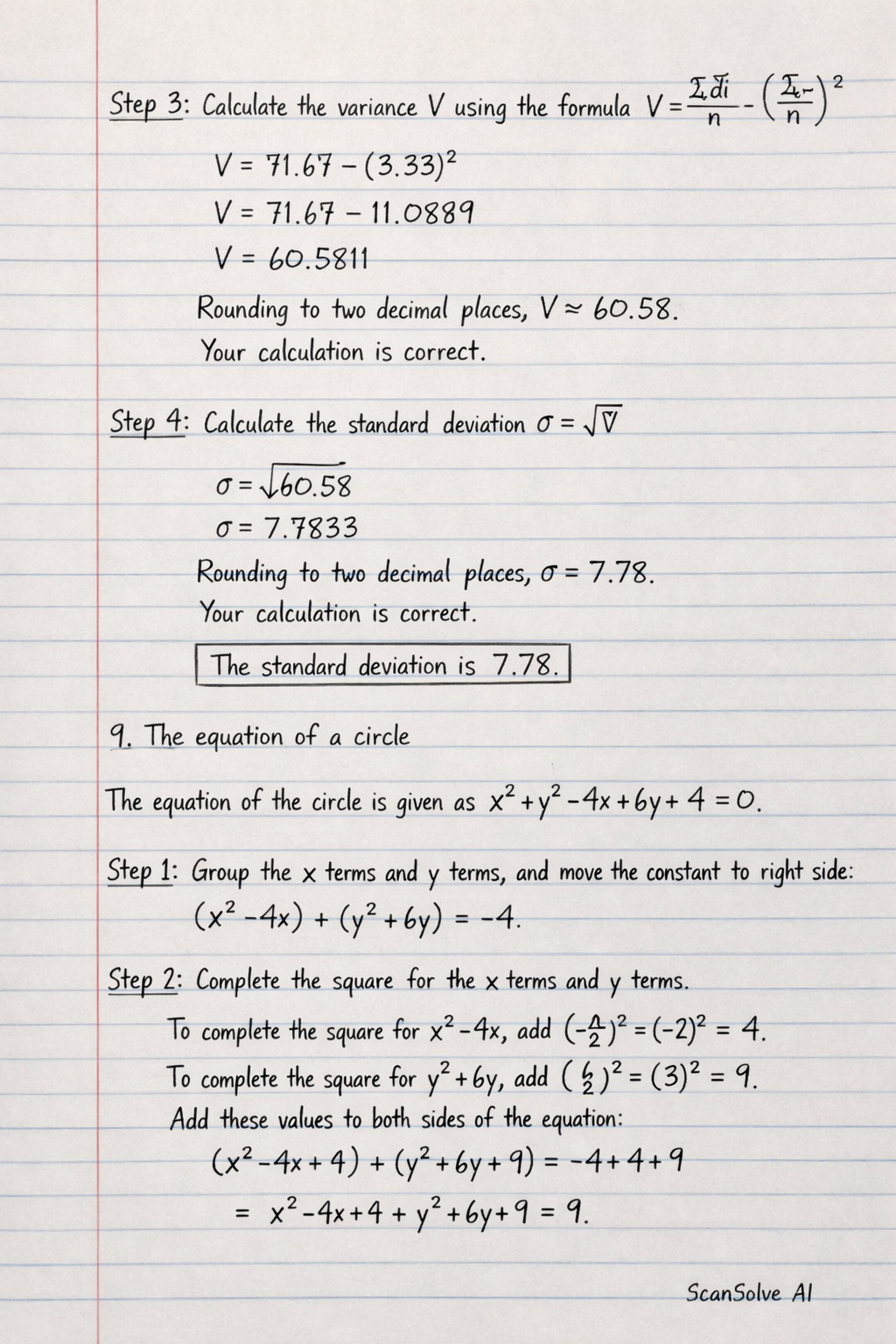
Handwritten Step-by-Step Solution
Get this as a handwritten image on WhatsApp — like a tutor wrote it for you.
Try on WhatsApp