Who should be primarily responsible for reducing plastic waste?

Psychology
Who should be primarily responsible for reducing plastic waste?

ScanSolve AI Answer

Answer

True

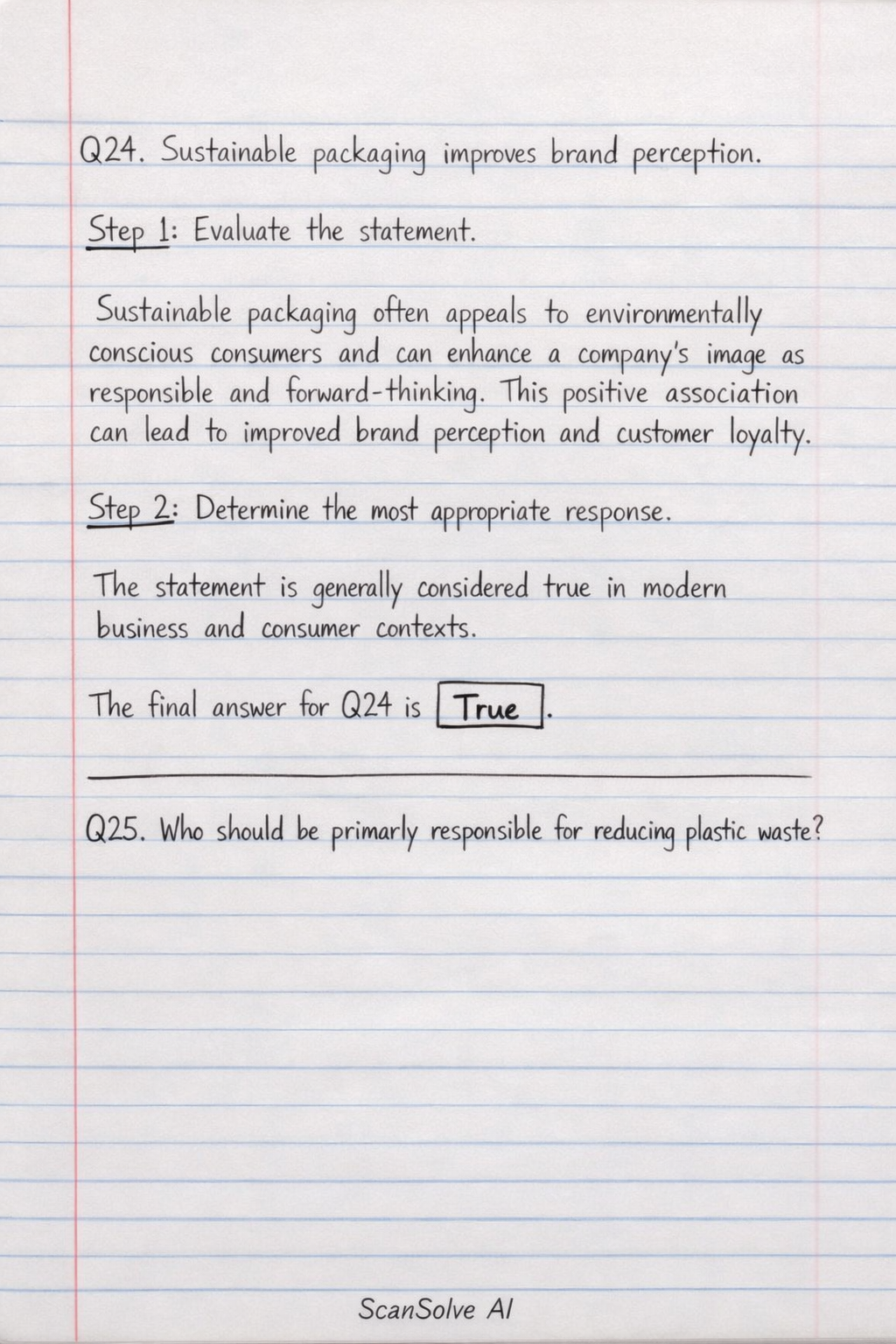
Q24. Sustainable packaging improves brand perception.

Step 1: Evaluate the statement. Sustainable packaging often appeals to environmentally conscious consumers and can enhance a company's image as responsible and forward-thinking. This positive association can lead to improved brand perception and customer loyalty.

Step 2: Determine the most appropriate response. The statement is generally considered true in modern business and consumer contexts.

The final answer for Q24 is True\boxed{True}.


Q25. Who should be primarily responsible for reducing plastic waste?

Step 1: Analyze the roles of each stakeholder in plastic waste reduction.

  • Government: Sets policies, regulations, and incentives for plastic production, use, and disposal.
  • Manufacturers: Design products and packaging, choose materials, and can implement extended producer responsibility (EPR) schemes.
  • Consumers: Make purchasing decisions, reduce consumption, reuse items, and participate in recycling programs.
  • Waste management authorities: Collect, sort, process, and dispose of plastic waste.

Step 2: Consider the concept of "primary responsibility" for a systemic issue. Reducing plastic waste is a complex, systemic problem that requires action at multiple stages of the plastic lifecycle. No single entity can solve it alone. Effective reduction strategies typically involve collaboration and shared responsibility across all parties.

Step 3: Evaluate the given options. While each group has a significant role, attributing primary responsibility to just one group oversimplifies the issue. The option "All stakeholders equally" acknowledges the interconnectedness of the problem and the necessity of collective action from all involved parties—from policy-makers and producers to consumers and waste managers. This holistic approach is widely advocated in environmental management.

The final answer for Q25 is Allstakeholdersequally\boxed{All stakeholders equally}.

Was this helpful?

Need help with your own homework?

Get instant step-by-step solutions to any question. Free to start.

Ask Your Question
Handwritten step-by-step solution preview

Handwritten Step-by-Step Solution

Get this as a handwritten image on WhatsApp — like a tutor wrote it for you.

Try on WhatsApp

Still have questions?

Quick Answer

Q24. Sustainable packaging improves brand perception.

Who should be primarily responsible for reducing plastic waste?
Psychology

This psychology problem is solved step by step below, with detailed explanations to help you understand the method and arrive at the correct answer.

ScanSolve AI Answer
Q24. Sustainable packaging improves brand perception. Step 1: Evaluate the statement. Sustainable packaging often appeals to environmentally conscious consumers and can enhance a company's image as responsible and forward-thinking. This positive association can lead to improved brand perception and customer loyalty. Step 2: Determine the most appropriate response. The statement is generally considered true in modern business and consumer contexts. The final answer for Q24 is True. --- Q25. Who should be primarily responsible for reducing plastic waste? Step 1: Analyze the roles of each stakeholder in plastic waste reduction. Government: Sets policies, regulations, and incentives for plastic production, use, and disposal. Manufacturers: Design products and packaging, choose materials, and can implement extended producer responsibility (EPR) schemes. Consumers: Make purchasing decisions, reduce consumption, reuse items, and participate in recycling programs. Waste management authorities: Collect, sort, process, and dispose of plastic waste. Step 2: Consider the concept of "primary responsibility" for a systemic issue. Reducing plastic waste is a complex, systemic problem that requires action at multiple stages of the plastic lifecycle. No single entity can solve it alone. Effective reduction strategies typically involve collaboration and shared responsibility across all parties. Step 3: Evaluate the given options. While each group has a significant role, attributing primary responsibility to just one group oversimplifies the issue. The option "All stakeholders equally" acknowledges the interconnectedness of the problem and the necessity of collective action from all involved parties—from policy-makers and producers to consumers and waste managers. This holistic approach is widely advocated in environmental management. The final answer for Q25 is All stakeholders equally.