
We read your photo as:
Step 1: Prime factorise 216. Step 2: Find the GCF of 8 and 6. Step 3: Find the LCM of 12 and 18. Step 4: Find how many triangular numbers will form a sum of 36.
ScanSolve AI Answer
Answers
3 partsStep-by-step solution
5 stepsPrime factorise 216.
We find the prime factors of 216 by dividing it by the smallest prime numbers.
So, the prime factors of 216 are .
In exponential form, this is .
In set notation, the prime factors are the unique prime numbers involved.
The prime factors of 216 are .Find the GCF of 8 and 6.
First, list the factors for each number.
Factors of 8: 1, 2, 4, 8
Factors of 6: 1, 2, 3, 6
The common factors are 1 and 2. The greatest common factor (GCF) is the largest of these common factors.
The GCF of 8 and 6 is .Find the LCM of 12 and 18.
We can find the LCM by listing multiples or using prime factorization.
Using prime factorization:
Prime factors of 12:
Prime factors of 18:
To find the LCM, we take the highest power of each prime factor present in either number.
LCM = .
The LCM of 12 and 18 is .Find how many triangular numbers will form a sum of 36.
Triangular numbers are generated by the formula .
Let's list the first few triangular numbers:
The 8th triangular number is 36. Therefore, one triangular number (the 8th one) forms a sum of 36.
The number of triangular numbers is .Find the next numbers in the sequences.
i) 5, 10, 15, 20, 25, 30, ___, 40, 45, 50
This is an arithmetic sequence where each term increases by 5.
The next number after 30 is .
The sequence is 5, 10, 15, 20, 25, 30, , 40, 45, 50.ii) 1, 3, ___, 7, 9, ___
This is an arithmetic sequence of odd numbers, where each term increases by 2.
The number after 3 is .
The number after 9 is .
The sequence is 1, 3, , 7, 9, .iii) 1, 4, 9, 16, 25, ___
This sequence consists of perfect squares: .
The next term in the sequence will be .
.
The sequence is 1, 4, 9, 16, 25, .
Try one yourself
A new problem that tests the same skill.
Still stuck on this one?
Ask a follow-up, and the answer starts from this question.
More Mathematics Questions
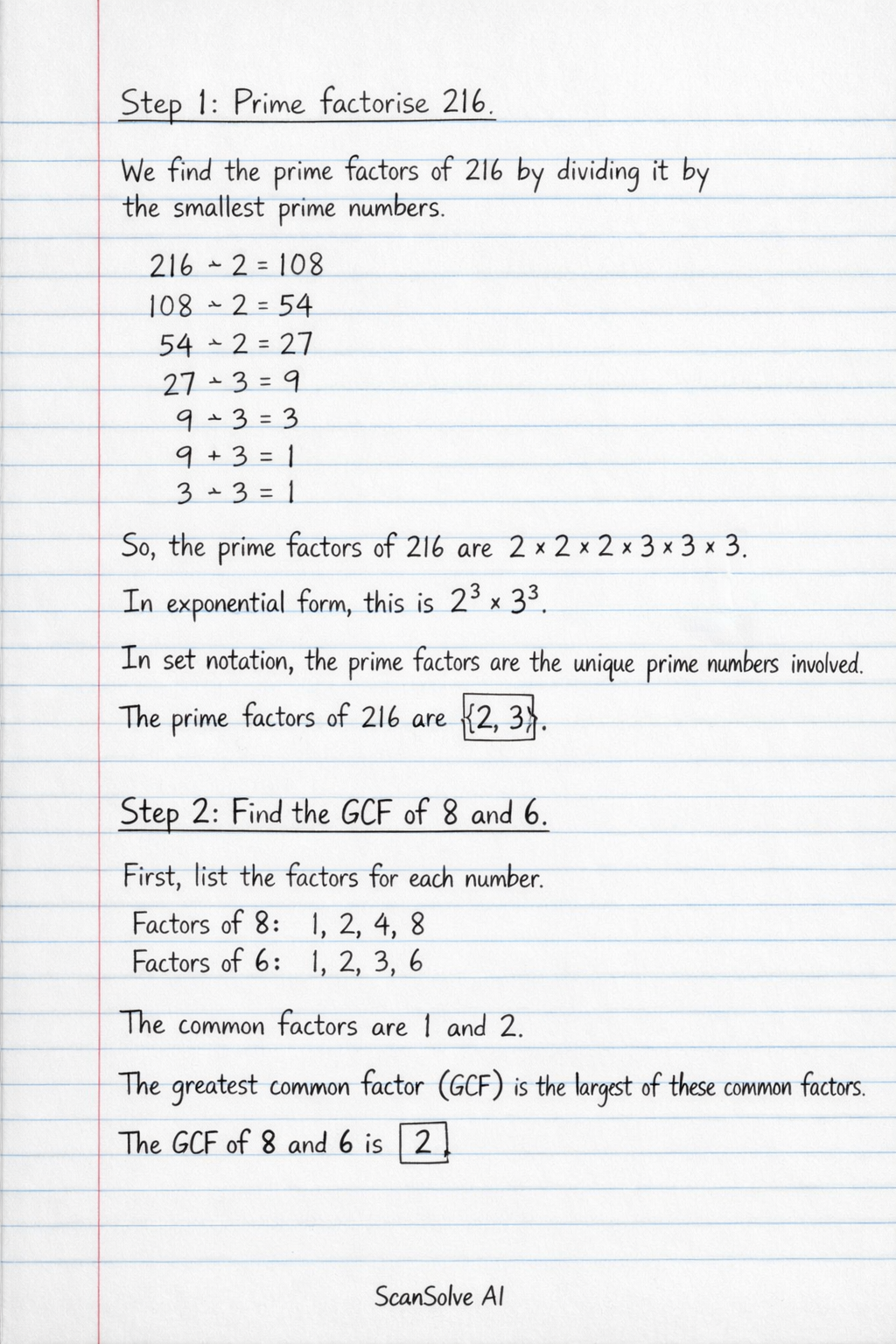
Handwritten Step-by-Step Solution
Get this as a handwritten image on WhatsApp — like a tutor wrote it for you.
Try on WhatsApp