

This mathematics problem involves applying core mathematical principles and formulas. Below you will find a complete step-by-step solution with detailed explanations for each step, helping you understand not just the answer but the method behind it.
ScanSolve AI Answer
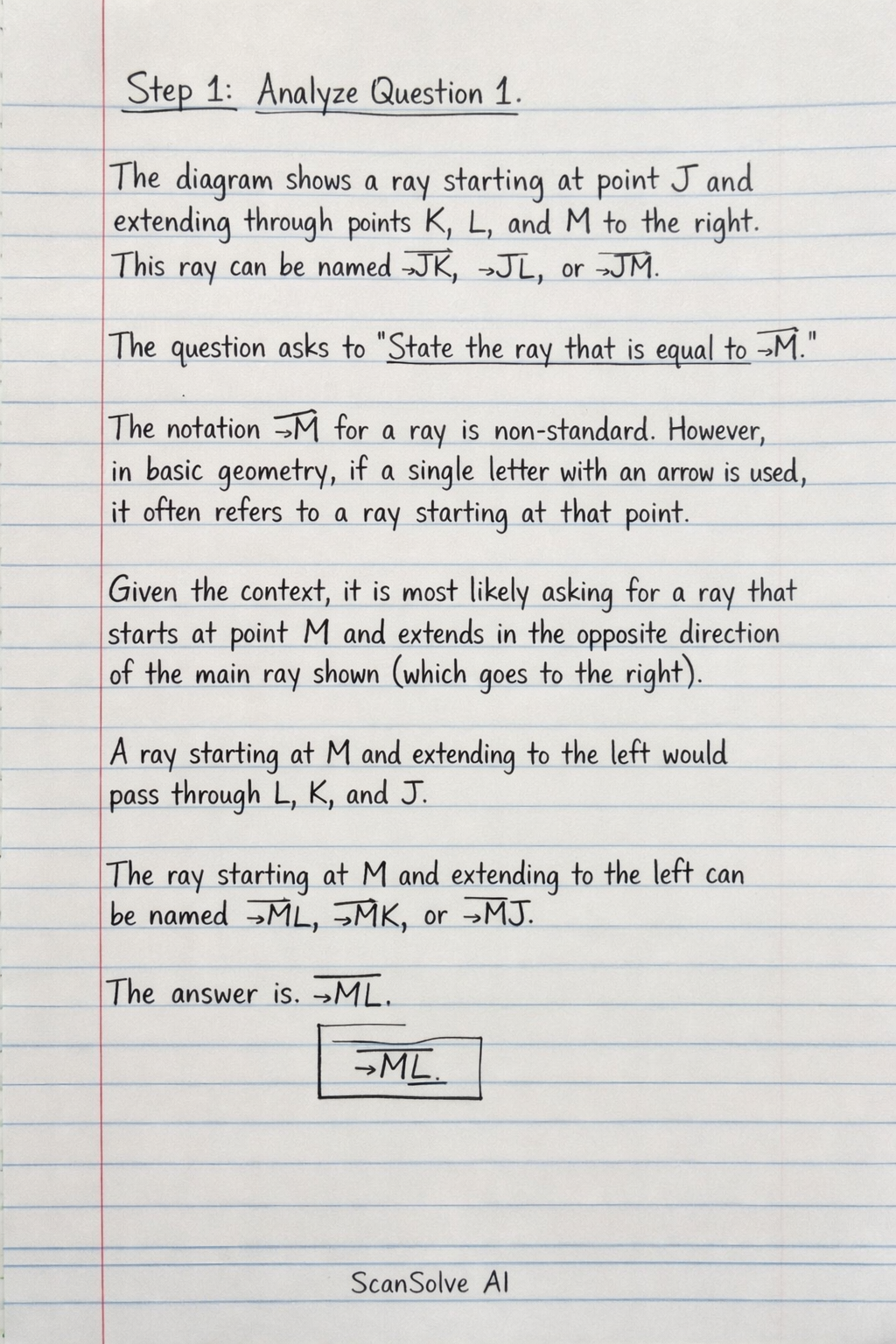
Step 1: Analyze Question 1. The diagram shows a ray starting at point J and extending through points K, L, and M to the right. This ray can be named JK, JL, or JM. The question asks to "State the ray that is equal to M". The notation M for a ray is non-standard. However, in basic geometry, if a single letter with an arrow is used, it often refers to a ray starting at that point. Given the context, it is most likely asking for a ray that starts at point M and extends in the opposite direction of the main ray shown (which goes to the right). A ray starting at M and extending to the left would pass through L, K, and J. The ray starting at M and extending to the left can be named ML, MK, or MJ. We will use ML. The answer is ML. Step 2: Analyze Question 2. The triangle shown has two sides marked with a single tick mark, indicating that these two sides are equal in length. The third side has two tick marks, indicating it has a different length. A triangle with exactly two sides of equal length is classified as an isosceles triangle. The answer is Isosceles triangle. Step 3: Analyze Question 3. The shape shown is a polygon. By counting its sides, we find that it has 5 sides. A polygon with 5 sides is called a pentagon. The formula for the sum of the interior angles of a polygon with n sides is given by (n-2) × 180^. For a pentagon, n=5. Sum of interior angles = (5-2) × 180^ Sum of interior angles = 3 × 180^ Sum of interior angles = 540^ The answer is 540^. Step 4: Analyze Question 4. The question asks how many different quadrilaterals can be obtained from a hexagon. A hexagon has 6 vertices. A quadrilateral is a polygon with 4 vertices. To form a quadrilateral from a hexagon, we need to choose 4 vertices out of the 6 available vertices. The order of choosing the vertices does not matter, so this is a combination problem. The number of combinations of choosing k items from a set of n items is given by the formula nk = (n!)/(k!(n-k)!). Here, n=6 (total vertices in a hexagon) and k=4 (vertices for a quadrilateral). Number of quadrilaterals = 64 Number of quadrilaterals = (6!)/(4!(6-4)!) Number of quadrilaterals = (6!)/(4!2!) Number of quadrilaterals = (6 × 5 × 4 × 3 × 2 × 1)/((4 × 3 × 2 × 1)(2 × 1)) Number of quadrilaterals = (6 × 5)/(2 × 1) Number of quadrilaterals = (30)/(2) Number of quadrilaterals = 15 The answer is 15. Send me the next one 📸