
Solve inverse matrix extensively
ScanSolve AI Answer
Answer
Step-by-step solution
4 stepsTo solve an inverse matrix extensively, I'll demonstrate the process for a matrix. If you have a specific matrix in mind, feel free to send it.
Let's find the inverse of the matrix :
Calculate the determinant of matrix .
For a matrix , the determinant is .
Check if the determinant is non-zero.
Since , the inverse of the matrix exists. If the determinant were 0, the inverse would not exist.
Find the adjugate matrix of .
For a matrix , the adjugate matrix is found by swapping the elements on the main diagonal ( and ) and changing the signs of the off-diagonal elements ( and ).
Calculate the inverse matrix .
The formula for the inverse of a matrix is .
The inverse of the matrix is:
Try one yourself
A new problem that tests the same skill.
Still stuck on this one?
Ask a follow-up, and the answer starts from this question.
More Mathematics Questions
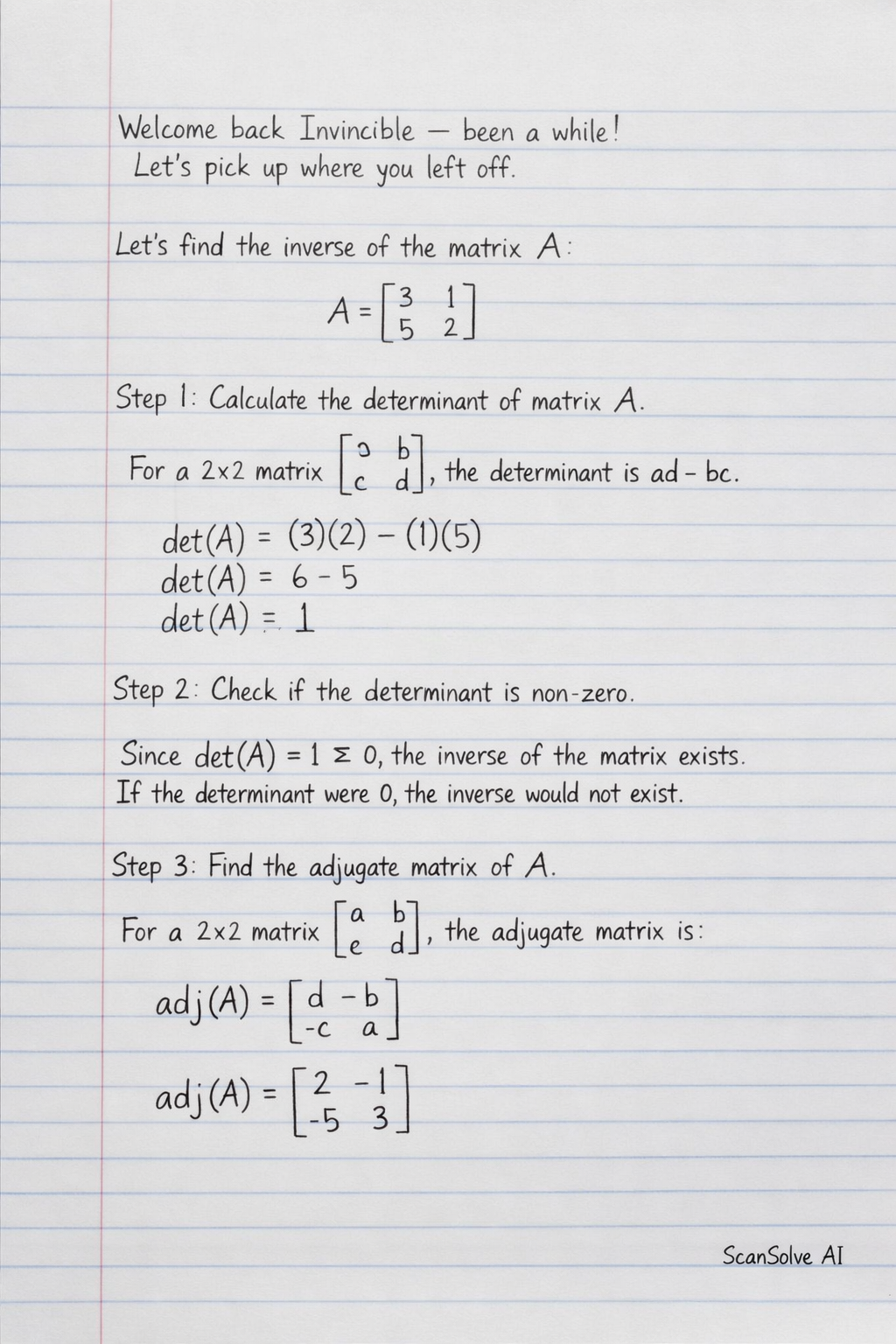
Handwritten Step-by-Step Solution
Get this as a handwritten image on WhatsApp — like a tutor wrote it for you.
Try on WhatsApp