
We read your photo as:
Find the sum and product of the roots of the following quadratic equations, and state their nature: a) x2 − 5x + 6 = 0 b) 3x2 − 12x + 12 = 0
ScanSolve AI Answer
Step-by-step solution
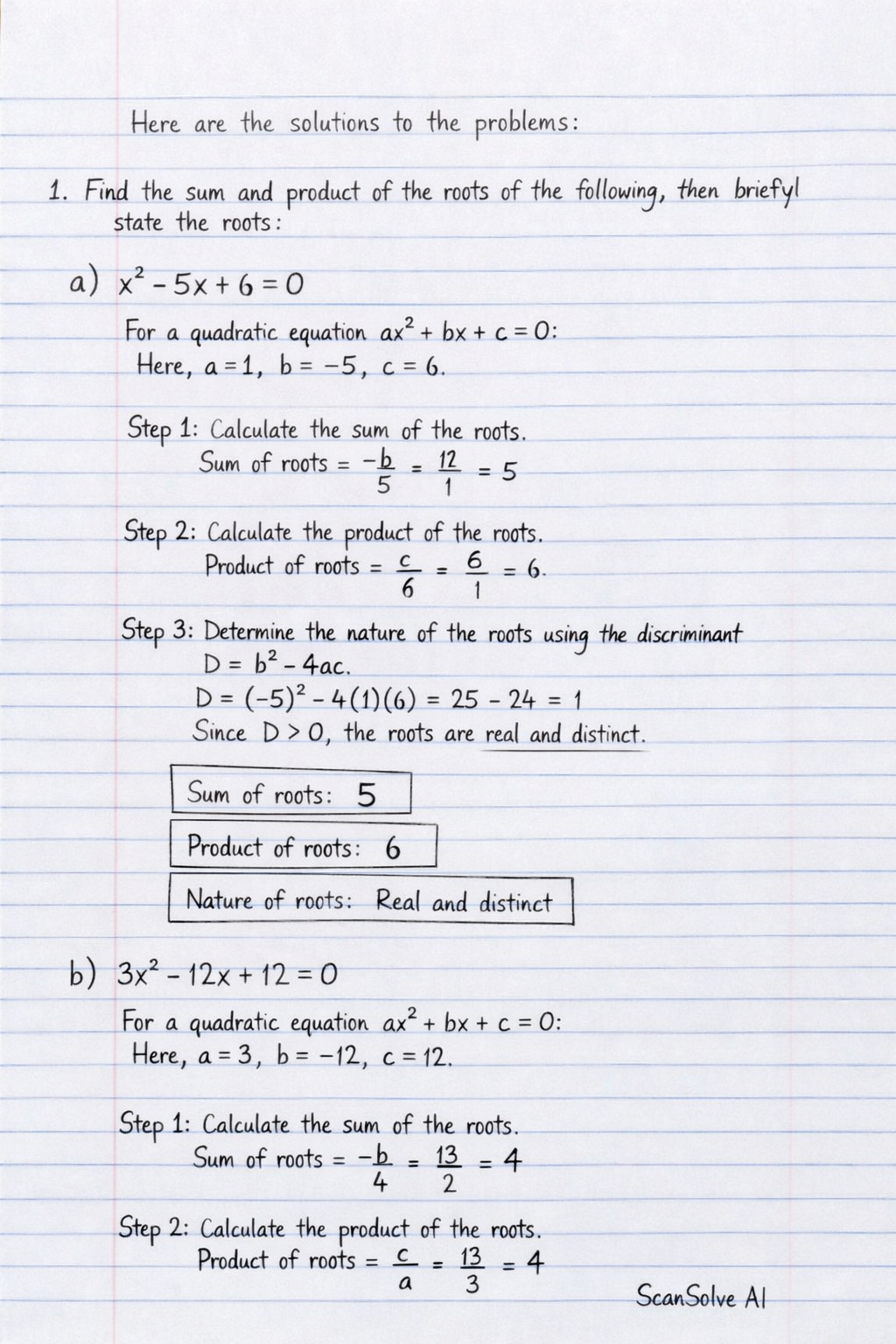
13 stepsHere are the solutions to the problems:
1. Find the sum and product of the roots of the following, then (briefly) state the roots:
- a) For a quadratic equation : Here, , , .
Calculate the sum of the roots.
Sum of roots $= -\frac{b}{a} = -\frac{-5}{1} = 5$Calculate the product of the roots.
Product of roots $= \frac{c}{a} = \frac{6}{1} = 6$Determine the nature of the roots using the discriminant .
$D = (-5)^2 - 4(1)(6) = 25 - 24 = 1$ Since $D > 0$, the roots are **real and distinct**. * Sum of roots: $\boxed{5}$ * Product of roots: $\boxed{6}$ * Nature of roots: $\boxed{\text{Real and distinct}}$- b) For a quadratic equation : Here, , , .
Calculate the sum of the roots.
Sum of roots $= -\frac{b}{a} = -\frac{-12}{3} = 4$Calculate the product of the roots.
Product of roots $= \frac{c}{a} = \frac{12}{3} = 4$Determine the nature of the roots using the discriminant .
$D = (-12)^2 - 4(3)(12) = 144 - 144 = 0$ Since $D = 0$, the roots are **real and equal**. * Sum of roots: $\boxed{4}$ * Product of roots: $\boxed{4}$ * Nature of roots: $\boxed{\text{Real and equal}}$2. The sum and product of the roots of a quadratic equation are 4 and -5 respectively. Form the quadratic equation.
Let the sum of the roots be and the product of the roots be .
Given and .
The general form of a quadratic equation is .Substitute the given sum and product into the general form.
Simplify the equation.
The quadratic equation is .
3. If one root of a quadratic equation is -1 and the sum of the roots is 6, find:
Let the two roots be and .
Given one root, .
Given the sum of the roots, .- a. The other root
Substitute the known root into the sum of roots equation.
$$ -1 + \beta = 6 $$Solve for .
$$ \beta = 6 + 1 $$ $$ \beta = 7 $$ The other root is $\boxed{7}$.- b. The product of the roots
Multiply the two roots.
$$ \text{Product} = \alpha \beta = (-1)(7) $$ $$ \text{Product} = -7 $$ The product of the roots is $\boxed{-7}$.- c. The quadratic equation We have the sum of roots and the product of roots . The general form of a quadratic equation is .
Substitute the sum and product into the general form.
$$ x^2 - (6)x + (-7) = 0 $$Simplify the equation.
$$
x^2 - 6x - 7 = 0
$$

The quadratic equation is $\boxed{x^2 - 6x - 7 = 0}$.
Still stuck on this one?
Ask a follow-up, and the answer starts from this question.
More Mathematics Questions
Handwritten Step-by-Step Solution
Get this as a handwritten image on WhatsApp — like a tutor wrote it for you.
Try on WhatsApp