
We read your photo as:
Calculate the surface area and volume of a concrete block with dimensions 390 mm x 190 mm x 190 mm.
ScanSolve AI Answer
Step-by-step solution
8 steps2.2.1
Convert the dimensions of the concrete block from millimeters to centimeters.
Given dimensions: Length (L) = 390 mm, Width (W) = 190 mm, Height (H) = 190 mm.
Since 1 cm = 10 mm:Calculate the surface area (SA) using the given formula.
The surface area of the concrete block is .
2.2.2
Use the dimensions in centimeters from 2.2.1.
L = 39 cm, W = 19 cm, H = 19 cm.
Calculate the volume (V) using the given formula.
The volume of the concrete block is .
2.2.3
The "RDP plans in 2.1" or the "floor plan" which contain the dimensions of the external walls of the RDP house are not provided in the image. Without these dimensions, it is not possible to calculate the total area of the walls and subsequently the number of pallets of concrete blocks required.2.2.4
The number of concrete blocks calculated in 2.2.3 is an estimation because it does not account for factors such as breakages during transport or construction, wastage from cutting blocks to fit specific areas (e.g., around windows or doors), or the mortar joints between blocks which reduce the number of blocks needed for a given area.3.1.1
Identify the provinces bordering the Free State on the map.
The provinces visible on the map are:
- North West
- Gauteng
- Mpumalanga
- Kwazulu Natal
- Eastern Cape
- Northern Cape There are provinces that can be seen on the map.
3.1.2
Locate Bloemfontein and the N1 route towards the Northern Cape on the map.
Following the N1 south from Bloemfontein towards the Northern Cape, the next town indicated on the route is Trompsburg.
The town you will find next to the N1 on route from Bloemfontein to the Northern Cape is .3.1.3
Set up the equation based on the given information.
The area of the Free State is 129 437 km², which forms 10.6% of the area of the whole of South Africa.
Let A be the total area of South Africa.Convert the percentage to a decimal and solve for A.
The area of the whole of South Africa is approximately .
Still stuck on this one?
Ask a follow-up, and the answer starts from this question.
More Mathematics Questions
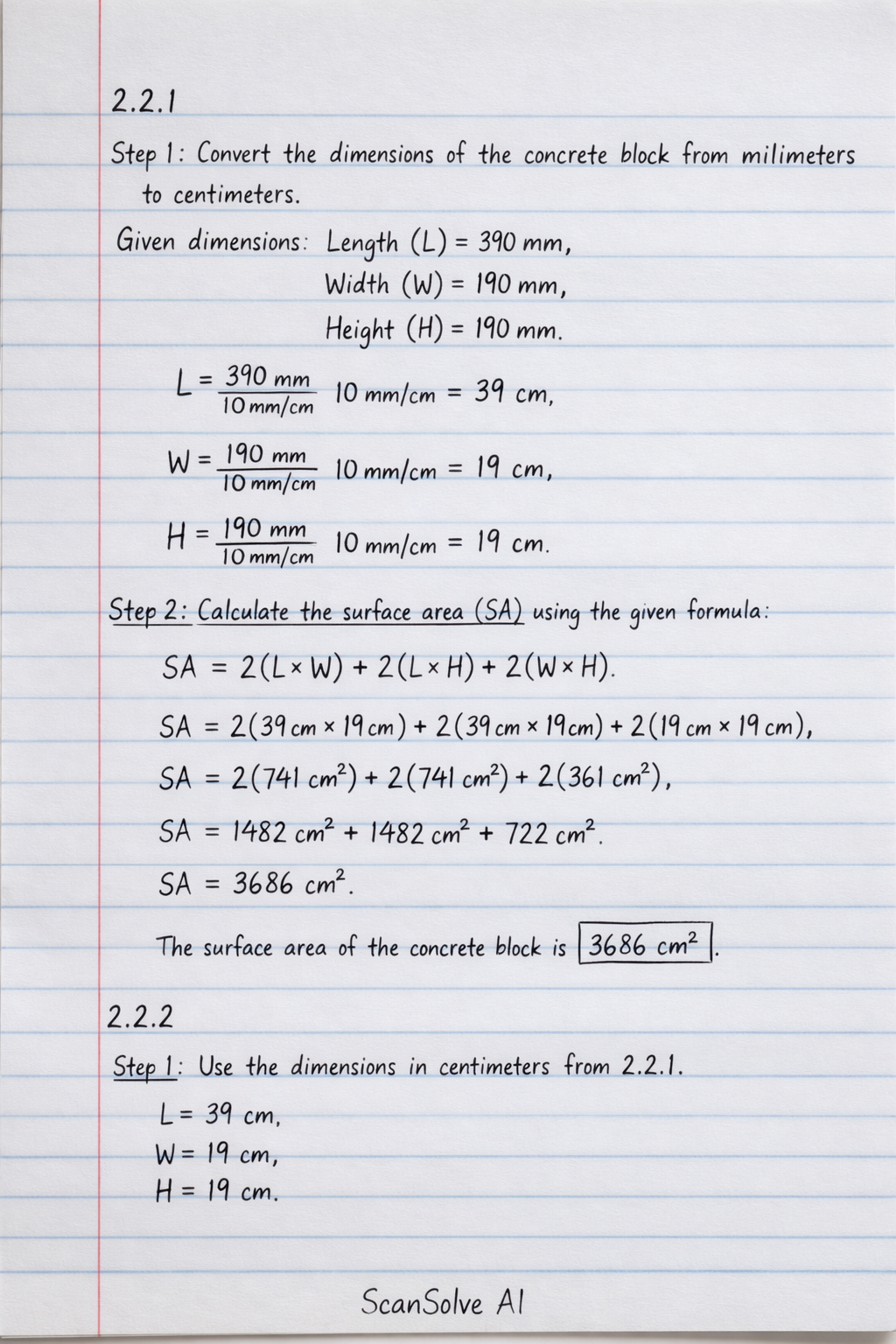
Handwritten Step-by-Step Solution
Get this as a handwritten image on WhatsApp — like a tutor wrote it for you.
Try on WhatsApp