
We read your photo as:
Prove the Tangent-Chord Theorem using the provided steps.
ScanSolve AI Answer
Answer
Step-by-step solution
4 stepsTo prove the Tangent-Chord Theorem, we will show that .
Construction.
Draw a diameter BF through the point of contact B. Connect F to E, forming chord EF.
Use properties of tangents and angles in a semicircle.
The tangent CAB is perpendicular to the radius at the point of contact B. Since BF is a diameter, it contains the radius.
The angle subtended by a diameter at any point on the circumference is . Therefore, is an angle in a semicircle.
In , the sum of angles is . Since , the other two angles are complementary:
From this, we can express :
Now, consider . We know .
Comparing the expressions for and , we see they are equal:
Use angles subtended by the same arc.
Angles subtended by the same arc at the circumference are equal. Both and are subtended by the arc BE.
Conclude the proof.
From Step 2, we established that .
From Step 3, we established that .
Therefore, by transitivity, we can conclude:This proves the Tangent-Chord Theorem.
Try one yourself
A new problem that tests the same skill.
Still stuck on this one?
Ask a follow-up, and the answer starts from this question.
More Mathematics Questions
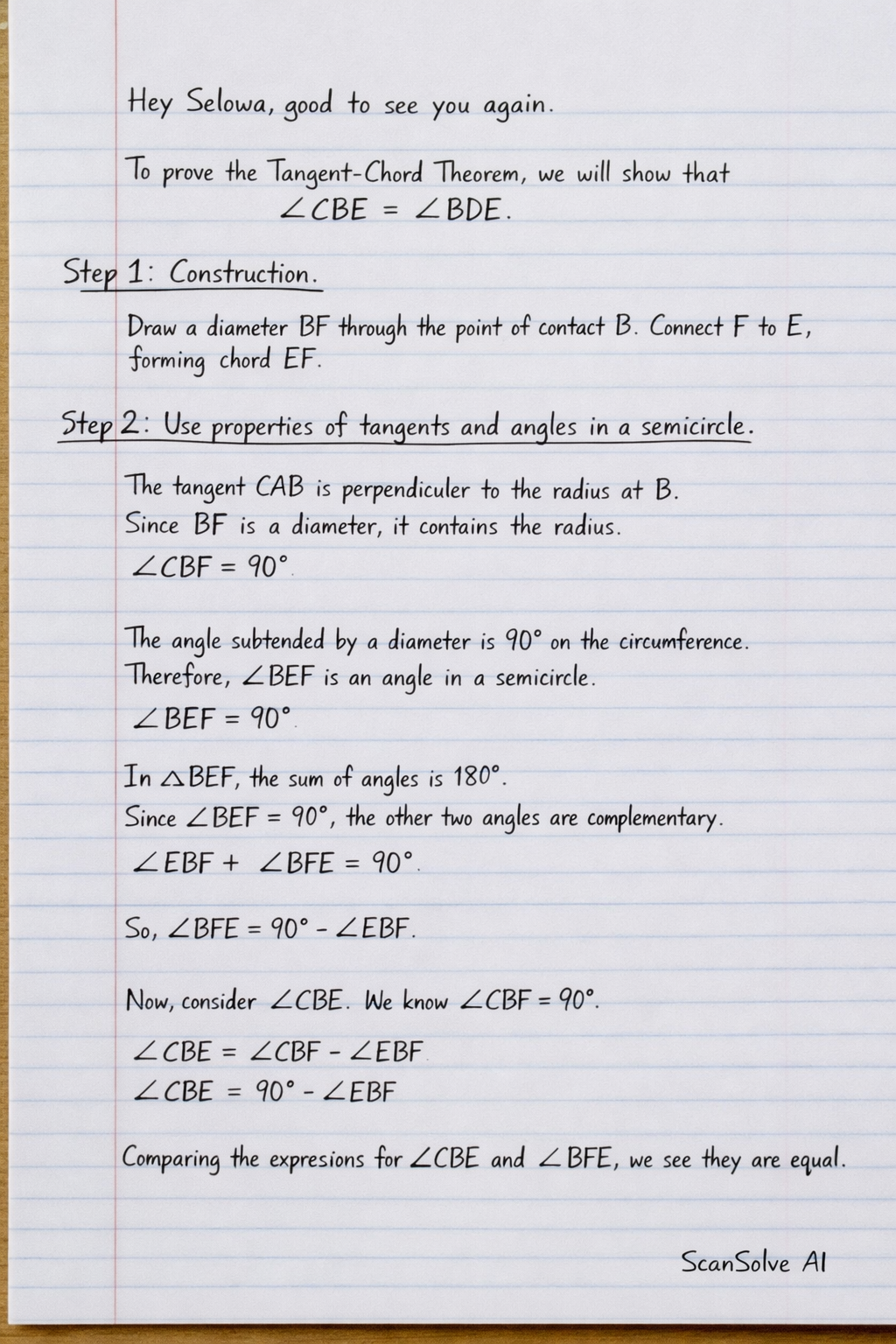
Handwritten Step-by-Step Solution
Get this as a handwritten image on WhatsApp — like a tutor wrote it for you.
Try on WhatsApp