
We read your photo as:
Find the Taylor series expansion of 1/√(x-8)² up to the term in (x-8)².
ScanSolve AI Answer
Step-by-step solution
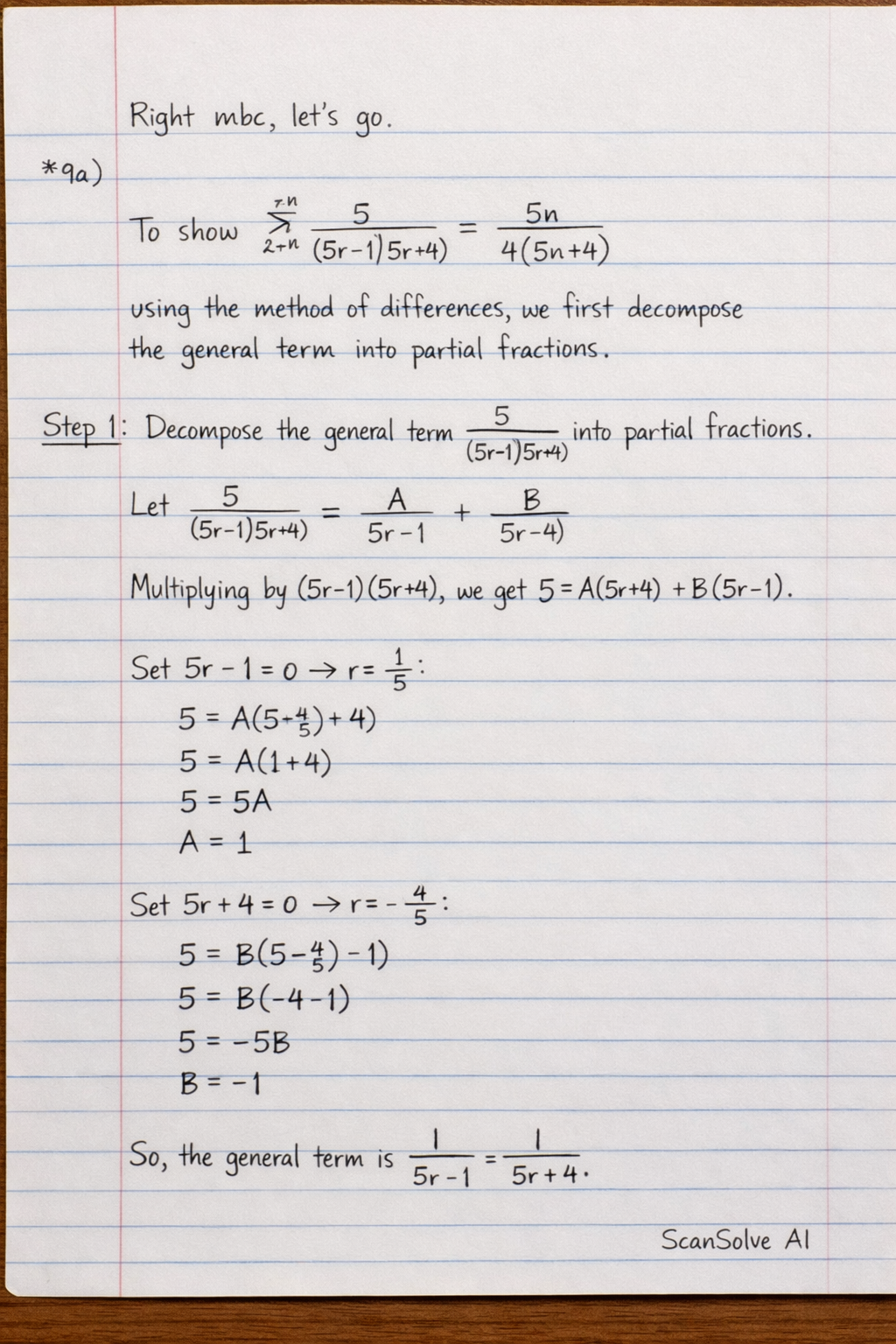
12 steps9a)
To show using the method of differences, we first decompose the general term into partial fractions.
Decompose the general term into partial fractions.
Let .
Multiplying by , we get .
Set :
.
Set :
.
So, the general term is .Write out the sum as a telescoping series.
For :
For :
For :
...
For :Sum the terms.
When summed, the intermediate terms cancel out:
Combine the remaining terms into a single fraction.
Thus, it is shown that .
9b)
To find the Taylor series expansion of up to the term in , we need to evaluate , , and at .
The Taylor series formula around is . Here .Find .
Find .
Find .
Substitute the values into the Taylor series formula.
The Taylor series expansion is .
9c)
To prove by induction that is divisible by 5 for all positive integers .Base Case ().
For , we have .
Since , 145 is divisible by 5.
Thus, the statement is true for .Inductive Hypothesis.
Assume the statement is true for some positive integer .
That is, assume is divisible by 5.
This means for some integer .
From this, we can write .Inductive Step ().
We need to show that is divisible by 5.
Substitute from the inductive hypothesis:
Since , we can factor out 5:
Since is an integer, is divisible by 5.
Conclusion.
By the principle of mathematical induction, is divisible by 5 for all positive integers .
Still stuck on this one?
Ask a follow-up, and the answer starts from this question.
More Mathematics Questions
Handwritten Step-by-Step Solution
Get this as a handwritten image on WhatsApp — like a tutor wrote it for you.
Try on WhatsApp