We read your photo as:

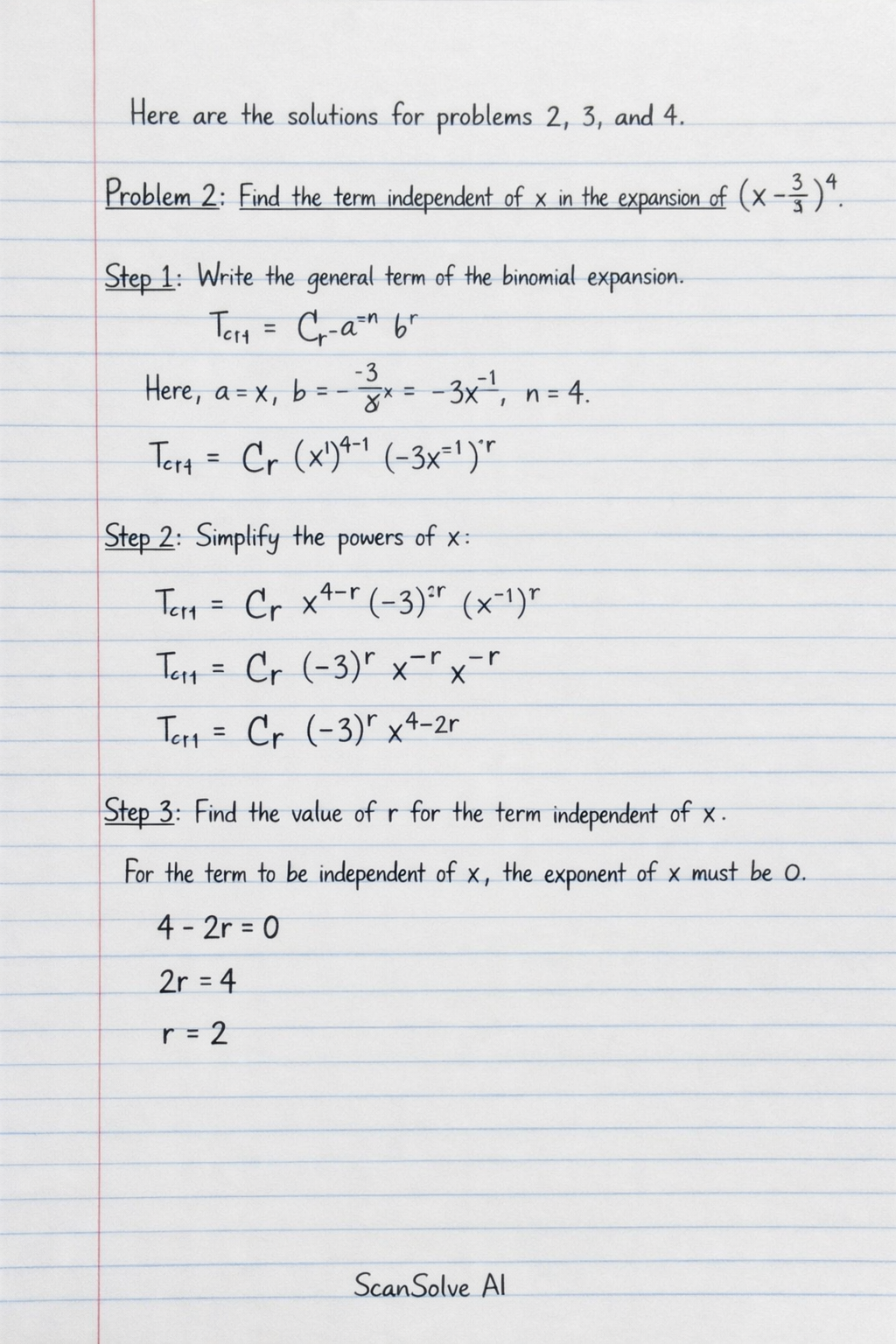
Find the term independent of x in the expansion of (x - (3)/(x))4.

Mathematics

ScanSolve AI Answer

Step-by-step solution

12 steps

Here are the solutions for problems 2, 3, and 4.

: Find the term independent of xx in the expansion of (x−3x)4\left(x - \frac{3}{x}\right)^4.

  1. Write the general term of the binomial expansion.

    The general term Tr+1T_{r+1} in the expansion of (a+b)n(a+b)^n is given by Tr+1=(nr)an−rbrT_{r+1} = \binom{n}{r} a^{n-r} b^r.
    In this case, a=xa=x, b=−3x=−3x−1b=-\frac{3}{x} = -3x^{-1}, and n=4n=4.

    Tr+1=(4r)(x)4−r(−3x−1)rT_{r+1} = \binom{4}{r} (x)^{4-r} (-3x^{-1})^r
  2. Simplify the powers of xx.

    Tr+1=(4r)x4−r(−3)r(x−1)rT_{r+1} = \binom{4}{r} x^{4-r} (-3)^r (x^{-1})^r Tr+1=(4r)(−3)rx4−rx−rT_{r+1} = \binom{4}{r} (-3)^r x^{4-r} x^{-r} Tr+1=(4r)(−3)rx4−2rT_{r+1} = \binom{4}{r} (-3)^r x^{4-2r}
  3. Find the value of rr for the term independent of xx.

    For the term to be independent of xx, the exponent of xx must be 0.

    4−2r=04 - 2r = 0 2r=42r = 4 r=2r = 2
  4. Substitute r=2r=2 into the general term to find the term.

    T2+1=T3=(42)(−3)2x4−2(2)T_{2+1} = T_3 = \binom{4}{2} (-3)^2 x^{4-2(2)} T3=4!2!(4−2)!(−3)2x0T_3 = \frac{4!}{2!(4-2)!} (-3)^2 x^0 T3=4×3×2×1(2×1)(2×1)(9)×1T_3 = \frac{4 \times 3 \times 2 \times 1}{(2 \times 1)(2 \times 1)} (9) \times 1 T3=244(9)T_3 = \frac{24}{4} (9) T3=6×9T_3 = 6 \times 9 T3=54T_3 = 54

    The term independent of xx is 54\boxed{54}.

    : Find the first three terms in ascending powers of yy in the expansion of (1−y)12(1-y)^{\frac{1}{2}}.

  5. Use the binomial expansion formula for fractional exponents.

    The formula for (1+x)n(1+x)^n is 1+nx+n(n−1)2!x2+…1 + nx + \frac{n(n-1)}{2!}x^2 + \dots.
    Here, x=−yx = -y and n=12n = \frac{1}{2}.

  6. Calculate the first term.

    The first term is 1.

  7. Calculate the second term.

    nx=12(−y)=−12ynx = \frac{1}{2}(-y) = -\frac{1}{2}y
  8. Calculate the third term.

    n(n−1)2!x2=12(12−1)2!(−y)2\frac{n(n-1)}{2!}x^2 = \frac{\frac{1}{2}(\frac{1}{2}-1)}{2!}(-y)^2 =12(−12)2×1(y2)= \frac{\frac{1}{2}(-\frac{1}{2})}{2 \times 1} (y^2) =−142y2= \frac{-\frac{1}{4}}{2} y^2 =−18y2= -\frac{1}{8}y^2
  9. Combine the first three terms.

    The first three terms in ascending powers of yy are 1−12y−18y21 - \frac{1}{2}y - \frac{1}{8}y^2.
    The final answer is 1−12y−18y2\boxed{1 - \frac{1}{2}y - \frac{1}{8}y^2}.

    : Find the coefficient of x−1x^{-1} in the expansion of ((x+1)(2x−1x))((x+1)(2x-\frac{1}{x})).

  10. Expand the product of the two factors.

    (x+1)(2x−1x)=x(2x)+x(−1x)+1(2x)+1(−1x)(x+1)\left(2x-\frac{1}{x}\right) = x(2x) + x\left(-\frac{1}{x}\right) + 1(2x) + 1\left(-\frac{1}{x}\right) =2x2−1+2x−1x= 2x^2 - 1 + 2x - \frac{1}{x}
  11. Rewrite the expression with negative exponents.

    =2x2+2x−1−x−1= 2x^2 + 2x - 1 - x^{-1}
  12. Identify the term containing x−1x^{-1} and its coefficient.

    The term containing x−1x^{-1} is −x−1-x^{-1}.
    The coefficient of x−1x^{-1} is −1-1.
    The final answer is −1\boxed{-1}.

Was this helpful?

Still stuck on this one?

Ask a follow-up, and the answer starts from this question.

Got a different question?Ask your own question
Handwritten step-by-step solution preview

Handwritten Step-by-Step Solution

Get this as a handwritten image on WhatsApp — like a tutor wrote it for you.

Try on WhatsApp