
This mathematics problem involves applying core mathematical principles and formulas. Below you will find a complete step-by-step solution with detailed explanations for each step, helping you understand not just the answer but the method behind it.
ScanSolve AI Answer
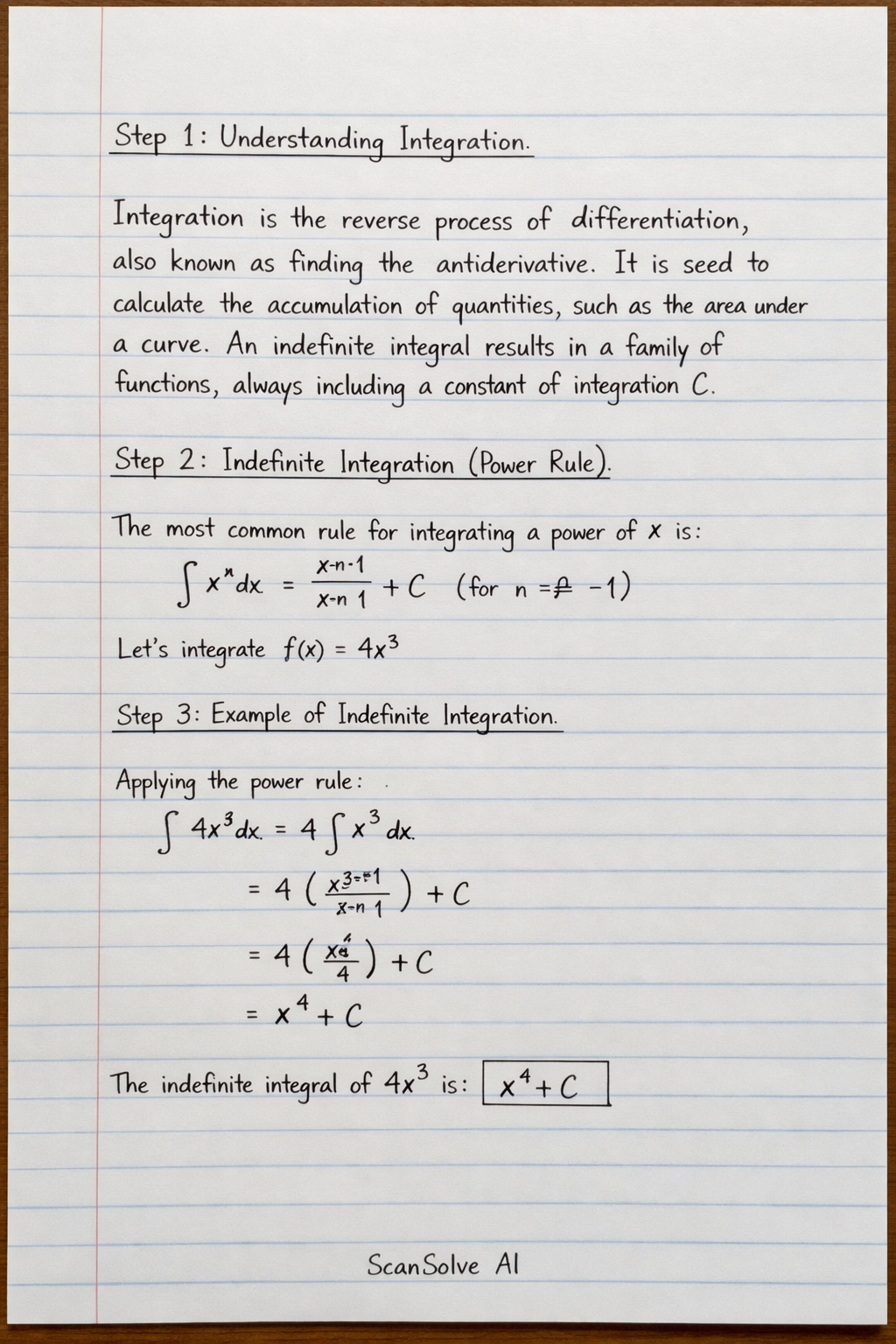
Step 1: Understanding Integration Integration is the reverse process of differentiation, also known as finding the antiderivative. It is used to calculate the accumulation of quantities, such as the area under a curve. An indefinite integral results in a family of functions, always including a constant of integration C. Step 2: Indefinite Integration (Power Rule) The most common rule for integrating a power of x is: x^n \,dx = x^n+1n+1 + C (for n ≠ -1) Let's integrate f(x) = 4x^3. Step 3: Example of Indefinite Integration Applying the power rule: 4x^3 \,dx = 4 x^3 \,dx = 4 (x^3+13+1) + C = 4 ((x^4)/(4)) + C = x^4 + C The indefinite integral of 4x^3 is x^4 + C. Step 4: Definite Integration A definite integral calculates the exact value of the area under a curve between two specific limits of integration, say from a to b. It does not include a constant of integration. The formula is: _a^b f(x)\,dx = F(b) - F(a) where F(x) is the antiderivative of f(x). Step 5: Example of Definite Integration Let's find the definite integral of f(x) = 4x^3 from x=1 to x=3. First, we use the antiderivative F(x) = x^4 (from Step 3, without C). Now, evaluate F(b) - F(a): _1^3 4x^3 \,dx = [x^4]_1^3 = (3)^4 - (1)^4 = 81 - 1 = 80 The definite integral is 80. Send me the next one 📸