
We read your photo as:
Show that ACD is similar to BCD.
ScanSolve AI Answer
Step-by-step solution
4 stepsShow that is similar to .
To prove similarity, we need to show that two angles in are equal to two angles in .
- (Common angle)
- (Angle between tangent DC and chord DB is equal to the angle in the alternate segment, ).
Since two angles are equal, the triangles are similar by AA similarity criterion.
Therefore, .Calculate AB.
Given cm and cm.
Using the Tangent-Secant Theorem, which states that the square of the length of the tangent from an external point to a circle is equal to the product of the lengths of the secant segment and its external segment.Substitute the given values:
Divide by 4 to find AC:
Since , we can find AB:
The length of AB is .
Calculate the size of angle .
From the similarity , we have the ratio of corresponding sides:
Substitute the known values cm and cm:
Cross-multiply:
Now consider . We have sides cm, cm, and cm.
We can use the Law of Cosines to find (which is ):Substitute the side lengths:
Rearrange to solve for :
Now, find the angle:
Rounding to one decimal place:
The size of angle is
\boxed{\text{41.4^\circ}}.Calculate the area of the circle to 1 decimal place.
The line AOB is a straight line passing through the center O, which means AB is the diameter of the circle.
From Step 2, we found cm.
So, the diameter cm.
The radius cm.
The area of a circle is given by the formula .Rounding to 1 decimal place:
The area of the circle is .
Still stuck on this one?
Ask a follow-up, and the answer starts from this question.
More Mathematics Questions
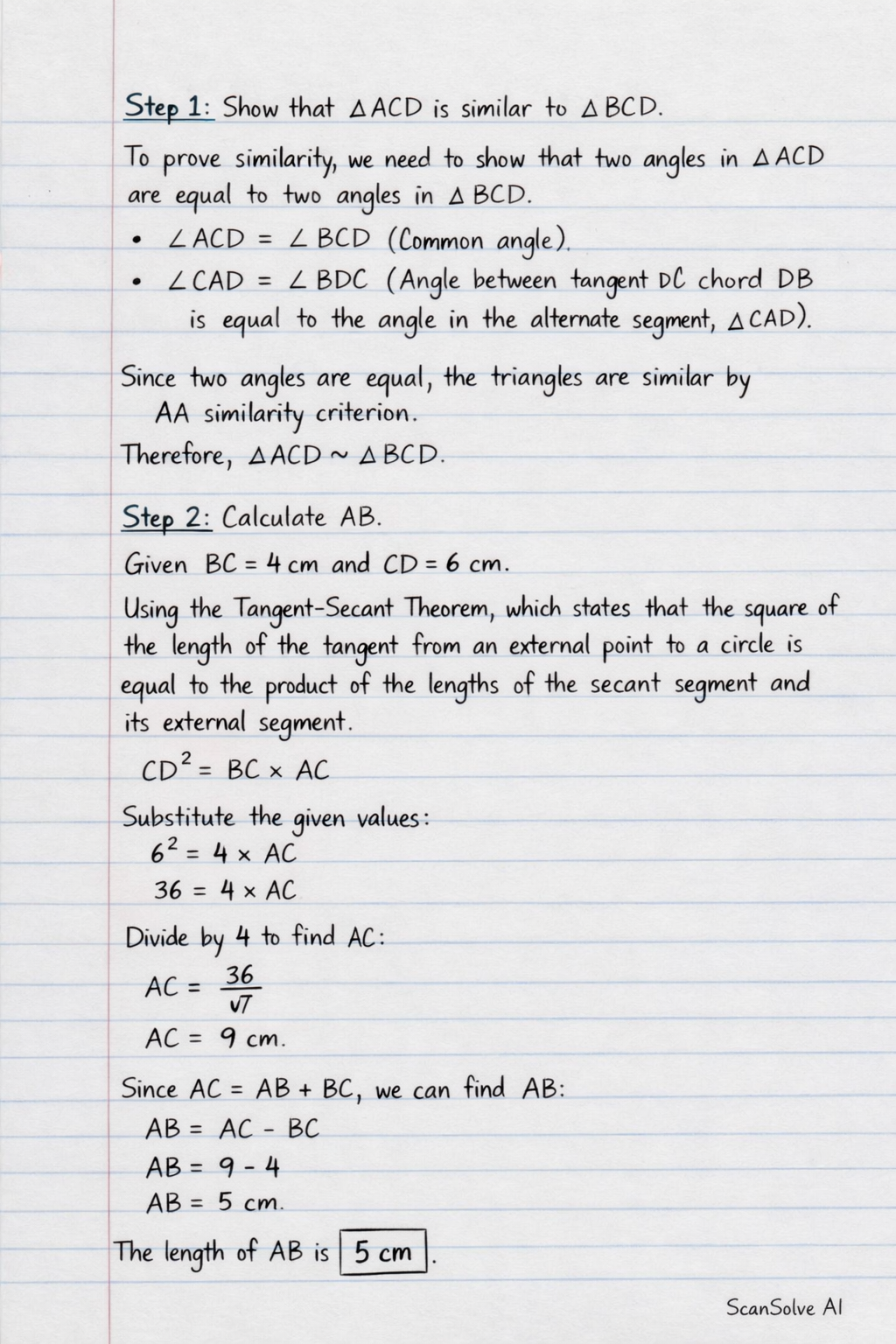
Handwritten Step-by-Step Solution
Get this as a handwritten image on WhatsApp — like a tutor wrote it for you.
Try on WhatsApp