
We read your photo as:
Prove that cos 2x - 1 cos 2x + 1 = cosec x + cotx Show that cos 2x - 1 cos 2x + 1 = -tan x If tan = c, derive the expressions for cos A and sin A in terms of c. Hence, or otherwise, prove that if sec A - tan A = x Then, tan = x
Mathematics
ScanSolve AI Answer
Answer
Step-by-step solution
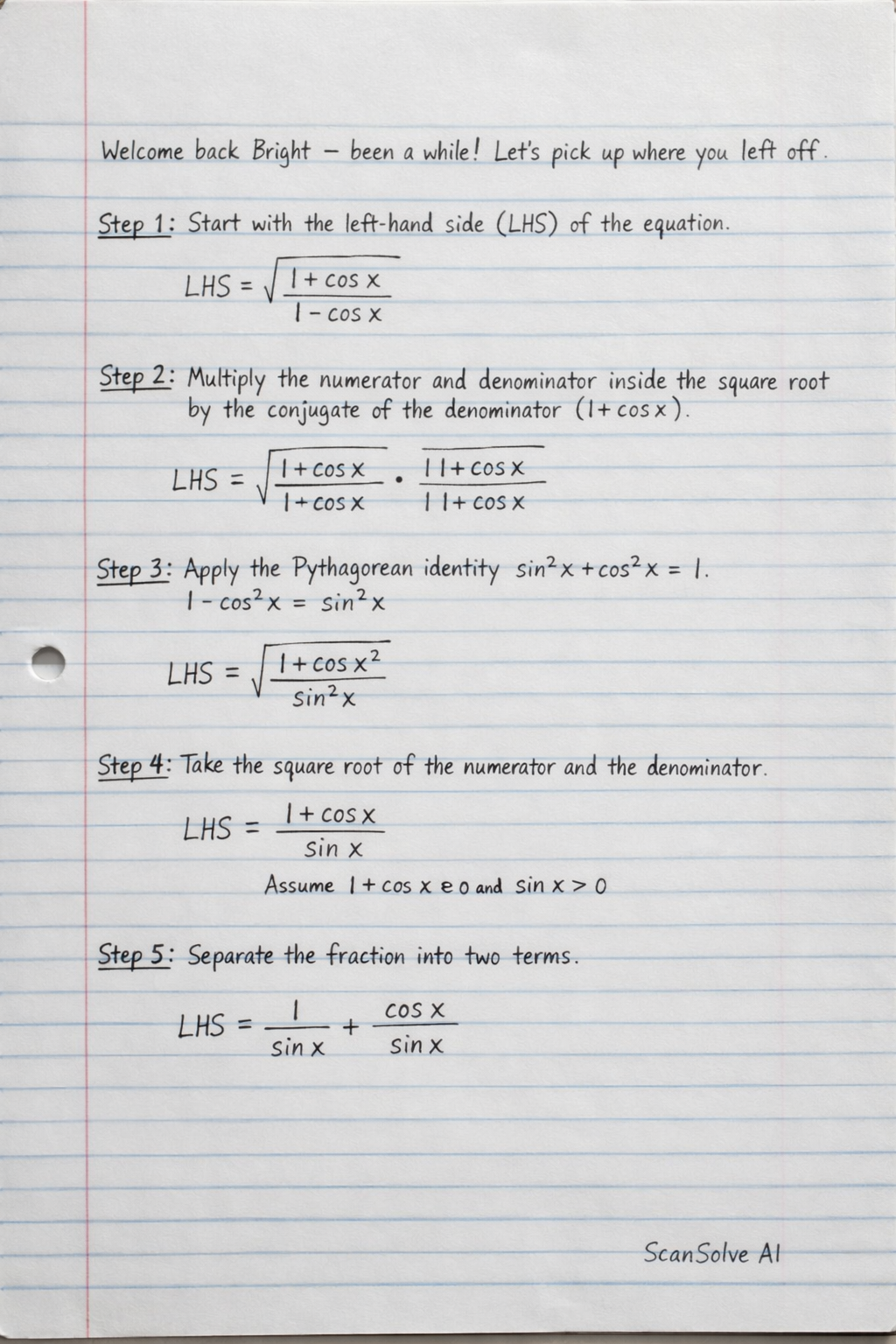
6 stepsStart with the left-hand side (LHS) of the equation.
Multiply the numerator and denominator inside the square root by the conjugate of the denominator, which is .
Apply the Pythagorean identity , which implies .
Take the square root of the numerator and the denominator.
Assuming and for the principal value, we can remove the absolute values.
Separate the fraction into two terms.
Use the definitions of cosecant () and cotangent ().
This matches the right-hand side (RHS) of the equation.
Therefore, we have proven that .
Was this helpful?
Try one yourself
A new problem that tests the same skill.
Still stuck on this one?
Ask a follow-up, and the answer starts from this question.
Got a different question?Ask your own question
More Mathematics Questions
QProve that cos 7x + cos 5x / cos 7x - cos 5x = cot x Prove that sin 2x / sin 2 x + cos 2 x = 2 sin xQQ1. Proof each of the following trigonometric identities a. (tanx)/(1+secx) + (tanx)/(1-secx)…QA) Prove that (1+cot θ)/(1+tan θ) = cot θ. b) Show that cos2 x – sin2 x = 1 – 2sin2 x. c) Determine…QA Prove that Sin2 O + Cos2 O = Cos2 O + Sin2 O b Prove that (1 + Cos O) / Sin O = Cosec O + Cot OQProve the identity: sin 2x / 2 cos2 x + sin x / tan x [1 + cos(90 − x)] = 1 / cos x
Browse by topic:Trigonometry
Handwritten Step-by-Step Solution
Get this as a handwritten image on WhatsApp — like a tutor wrote it for you.
Try on WhatsApp