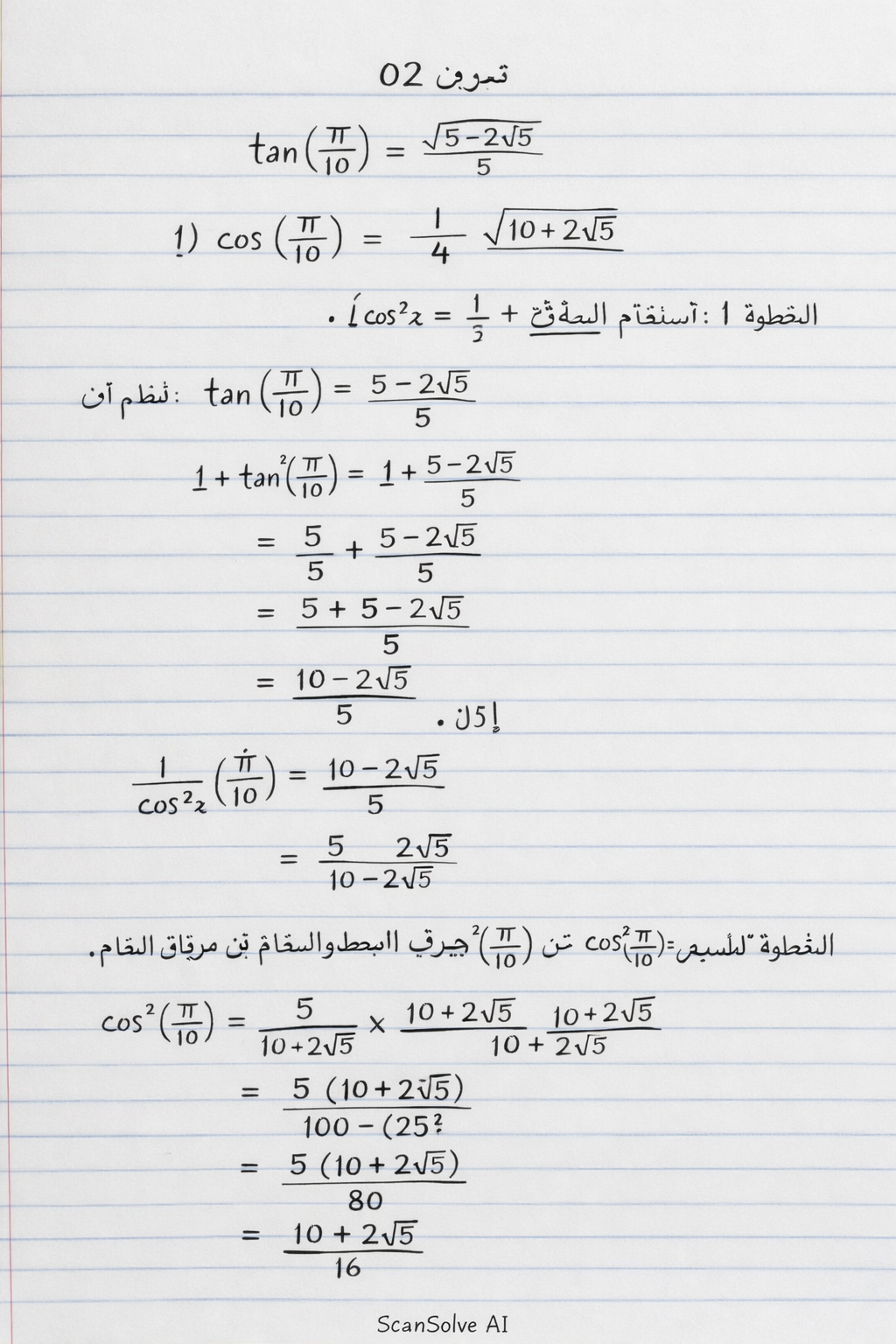
Prove that cos(pi/10) = (1/4) sqrt(10 + 2 sqrt(5)) given tan(pi/10) = sqrt((5 - 2 * sqrt(5))/5)
|Mathematics
Prove that cos(pi/10) = (1/4) sqrt(10 + 2 sqrt(5)) given tan(pi/10) = sqrt((5 - 2 * sqrt(5))/5)
ScanSolve AI Answer
Answer
cos(10π)=4110+25
تمرين 02
معطى: tan(10π)=55−25
1) إثبات أن: cos(10π)=4110+25
الخطوة 1: استخدام المتطابقة المثلثية 1+tan2x=cos2x1.
نعلم أن tan2(10π)=55−25.
1+tan2(10π)=1+55−25=55+55−25=55+5−25=510−25
إذن:
cos2(10π)1=510−25cos2(10π)=10−255
الخطوة 2: تبسيط التعبير عن cos2(10π) بضرب البسط والمقام في مرافق المقام.
cos2(10π)=10−255×10+2510+25=102−(25)25(10+25)=100−(4×5)5(10+25)=100−205(10+25)=805(10+25)=1610+25
الخطوة 3: أخذ الجذر التربيعي.
بما أن 10π تقع في الربع الأول (0<10π<2π)، فإن cos(10π)>0.
cos(10π)=1610+25=1610+25=410+25cos(10π)=4110+25
الخطوة 2: تبسيط التعبير داخل الجذر.
نضرب البسط داخل الجذر:
(5−25)(10+25)=5×10+5×25−25×10−25×25=50+105−205−4×5=50−105−20=30−105
نعود إلى تعبير sin(10π):
sin(10π)=41530−105sin(10π)=41510(3−5)sin(10π)=412(3−5)sin(10π)=416−25
3) استنتاج القيمة الدقيقة لـ cos(109π) و sin(53π)
حساب cos(109π):
نلاحظ أن 109π=π−10π.
باستخدام المتطابقة cos(π−x)=−cosx:
cos(109π)=cos(π−10π)=−cos(10π)
من الجزء 1، لدينا cos(10π)=4110+25.
إذن:
cos(109π)=−4110+25
حساب sin(53π):
نلاحظ أن 53π=106π.
يمكننا كتابة 106π كـ 105π+π=105π+10π=2π+10π.
باستخدام المتطابقة sin(2π+x)=cosx:
sin(53π)=sin(2π+10π)=cos(10π)
من الجزء 1، لدينا $\cos\left(\frac{\pi}{10}\right) =
Was this helpful?
Need help with your own homework?
Get instant step-by-step solutions to any question. Free to start.
This mathematics problem involves applying core mathematical principles and formulas. Below you will find a complete step-by-step solution with detailed explanations for each step, helping you understand not just the answer but the method behind it.
ScanSolve AI Answer
تمرين 02 معطى: (()/(10)) = sqrt(5-25)5 1) إثبات أن: (()/(10)) = (1)/(4)sqrt(10+25) الخطوة 1: استخدام المتطابقة المثلثية 1 + ^2 x = (1)/(^2 x). نعلم أن ^2(()/(10)) = 5-2sqrt(5)5. 1 + ^2(()/(10)) = 1 + 5-2sqrt(5)5 = (5)/(5) + 5-2sqrt(5)5 = 5+5-2sqrt(5)5 = 10-2sqrt(5)5 إذن: (1)/(^2()10) = 10-2sqrt(5)5 ^2(()/(10)) = (5)/(10-2sqrt(5)) الخطوة 2: تبسيط التعبير عن ^2(()/(10)) بضرب البسط والمقام في مرافق المقام. ^2(()/(10)) = (5)/(10-2sqrt(5)) × 10+2sqrt(5)10+2sqrt(5) = 5(10+2sqrt(5))10^2 - (2sqrt(5))^2 = 5(10+2sqrt(5))100 - (4 × 5) = 5(10+2sqrt(5))100 - 20 = 5(10+2sqrt(5))80 = 10+2sqrt(5)16 الخطوة 3: أخذ الجذر التربيعي. بما أن ()/(10) تقع في الربع الأول (0 < ()/(10) < ()/(2))، فإن (()/(10)) > 0. (()/(10)) = sqrt(10+25)16 = sqrt(10+25)sqrt(16) = sqrt(10+25)4 (()/(10)) = (1)/(4)sqrt(10+25) 2) حساب قيمة (()/(10)) الخطوة 1: استخدام المتطابقة x = x × x. (()/(10)) = (()/(10)) × (()/(10)) نعوض بالقيم المعطاة والمحسوبة: (()/(10)) = sqrt(5-25)5 × (1)/(4)sqrt(10+25) (()/(10)) = (1)/(4)sqrt((5-25))(10+2sqrt(5))5 الخطوة 2: تبسيط التعبير داخل الجذر. نضرب البسط داخل الجذر: (5-2sqrt(5))(10+2sqrt(5)) = 5 × 10 + 5 × 2sqrt(5) - 2sqrt(5) × 10 - 2sqrt(5) × 2sqrt(5) = 50 + 10sqrt(5) - 20sqrt(5) - 4 × 5 = 50 - 10sqrt(5) - 20 = 30 - 10sqrt(5) نعود إلى تعبير (()/(10)): (()/(10)) = (1)/(4)sqrt(30-105)5 (()/(10)) = (1)/(4)sqrt(10(3-5))5 (()/(10)) = (1)/(4)sqrt(2(3-5)) (()/(10)) = (1)/(4)sqrt(6-25) 3) استنتاج القيمة الدقيقة لـ ((9)/(10)) و ((3)/(5)) حساب ((9)/(10)): نلاحظ أن (9)/(10) = - ()/(10). باستخدام المتطابقة ( - x) = - x: ((9)/(10)) = ( - ()/(10)) = -(()/(10)) من الجزء 1، لدينا (()/(10)) = (1)/(4)sqrt(10+25). إذن: ((9)/(10)) = -(1)/(4)sqrt(10+25) حساب ((3)/(5)): نلاحظ أن (3)/(5) = (6)/(10). يمكننا كتابة (6)/(10) كـ (5 + )/(10) = (5)/(10) + ()/(10) = ()/(2) + ()/(10). باستخدام المتطابقة (()/(2) + x) = x: ((3)/(5)) = (()/(2) + ()/(10)) = (()/(10)) من الجزء 1، لدينا $(()/(10)) =