
We read your photo as:
Prove that for any odd integer m, the number (m4 + 4m2 + 11)/16 is an integer.
ScanSolve AI Answer
Step-by-step solution
19 stepsLet be an odd integer.
We can express any odd integer in the form for some integer .
Find expressions for and in terms of .
Since and are consecutive integers, one of them must be even. Therefore, is always an even integer. Let for some integer .
Then, .
Now, find :Substitute these expressions into the given number.
The number is .
Substitute and :Simplify the expression.
Factor out 16 from the numerator:
Since is an integer, is also an integer.
Therefore, the given number is an integer.Combine the square roots using the property .
Multiply the fractions inside the square root.
Cancel out common terms in the numerator and denominator.
Evaluate the square root.
Thus, .
The problem states that .
We need to find the value of .
Substitute the given value of into the expression:
Start with the known inequality that the square of any real number is non-negative.
For any real numbers and , .
Expand the inequality.
Since and are positive real numbers, their product is also positive.
We can divide the entire inequality by without changing the direction of the inequality sign.
Simplify the terms.
Add 2 to both sides of the inequality.
This proves the statement.
Start with the known inequality that the square of any real number is non-negative.
Since is a real number and , is a real number.
Therefore, .Expand the square.
Substitute the expanded form back into the inequality.
Add 2 to both sides of the inequality.
This proves the statement.
Still stuck on this one?
Ask a follow-up, and the answer starts from this question.
More Mathematics Questions
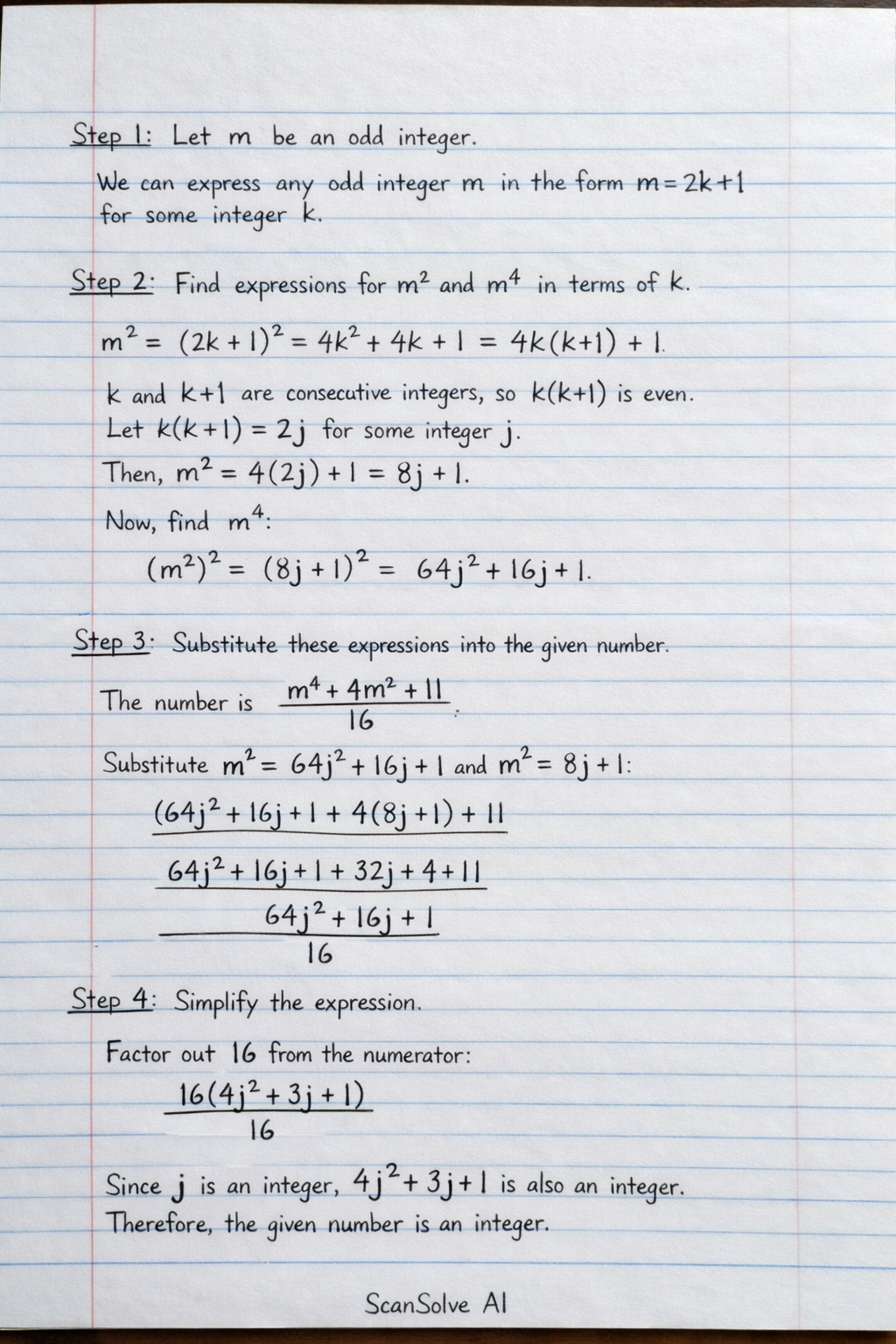
Handwritten Step-by-Step Solution
Get this as a handwritten image on WhatsApp — like a tutor wrote it for you.
Try on WhatsApp