
We read your photo as:
Show that g(x) = -x2 + 4x + 5. Calculate the average gradient of g between A(0; 5) and C(2; 9). Find the length of BD, given that B is the negative x-intercept of g(x) and D is the negative x-intercep
ScanSolve AI Answer
Use the left and right arrow keys to trace the curve, up and down to jump between key points, and plus and minus to zoom.
| Point | x | y |
|---|---|---|
| x-intercept | −1 | 0 |
| y-intercept | 0 | 5 |
| Maximum | 2 | 9 |
| x-intercept | 5 | 0 |
Step-by-step solution
6 stepsShow that .
The general form of a parabola with a turning point is .
Given the turning point C(2; 9), we substitute and :Given the y-intercept A(0; 5), we substitute and to find :
\begin{align*} 5 &= a(0-2)^2 + 9 \ 5 &= a(-2)^2 + 9 \ 5 &= 4a + 9 \ 4a &= 5 - 9 \ 4a &= -4 \ a &= -1 \end{align*}
Now substitute back into the equation:
\begin{align*} g(x) &= -1(x-2)^2 + 9 \ g(x) &= -(x^2 - 4x + 4) + 9 \ g(x) &= -x^2 + 4x - 4 + 9 \ g(x) &= -x^2 + 4x + 5 \end{align*}
This matches the required form.Calculate the average gradient of between A and C.
The coordinates are A(0; 5) and C(2; 9).
The formula for the average gradient (slope) between two points and is .The average gradient is .
Calculate the length of BD.
First, find the x-intercepts of . Set :
\begin{align*} \frac{1}{2}x^2 - 8 &= 0 \ \frac{1}{2}x^2 &= 8 \ x^2 &= 16 \ x &= \pm 4 \end{align*}
From the graph, B is the negative x-intercept, so B(-4; 0).Next, find the x-intercepts of . Set :
\begin{align*} -x^2 + 4x + 5 &= 0 \ x^2 - 4x - 5 &= 0 \ (x-5)(x+1) &= 0 \ x = 5 \quad &or \quad x = -1 \end{align*}
From the graph, D is the positive x-intercept, so D(5; 0).The length of BD is the distance between B(-4; 0) and D(5; 0):
The length of BD is .
Use the graphs to solve for x.
The x-intercepts of are and .
Since is a parabola opening upwards, when is outside or on the x-intercepts.
Therefore, or .
The solution is .and are both strictly increasing
For : This parabola opens upwards and its turning point is at . So, is strictly increasing for .
For : This parabola opens downwards and its turning point is at . So, is strictly increasing for .
For both functions to be strictly increasing, we need the intersection of these two intervals:
AND .
The solution is .
Still stuck on this one?
Ask a follow-up, and the answer starts from this question.
More Mathematics Questions
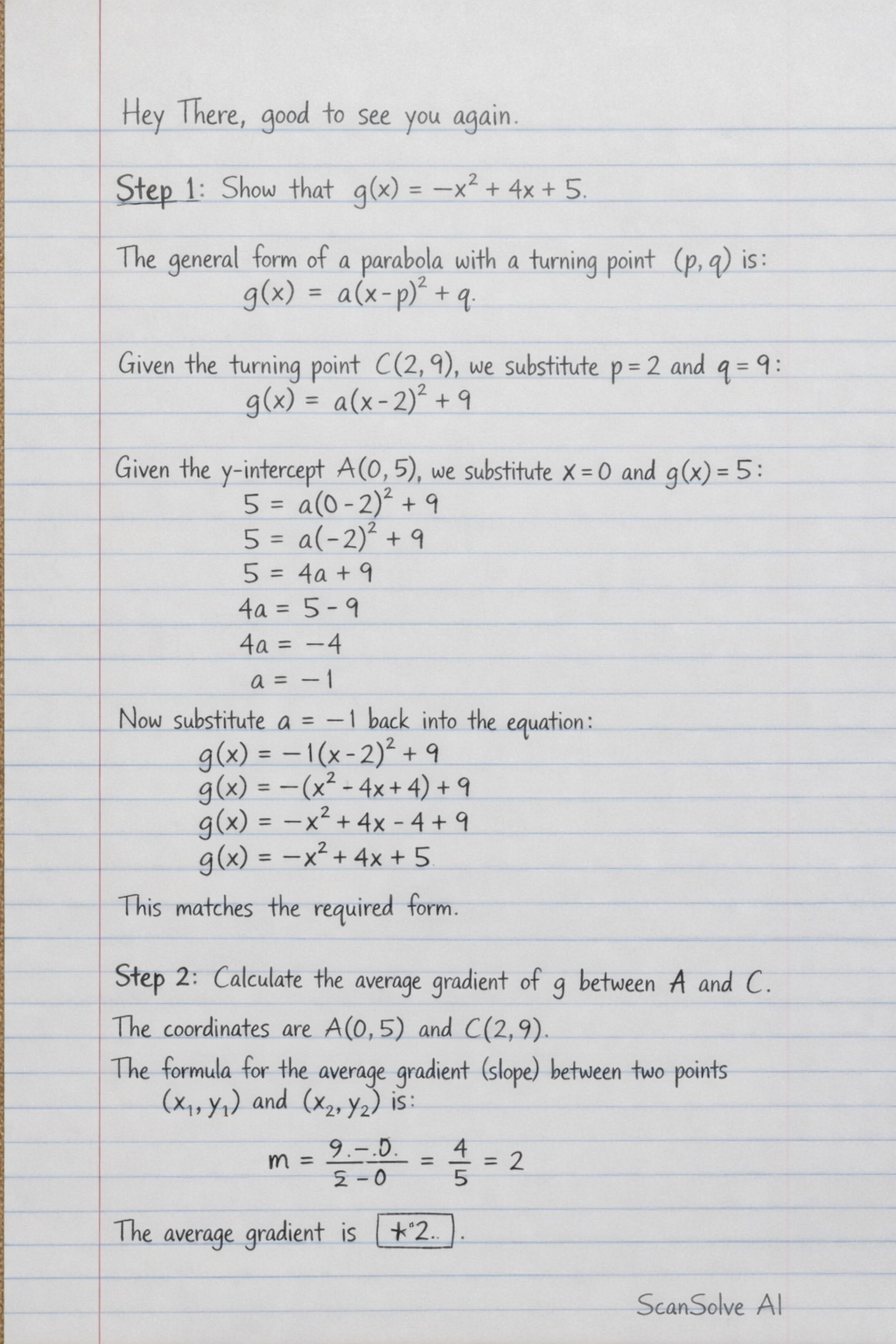
Handwritten Step-by-Step Solution
Get this as a handwritten image on WhatsApp — like a tutor wrote it for you.
Try on WhatsApp