
We read your photo as:
Prove that opposite sides of a parallelogram are equal. Also, given parallelogram EFGH with angles G = 9x + 12 and F = 15x − 24, calculate the value of x.
ScanSolve AI Answer
Step-by-step solution
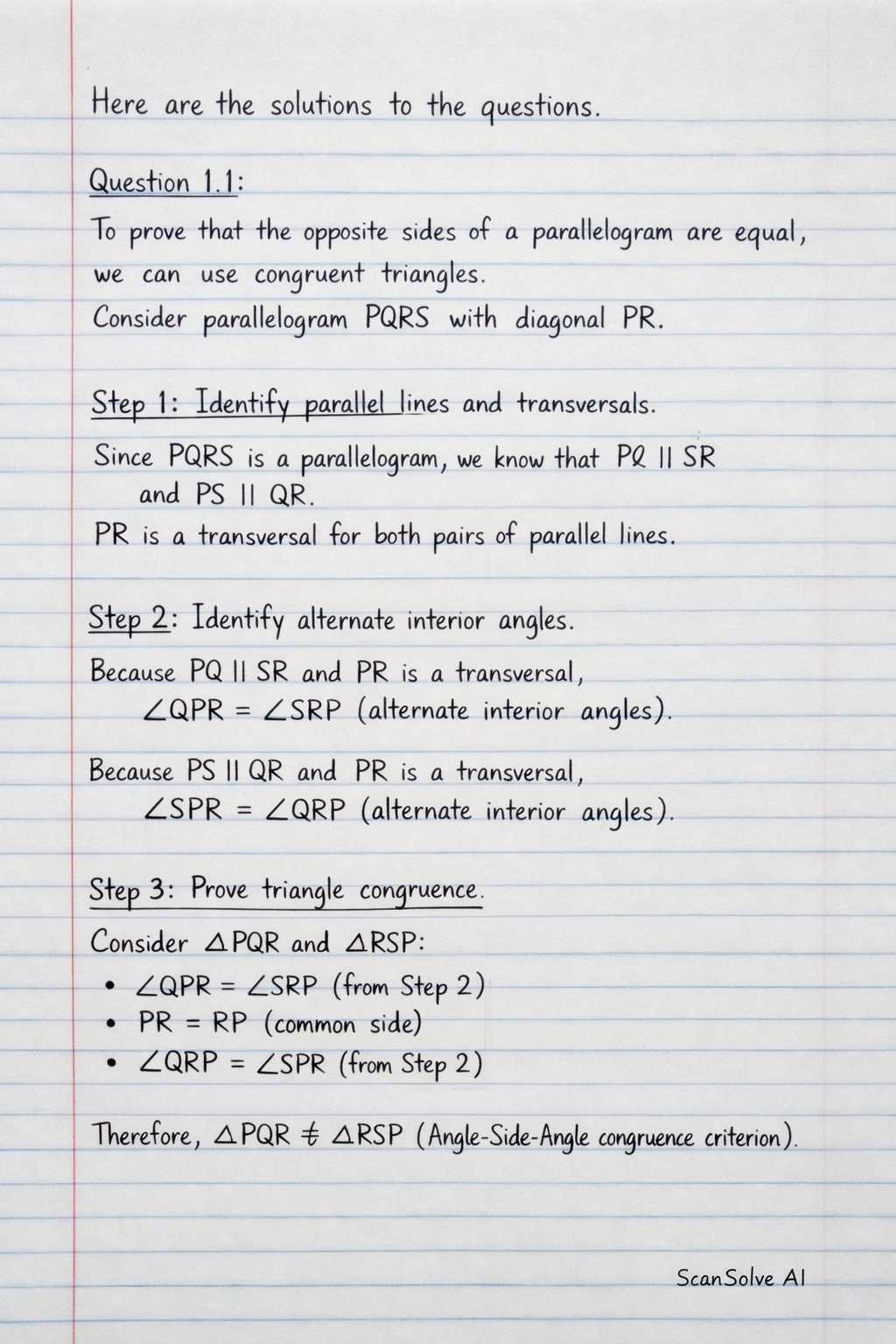
8 stepsHere are the solutions to the questions.
Question 1.1:
To prove that the opposite sides of a parallelogram are equal, we can use congruent triangles.
Consider parallelogram PQRS with diagonal PR.
Identify parallel lines and transversals.
Since PQRS is a parallelogram, we know that and .
PR is a transversal for both pairs of parallel lines.Identify alternate interior angles.
Because and PR is a transversal, (alternate interior angles).
Because and PR is a transversal, (alternate interior angles).Prove triangle congruence.
Consider and :
- (from Step 2)
- (common side)
- (from Step 2) Therefore, (Angle-Side-Angle congruence criterion).
Conclude equality of opposite sides.
Since , their corresponding sides are equal:
Thus, the opposite sides of a parallelogram are equal.Question 1.2:
In parallelogram EFGH, and .Question 1.2.1:
Calculate the value of .Use the property of consecutive angles in a parallelogram.
Consecutive angles in a parallelogram are supplementary, meaning they add up to .
Substitute the given expressions for and and solve for .
Question 1.2.2:
Determine the size of .Calculate the measure of using the value of .
Substitute :
Use the property of opposite angles in a parallelogram.
Opposite angles in a parallelogram are equal. Therefore, .
Question 2:
The question provides the vertices of a quadrilateral NTWZ as N (-6;-6), T (3;0), W (x;y) and Z (5;-3). However, the actual question to be solved (e.g., "find x and y if NTWZ is a parallelogram", or "calculate the length of a side") is not visible in the image. Please provide the complete question for Question 2.
Still stuck on this one?
Ask a follow-up, and the answer starts from this question.
More Mathematics Questions
Handwritten Step-by-Step Solution
Get this as a handwritten image on WhatsApp — like a tutor wrote it for you.
Try on WhatsApp