
We read your photo as:
Use the diagram below to prove that the opposite sides of a parallelogram are equal.
ScanSolve AI Answer
Answer
Step-by-step solution
11 steps1.1 Use the diagram below to prove that the opposite sides of a parallelogram are equal.
Consider the parallelogram PQRS with diagonal PR.
Given that PQRS is a parallelogram, we know that its opposite sides are parallel: and .
Identify alternate interior angles.
Since and PR is a transversal, the alternate interior angles are equal:
Since and PR is a transversal, the alternate interior angles are equal:
Identify the common side.
The diagonal PR is common to both and .
Prove triangle congruence.
By the Angle-Side-Angle (ASA) congruence criterion, is congruent to :
Conclude equality of opposite sides.
Since the triangles are congruent, their corresponding sides are equal:
Therefore, the opposite sides of a parallelogram are equal.
1.2 In the diagram below ABCD is a parallelogram with and .
(Assuming the parallelogram in the diagram is EFGH, and the given angles and refer to and of parallelogram EFGH.)1.2.1 Calculate the value of x.
Identify the property of consecutive angles in a parallelogram.
In a parallelogram, consecutive angles are supplementary, meaning they add up to .
Therefore, .Set up the equation.
Substitute the given expressions for and :
Solve for x.
Combine like terms:
Add to both sides:
Divide by 24:
The value of x is .
1.2.2 Determine the size of .
Identify the property of opposite angles in a parallelogram.
In a parallelogram, opposite angles are equal.
Therefore, .Calculate the measure of using the value of x.
Substitute into the expression for :
Determine the size of .
Since :
The size of is .
Try one yourself
A new problem that tests the same skill.
Still stuck on this one?
Ask a follow-up, and the answer starts from this question.
More Mathematics Questions
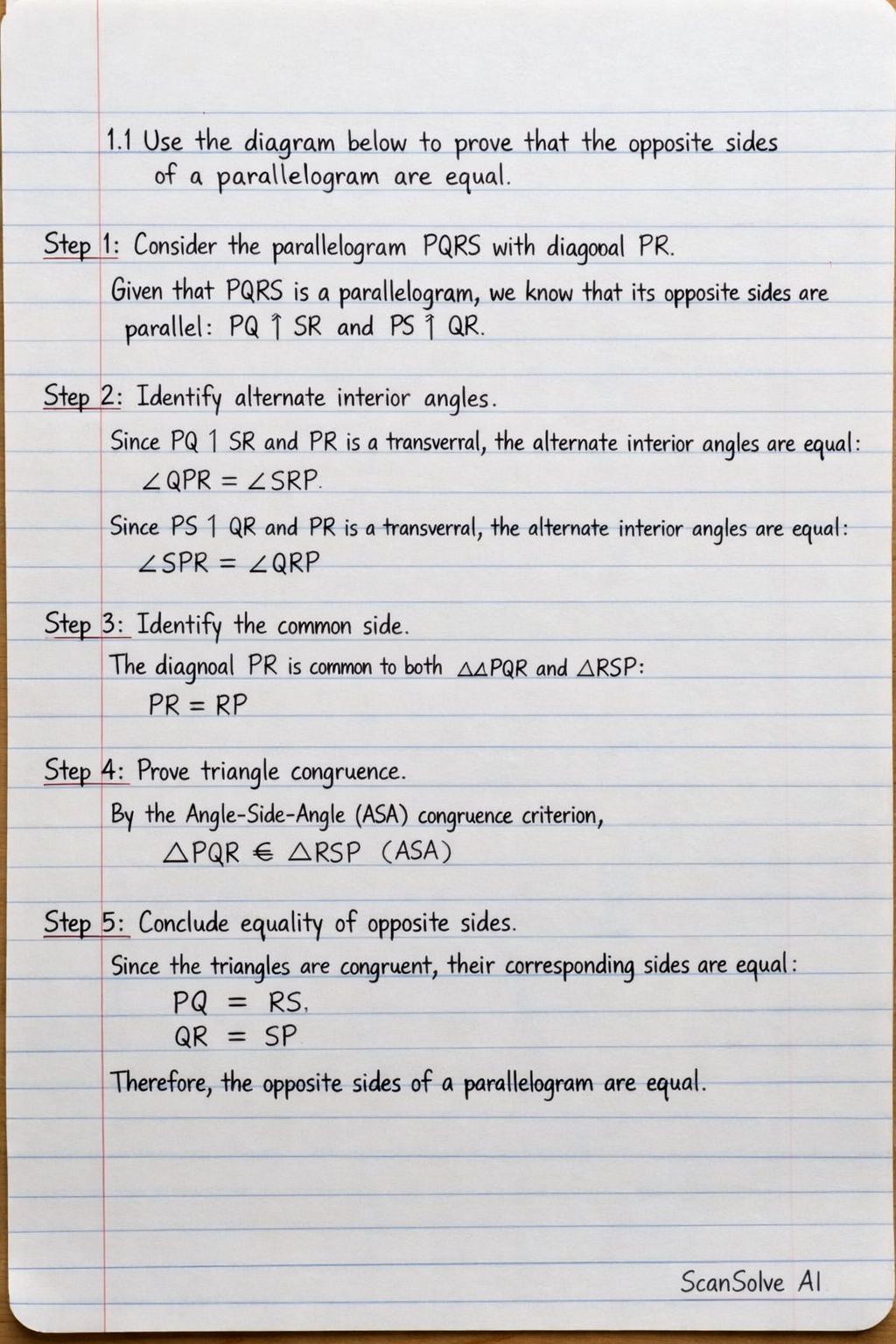
Handwritten Step-by-Step Solution
Get this as a handwritten image on WhatsApp — like a tutor wrote it for you.
Try on WhatsApp