We read your photo as:

Prove that x = - b±√b²-4ac / 29

Mathematics

ScanSolve AI Answer

Answer

1
6.1278

Step-by-step solution

9 steps

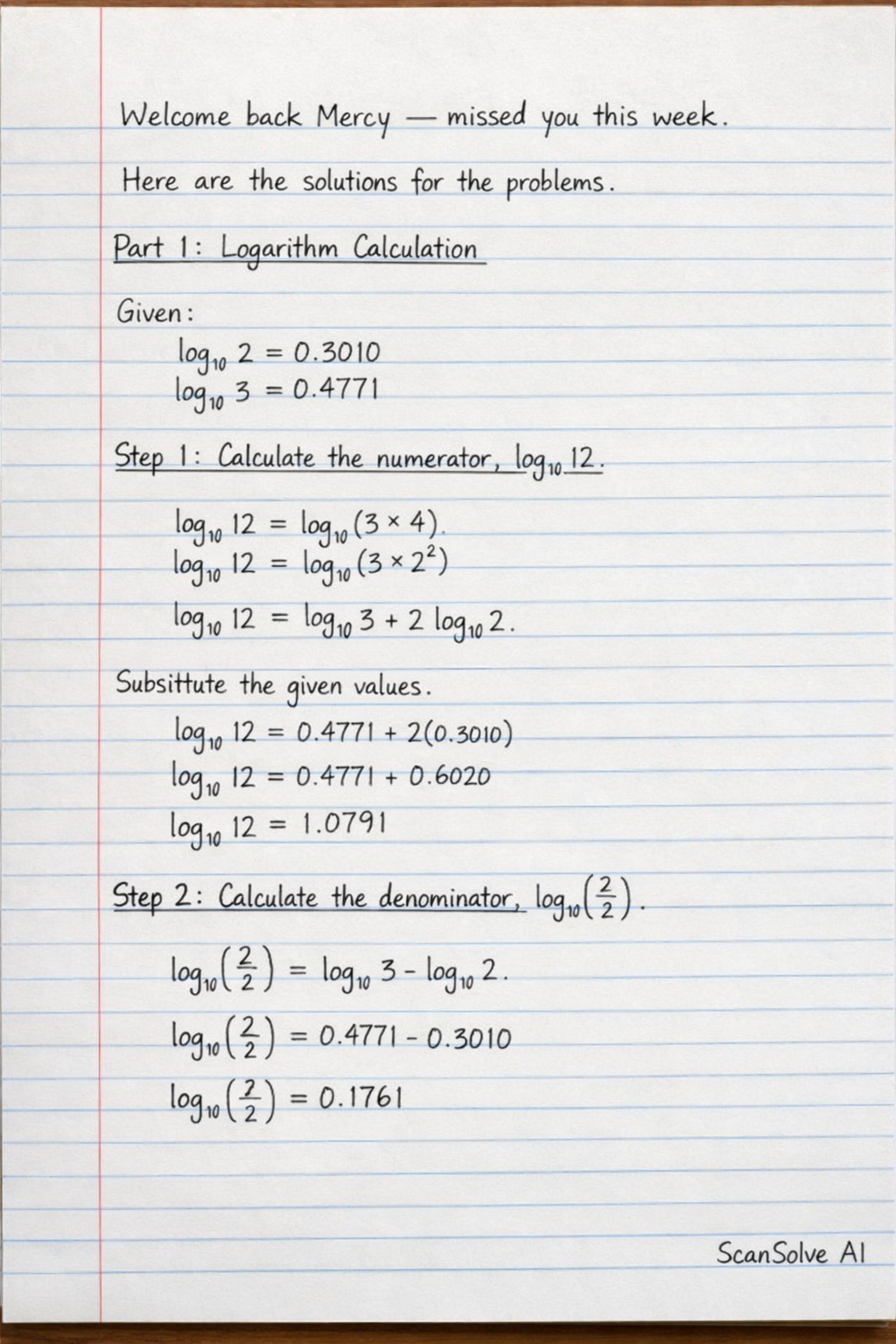
Here are the solutions for the problems.

Part 1· 3 steps

Logarithm Calculation

The problem involves evaluating a ratio of logarithms using given approximate values for log⁡102\log_{10} 2 and log⁡103\log_{10} 3.
Given:
log⁡102≈0.3010\log_{10} 2 \approx 0.3010
log⁡103≈0.4771\log_{10} 3 \approx 0.4771

  1. Calculate the numerator, log⁡1012\log_{10} 12.

    Using logarithm properties log⁡(MN)=log⁡M+log⁡N\log(MN) = \log M + \log N and log⁡(Mp)=plog⁡M\log(M^p) = p \log M:

    log⁡1012=log⁡10(3×4)=log⁡10(3×22)\log_{10} 12 = \log_{10}(3 \times 4) = \log_{10}(3 \times 2^2) log⁡1012=log⁡103+2log⁡102\log_{10} 12 = \log_{10} 3 + 2 \log_{10} 2

    Substitute the given values:

    log⁡1012=0.4771+2(0.3010)\log_{10} 12 = 0.4771 + 2(0.3010) log⁡1012=0.4771+0.6020\log_{10} 12 = 0.4771 + 0.6020 log⁡1012=1.0791\log_{10} 12 = 1.0791
  2. Calculate the denominator, log⁡10(3/2)\log_{10}(3/2).

    Using logarithm property log⁡(M/N)=log⁡M−log⁡N\log(M/N) = \log M - \log N:

    log⁡10(32)=log⁡103−log⁡102\log_{10}\left(\frac{3}{2}\right) = \log_{10} 3 - \log_{10} 2

    Substitute the given values:

    log⁡10(32)=0.4771−0.3010\log_{10}\left(\frac{3}{2}\right) = 0.4771 - 0.3010 log⁡10(32)=0.1761\log_{10}\left(\frac{3}{2}\right) = 0.1761
  3. Calculate the ratio.

    log⁡1012log⁡10(3/2)=1.07910.1761\frac{\log_{10} 12}{\log_{10}(3/2)} = \frac{1.0791}{0.1761} 1.07910.1761≈6.127768...\frac{1.0791}{0.1761} \approx 6.127768...

    Rounding to four decimal places:

    log⁡1012log⁡10(3/2)≈6.1278\frac{\log_{10} 12}{\log_{10}(3/2)} \approx \boxed{6.1278}

Part 2· 6 steps

Proof of the Quadratic Formula

The problem asks to prove the quadratic formula. We will assume the denominator "29" in the image is a typo and should be "2a".

  1. Start with the standard quadratic equation.

    ax2+bx+c=0ax^2 + bx + c = 0

    Assuming a≠0a \neq 0, divide the entire equation by aa:

    x2+bax+ca=0x^2 + \frac{b}{a}x + \frac{c}{a} = 0
  2. Move the constant term to the right side.

    x2+bax=−cax^2 + \frac{b}{a}x = -\frac{c}{a}
  3. Complete the square on the left side.

    Add (b2a)2\left(\frac{b}{2a}\right)^2 to both sides:

    x2+bax+(b2a)2=−ca+(b2a)2x^2 + \frac{b}{a}x + \left(\frac{b}{2a}\right)^2 = -\frac{c}{a} + \left(\frac{b}{2a}\right)^2

    Rewrite the left side as a perfect square:

    (x+b2a)2=−ca+b24a2\left(x + \frac{b}{2a}\right)^2 = -\frac{c}{a} + \frac{b^2}{4a^2}
  4. Simplify the right side.

    Find a common denominator (4a24a^2) for the terms on the right side:

    (x+b2a)2=−4ac4a2+b24a2\left(x + \frac{b}{2a}\right)^2 = -\frac{4ac}{4a^2} + \frac{b^2}{4a^2} (x+b2a)2=b2−4ac4a2\left(x + \frac{b}{2a}\right)^2 = \frac{b^2 - 4ac}{4a^2}
  5. Take the square root of both sides.

    x+b2a=±b2−4ac4a2x + \frac{b}{2a} = \pm\sqrt{\frac{b^2 - 4ac}{4a^2}}

    Simplify the square root:

    x+b2a=±b2−4ac2ax + \frac{b}{2a} = \pm\frac{\sqrt{b^2 - 4ac}}{2a}
  6. Isolate xx.

    Subtract b2a\frac{b}{2a} from both sides:

    x=−b2a±b2−4ac2ax = -\frac{b}{2a} \pm\frac{\sqrt{b^2 - 4ac}}{2a}

    Combine the terms since they have a common denominator:

    x=∗−b±b2−4ac2ax = \boxed*{\frac{-b \pm \sqrt{b^2 - 4ac}}{2a}}
Was this helpful?

Try one yourself

A new problem that tests the same skill.

Still stuck on this one?

Ask a follow-up, and the answer starts from this question.

Got a different question?Ask your own question
Handwritten step-by-step solution preview

Handwritten Step-by-Step Solution

Get this as a handwritten image on WhatsApp — like a tutor wrote it for you.

Try on WhatsApp