
We read your photo as:
What are the answers to question 9? (i) Smallest prime number? (ii) Smallest even prime? (iii) Smallest odd prime? (iv) Smallest odd composite?
Mathematics
ScanSolve AI Answer
Step-by-step solution
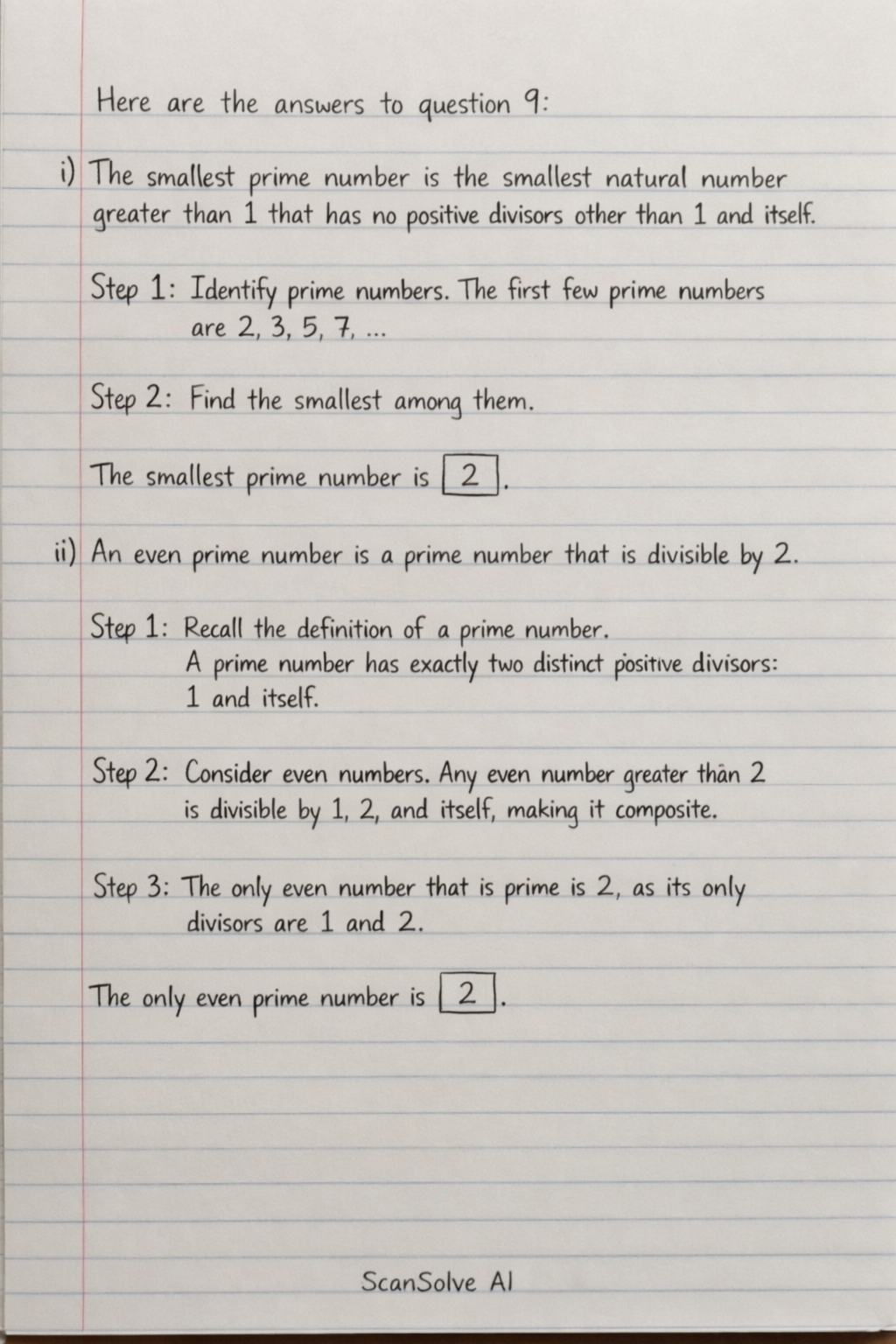
9 stepsHere are the answers to question 9:
- i) The smallest prime number is the smallest natural number greater than 1 that has no positive divisors other than 1 and itself.
Identify prime numbers.
The first few prime numbers are 2, 3, 5, 7, ...
Find the smallest among them.
The smallest prime number is $\boxed{\text{2}}$.- ii) An even prime number is a prime number that is divisible by 2.
Recall the definition of a prime number.
A prime number has exactly two distinct positive divisors: 1 and itself.
Consider even numbers.
Any even number greater than 2 is divisible by 1, 2, and itself, making it composite.
The only even number that is prime is 2, as its only divisors are 1 and 2.
The only even prime number is $\boxed{\text{2}}$.- iii) The smallest odd prime number is the smallest prime number that is not divisible by 2.
List prime numbers
2, 3, 5, 7, ...
Identify the first odd prime number.
The number 2 is even. The next prime number is 3, which is odd.
The smallest odd prime number is .- iv) The smallest odd composite number is the smallest natural number greater than 1 that is not prime and is not divisible by 2.
List natural numbers greater than 1 and classify them as prime or composite, and even or odd.
- 2 (prime, even)
- 3 (prime, odd)
- 4 (composite, even, )
- 5 (prime, odd)
- 6 (composite, even, )
- 7 (prime, odd)
- 8 (composite, even, )
- 9 (composite, odd, )
Identify the smallest composite number that is also odd.
The first composite numbers are 4, 6, 8, 9, ... The smallest odd number in this list is 9.
The smallest odd composite number is .
Was this helpful?
Still stuck on this one?
Ask a follow-up, and the answer starts from this question.
Got a different question?Ask your own question
More Mathematics Questions
QFind the square root of the following numbers using the Prime Factorisation Method: (i) 729 (ii) 400…QPlease solve the following questions: Q6 (i) Make the largest 4 digit number and smallest 4 digit…QWhich of the following are squares of odd numbers? (i) 484 (ii) 961 (iii) 7396 (iv) 8649 (v) 4225…QWhich of the following numbers are definitely NOT perfect squares and why? (i) 153 (ii) 257 (iii)…QFind the HCF of the following by prime-factorisation method: (i) 36, 60 (ii) 45, 85 (iii) 16, 40…
Browse by topic:Number Theory
Handwritten Step-by-Step Solution
Get this as a handwritten image on WhatsApp — like a tutor wrote it for you.
Try on WhatsApp