We read your photo as:

What are the answers to the following questions: 12. m9 / m2=?, 13. Find the gradient of the line passing through points (0,2) and (1,5). 14. If Q = [50, 30, 60]^T and P = [60, 20, 70]^T, what is Q+P?

Mathematics

ScanSolve AI Answer

Step-by-step solution

12 steps
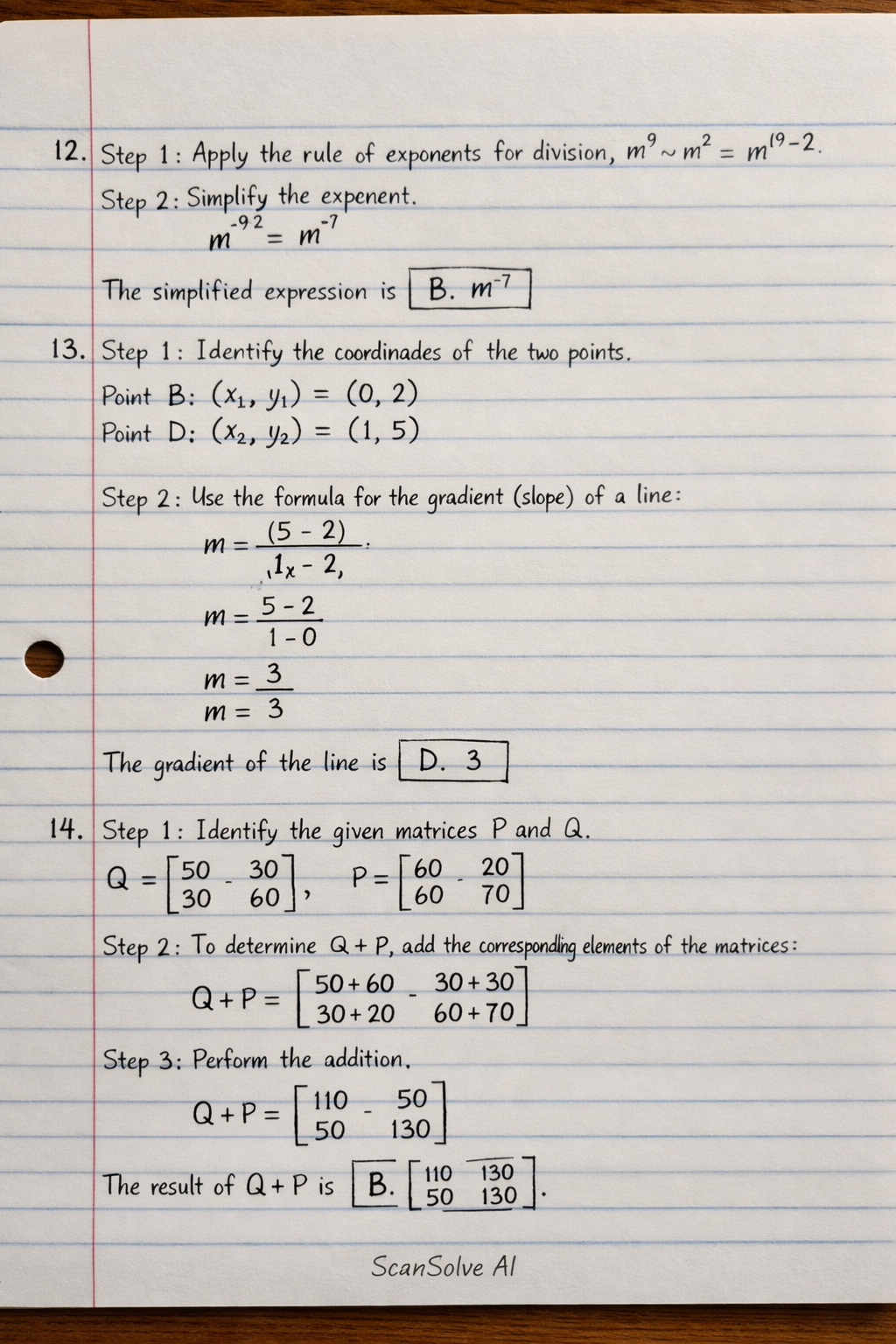
  1. Step 1: Apply the rule of exponents for division, ax÷ay=ax−ya^x \div a^y = a^{x-y}.
m9÷m2=m9−2m^9 \div m^2 = m^{9-2}
  1. Simplify the exponent.

    m9−2=m7m^{9-2} = m^7

    The simplified expression is B. m7\boxed{\text{B. } m^7}.

    1. Step 1: Identify the coordinates of the two points. Point B: (x1,y1)=(0,2)(x_1, y_1) = (0, 2) Point D: (x2,y2)=(1,5)(x_2, y_2) = (1, 5)
  2. Use the formula for the gradient (slope) of a line

    m=y2−y1x2−x1m = \frac{y_2 - y_1}{x_2 - x_1}.

    m=5−21−0m = \frac{5 - 2}{1 - 0}
  3. Calculate the gradient.

    m=31m = \frac{3}{1} m=3m = 3

    The gradient of the line is D. 3\boxed{\text{D. } 3}.

    1. Step 1: Identify the given matrices P and Q.
    Q=[503060],P=[602070]Q = \begin{bmatrix} 50 \\ 30 \\ 60 \end{bmatrix}, \quad P = \begin{bmatrix} 60 \\ 20 \\ 70 \end{bmatrix}
  4. To determine Q+PQ+P, add the corresponding elements of the matrices.

    Q+P=[50+6030+2060+70]Q+P = \begin{bmatrix} 50+60 \\ 30+20 \\ 60+70 \end{bmatrix}
  5. Perform the addition.

    Q+P=[11050130]Q+P = \begin{bmatrix} 110 \\ 50 \\ 130 \end{bmatrix}

    The result of Q+PQ+P is B. [11050130]\boxed{\text{B. } \begin{bmatrix} 110 \\ 50 \\ 130 \end{bmatrix}}.

    1. Step 1: State the given map distance and actual distance. Map distance = 16 cm16 \text{ cm} Actual distance = 640 km640 \text{ km}
  6. Express the scale as a ratio of map distance to actual distance.

    Scale = 16 cm:640 km16 \text{ cm} : 640 \text{ km}

  7. Simplify the ratio so that the map distance is 1 cm1 \text{ cm}.

    Divide both sides by 16.

    1 cm:64016 km1 \text{ cm} : \frac{640}{16} \text{ km} 1 cm:40 km1 \text{ cm} : 40 \text{ km}

    The scale of the map in statement form is 1 cm represents 40 km\boxed{1 \text{ cm represents } 40 \text{ km}}.

    1. Step 1: State the given map distance and actual distance. Map distance = 4 cm4 \text{ cm} Actual distance = 1.2 km1.2 \text{ km}
  8. Convert the actual distance to centimeters to have consistent units for the ratio.

    1 km=1000 m1 \text{ km} = 1000 \text{ m}
    1 m=100 cm1 \text{ m} = 100 \text{ cm}
    So, 1 km=1000×100 cm=100,000 cm1 \text{ km} = 1000 \times 100 \text{ cm} = 100,000 \text{ cm}.
    Actual distance = 1.2 km×100,000 cm/km=120,000 cm1.2 \text{ km} \times 100,000 \text{ cm/km} = 120,000 \text{ cm}.

  9. Express the scale as a ratio of map distance to actual distance.

    Scale = 4 cm:120,000 cm4 \text{ cm} : 120,000 \text{ cm}

  10. Simplify the ratio so that the map distance is 1 cm1 \text{ cm}.

    Divide both sides by 4.

    1 cm:120,0004 cm1 \text{ cm} : \frac{120,000}{4} \text{ cm} 1 cm:30,000 cm1 \text{ cm} : 30,000 \text{ cm}

    The scale of the map is 1:30,000\boxed{1:30,000}.

    1. Step 1: State the given map scale and map distance. Scale = 1:500001:50000 (This means 1 cm1 \text{ cm} on the map represents 50,000 cm50,000 \text{ cm} in actual distance). Map distance = 4 cm4 \text{ cm}
  11. Calculate the actual distance in centimeters.

    Actual distance = Map distance ×\times Scale factor
    Actual distance = 4 cm×50,0004 \text{ cm} \times 50,000
    Actual distance = 200,000 cm200,000 \text{ cm}

  12. Convert the actual distance from centimeters to kilometers.

    1 km=100,000 cm1 \text{ km} = 100,000 \text{ cm}
    Actual distance in km = 200,000 cm100,000 cm/km\frac{200,000 \text{ cm}}{100,000 \text{ cm/km}}
    Actual distance = 2 km2 \text{ km}
    The actual length of the road is 2 km\boxed{2 \text{ km}}.

Was this helpful?

Still stuck on this one?

Ask a follow-up, and the answer starts from this question.

Got a different question?Ask your own question
Handwritten step-by-step solution preview

Handwritten Step-by-Step Solution

Get this as a handwritten image on WhatsApp — like a tutor wrote it for you.

Try on WhatsApp