
We read your photo as:
What are the definitions and examples of approximation error, significant digits, and terminating decimals?
ScanSolve AI Answer
Answers
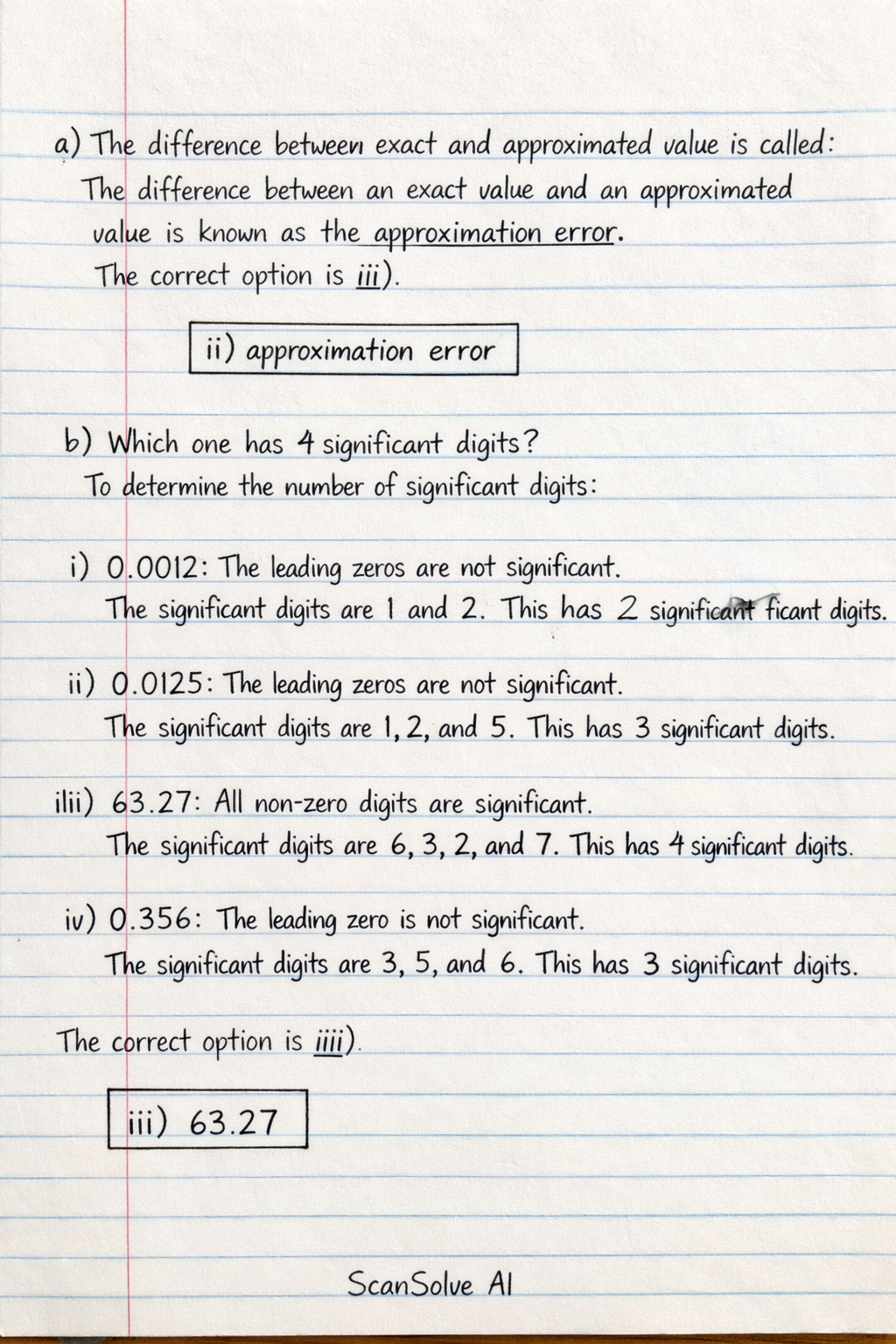
4 partsa) The difference between exact and approximated value is called:
The difference between an exact value and an approximated value is known as the approximation error.
The correct option is ii).
b) Which one has 4 significant digits?
To determine the number of significant digits:
- i) 0.0012: The leading zeros are not significant. The significant digits are 1 and 2. This has 2 significant digits.
- ii) 0.0125: The leading zeros are not significant. The significant digits are 1, 2, and 5. This has 3 significant digits.
- iii) 63.27: All non-zero digits are significant. The significant digits are 6, 3, 2, and 7. This has 4 significant digits.
- iv) 0.356: The leading zero is not significant. The significant digits are 3, 5, and 6. This has 3 significant digits. The correct option is iii).
c) Which fraction shows the terminating decimal?
A fraction represents a terminating decimal if, when simplified, the prime factors of its denominator are only s and s.
- i) : The denominator is 5. Since 5 is a prime factor, this is a terminating decimal ().
- ii) : The denominator is 13. Since 13 is not 2 or 5, this is a non-terminating, repeating decimal.
- iii) : The denominator is 3. Since 3 is not 2 or 5, this is a non-terminating, repeating decimal ().
- iv) : The denominator is . Since 3 is not 2 or 5, this is a non-terminating, repeating decimal (). The correct option is i).
d) The union of rational and irrational numbers is called:
- Rational numbers are numbers that can be expressed as a fraction where and are integers and .
- Irrational numbers are numbers that cannot be expressed as a simple fraction (e.g., , ). The set of all rational and irrational numbers together forms the set of real numbers. The correct option is iii).
Try one yourself
A new problem that tests the same skill.
Still stuck on this one?
Ask a follow-up, and the answer starts from this question.
More Mathematics Questions
Handwritten Step-by-Step Solution
Get this as a handwritten image on WhatsApp — like a tutor wrote it for you.
Try on WhatsApp