
We read your photo as:
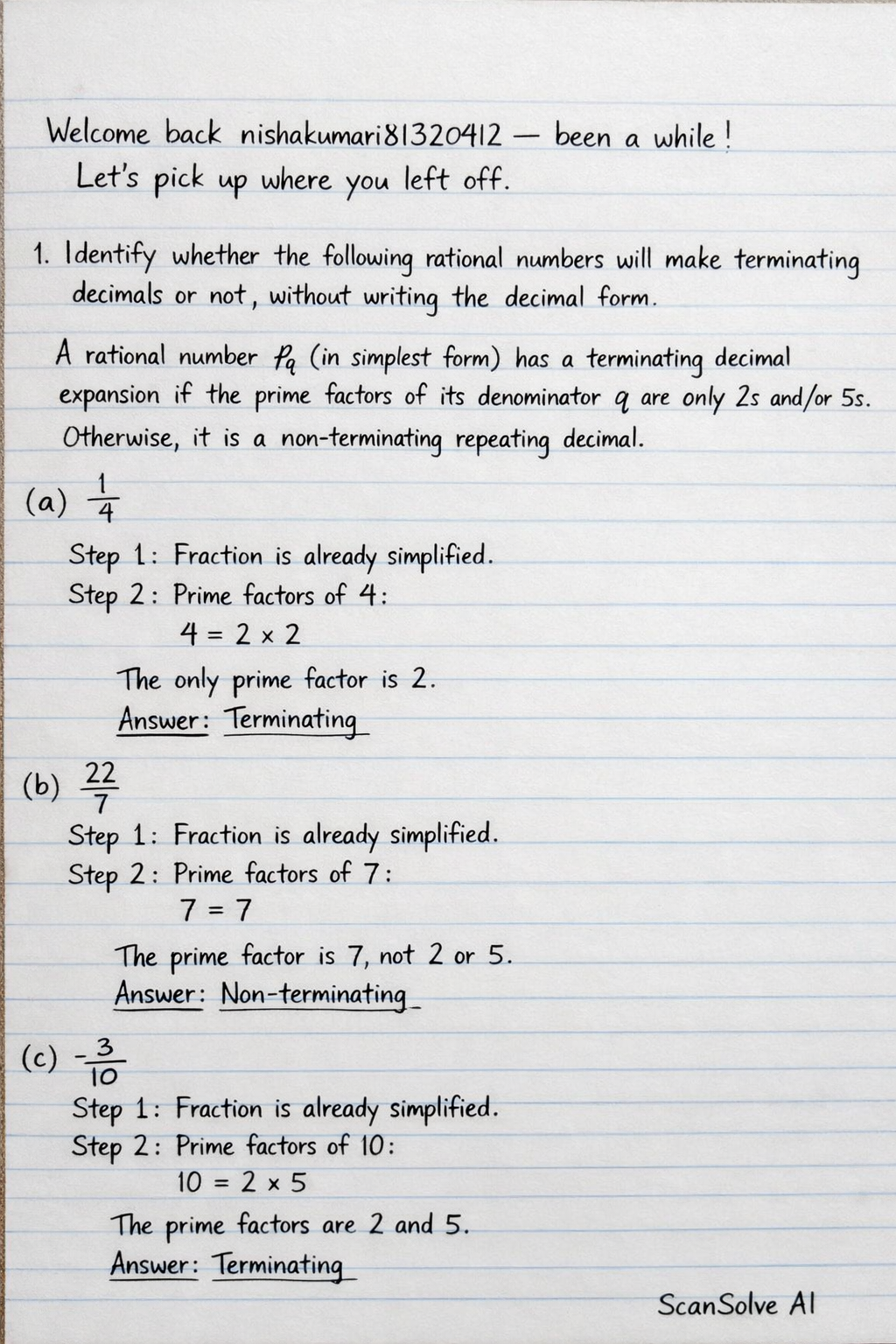
Determine if the following rational numbers will produce terminating decimals without converting them to decimal form:
ScanSolve AI Answer
Step-by-step solution
30 steps1. Identify whether the following rational numbers will make terminating decimals or not, without writing the decimal form.
A rational number (in simplest form) has a terminating decimal expansion if the prime factors of its denominator are only 2s and/or 5s. Otherwise, it is a non-terminating repeating decimal.
a)
Simplify the fraction (already in simplest form).
Find the prime factors of the denominator.
The only prime factor is 2.
Answer: Terminatingb)
Simplify the fraction (already in simplest form).
Find the prime factors of the denominator.
The prime factor is 7, which is not 2 or 5.
Answer: Non-terminatingc)
Simplify the fraction (already in simplest form).
Find the prime factors of the denominator.
The prime factors are 2 and 5.
Answer: Terminatingd)
Simplify the fraction (already in simplest form).
Find the prime factors of the denominator.
The prime factors include 3, which is not 2 or 5.
Answer: Non-terminatinge)
Simplify the fraction (already in simplest form).
Find the prime factors of the denominator.
The prime factors include 11, which is not 2 or 5.
Answer: Non-terminatingf)
Simplify the fraction (already in simplest form).
Find the prime factors of the denominator.
The only prime factor is 2.
Answer: Terminating2. Express the following rational numbers as terminating decimals.
a)
Simplify the fraction.
Perform the division.
Answer:
b)
Perform the division.
Answer:
c)
Perform the division.
Answer:
d)
Simplify the fraction.
Perform the division.
Answer:
3. Express the following rational numbers as non-terminating decimals. Mark the repeating decimal digits with a bar over them.
a)
Perform the division.
Mark the repeating digit with a bar.
Answer:
b)
Perform the division.
Mark the repeating digit with a bar.
Answer:
c)
Perform the division.
Mark the repeating digit with a bar.
Answer:
d)
Perform the division.
Mark the repeating block of digits with a bar.
Answer:
4. Write a terminating rational number and a non-terminating rational number between and .
Convert the given fractions to decimals to understand the range.
We need numbers between and .
Find a common denominator for the given fractions to identify fractions in between.
The least common multiple of 3 and 4 is 12.
So we are looking for numbers between and . Possible fractions include .
Choose a terminating rational number.
A terminating rational number has a denominator whose prime factors are only 2s and/or 5s.
Let's choose .The denominator is 2, so it's terminating. Its decimal value is .
Terminating rational number: (or )
Choose a non-terminating rational number.
A non-terminating rational number has a denominator with prime factors other than 2s and 5s.
Let's choose .
The denominator is . Since it has a prime factor of 3, it is non-terminating.
Its decimal value is .Non-terminating rational number: (or )
Still stuck on this one?
Ask a follow-up, and the answer starts from this question.
More Mathematics Questions
Handwritten Step-by-Step Solution
Get this as a handwritten image on WhatsApp — like a tutor wrote it for you.
Try on WhatsApp