
We read your photo as:
What are the definitions of additive identity, mantissa, 3rd quadrant, medians, horizontal line, quadratic equation, triangle inequality theorem, and binomial cube expansion?
ScanSolve AI Answer
Step-by-step solution
10 steps-
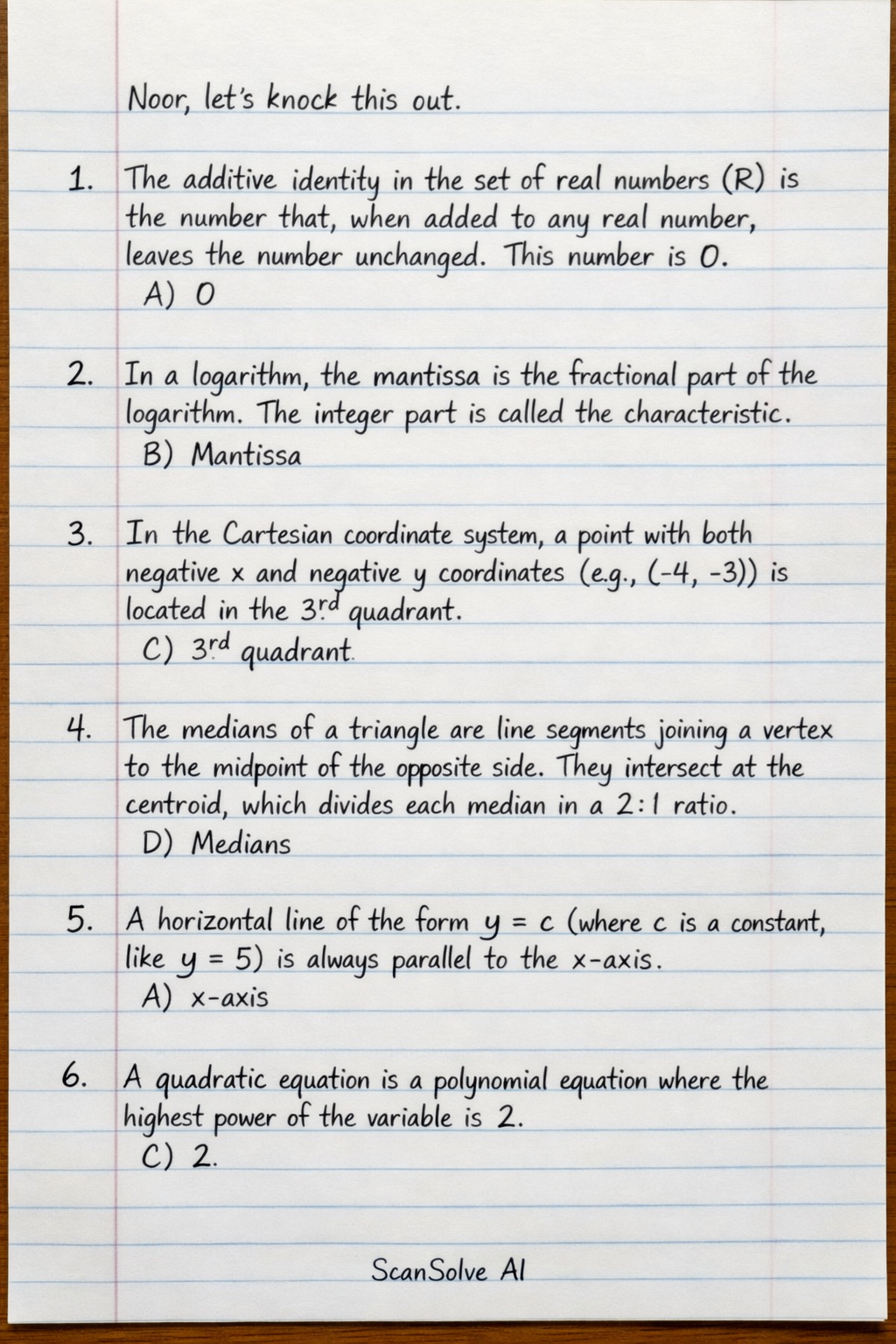
The additive identity in the set of real numbers () is the number that, when added to any real number, leaves the number unchanged. This number is 0.
- A) 0
-
In a logarithm, the mantissa is the fractional part of the logarithm. The integer part is called the characteristic.
- B) Mantissa
-
In the Cartesian coordinate system, a point with both negative x and negative y coordinates (e.g., ) is located in the 3rd quadrant.
- C) 3rd quadrant
-
The medians of a triangle are line segments joining a vertex to the midpoint of the opposite side. They intersect at the centroid, which divides each median in a ratio.
- D) Medians
-
A horizontal line of the form (where is a constant, like ) is always parallel to the x-axis.
- A) x-axis
-
A quadratic equation is a polynomial equation where the highest power of the variable is 2.
- C) 2
-
According to the triangle inequality theorem, the sum of the lengths of any two sides of a triangle must be greater than the length of the third side.
- B) Greater
-
Step 1: Recognize the expression as the expansion of a binomial cube. The formula for is .
Expand the given expression.
$$ a^3 - 3ab(a-b) - b^3 = a^3 - (3a^2b - 3ab^2) - b^3 $$ $$ = a^3 - 3a^2b + 3ab^2 - b^3 $$Compare with the formula.
The expanded form matches $(a-b)^3$. * **B) $(a-b)^3$**9. Step 1: Use the distance formula between two points and :
Substitute the given points and .
$$ D = \sqrt{(0-3)^2 + (3-0)^2} $$ $$ D = \sqrt{(-3)^2 + (3)^2} $$ $$ D = \sqrt{9 + 9} $$ $$ D = \sqrt{18} $$Simplify the radical.
$$ D = \sqrt{9 \times 2} $$ $$ D = 3\sqrt{2} $$ The distance is $3\sqrt{2}$ units. * **C) $3\sqrt{2}$ units**10. Step 1: Convert the logarithmic equation to exponential form. If , then .
Substitute the given values .
$$ x = 10^0 $$Evaluate the exponential expression.
Any non-zero number raised to the power of 0 is 1. $$ x = 1 $$ * **B) 1**11. Step 1: Recognize the expression as a difference of squares. The formula is .
Substitute and .
$$ (4 + \sqrt{14})(4 - \sqrt{14}) = 4^2 - (\sqrt{14})^2 $$ $$ = 16 - 14 $$ $$ = 2 $$ * **A) 2**12. Step 1: Multiply the coefficients and the imaginary units.
Substitute the value of .
Recall that $i^2 = -1$. $$ = 10(-1) $$ $$ = -10 $$ * **A) -10**13. The two coordinate axes (x-axis and y-axis) in a standard Cartesian system are perpendicular to each other, meaning they intersect at an angle of 90 degrees. * B)
- Step 1: Factorize both expressions.
Identify the common and unique factors for the Least Common Multiple (LCM).
The factors are $(x^2 - y^2)$ and $(x^2 + y^2)$. The LCM includes all factors raised to their highest power. $$ \text{LCM} = (x^2 - y^2)(x^2 + y^2) $$Simplify the LCM.
$$ \text{LCM} = x^4 - y^4 $$ * **C) $x^4 - y^4$**15. A surd is an irrational number that can be expressed as a root of an integer. is an irrational number because 5 is not a perfect square. Since it consists of a single term, it is a monomial surd. * A) Monomial surd
Still stuck on this one?
Ask a follow-up, and the answer starts from this question.
More Mathematics Questions
Handwritten Step-by-Step Solution
Get this as a handwritten image on WhatsApp — like a tutor wrote it for you.
Try on WhatsApp