
We read your photo as:
The diagonal and the longer side of a rectangle make an angle of 43.2. If the longer side is 12.6 cm, find the length of the shorter side.
ScanSolve AI Answer
Step-by-step solution
12 stepsHere are the solutions to the problems from the image:
5. The diagonal and the longer side of a rectangle make an angle of 43.2. If the longer side is 12.6 cm, find the length of the shorter side.
Identify the sides and the angle.
Let be the longer side (adjacent to the angle) and be the shorter side (opposite the angle).
Given: cm, .
We use the tangent function:Substitute the given values.
Solve for .
The length of the shorter side is approximately .
6. A rhombus has diagonals of length 12 cm and 7 cm respectively. Find the larger angle of the rhombus.
Understand the properties of a rhombus.
The diagonals of a rhombus bisect each other at right angles. This forms four congruent right-angled triangles. The legs of these triangles are half the lengths of the diagonals.
Half of diagonal 1: cm.
Half of diagonal 2: cm.Find half of the larger angle of the rhombus.
Let be half of the larger angle of the rhombus. In one of the right-angled triangles, is the angle opposite the longer half-diagonal () and adjacent to the shorter half-diagonal ().
Solve for and the larger angle.
The larger angle of the rhombus is .
The larger angle of the rhombus is approximately
\boxed{\text{119.48^\circ}}.7. Find the angle of elevation to the top of a 62 m high building from point A, which is at ground level 155m from its base. What is the angle of depression from the top of the building to A?
Find the angle of elevation.
Let be the height of the building (62 m) and be the distance from point A to the base (155 m). Let be the angle of elevation.
Calculate .
The angle of elevation is approximately
\boxed{\text{21.80^\circ}}.Find the angle of depression.
The angle of depression from the top of the building to point A is equal to the angle of elevation from point A to the top of the building (alternate interior angles).
Therefore, the angle of depression is also approximately\boxed{\text{21.80^\circ}}.8. The angle of depression from the top of a 180 m high vertical cliff to a boat B is 26. Find how far the boat is from the base of the cliff.
Identify the knowns and unknowns.
Let be the height of the cliff (180 m).
Let be the distance from the boat to the base of the cliff (horizontal distance).
The angle of depression from the top of the cliff to the boat is . This means the angle of elevation from the boat to the top of the cliff is also .
We use the tangent function:Set up the equation.
Solve for .
The boat is approximately from the base of the cliff.
Still stuck on this one?
Ask a follow-up, and the answer starts from this question.
More Mathematics Questions
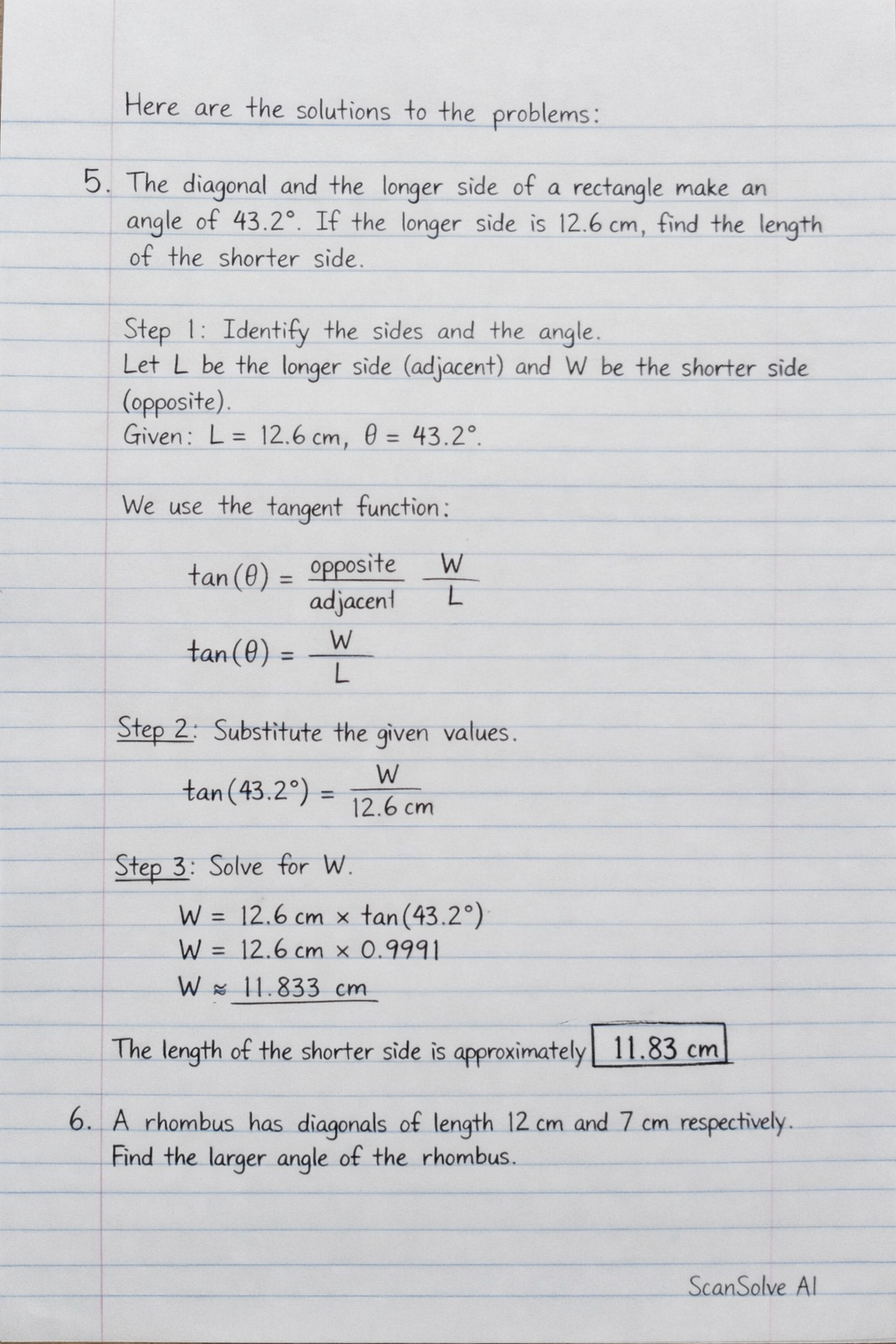
Handwritten Step-by-Step Solution
Get this as a handwritten image on WhatsApp — like a tutor wrote it for you.
Try on WhatsApp