We read your photo as:

The diagram below shows a triangle KMN in which KM = 8km, MN = 10km and angle KMN = 92 degrees. Calculate (i) KN, (ii) the area of triangle KMN, (iii) the shortest distance from M to KN. Solve the equation 2 tan theta = -3 for 0 <= theta <= 180 degrees.

Mathematics

ScanSolve AI Answer

Answers

4 parts
a(i)

KN=13.0 km\text{KN} = 13.0 \text{ km}

a(ii)

Area=40.0 km2\text{Area} = 40.0 \text{ km}^2

a(iii)

h=6.14 kmh = 6.14 \text{ km}

b

θ=123.7∘\theta = 123.7^\circ

Step-by-step solution

11 steps

Part a(i)· 3 steps

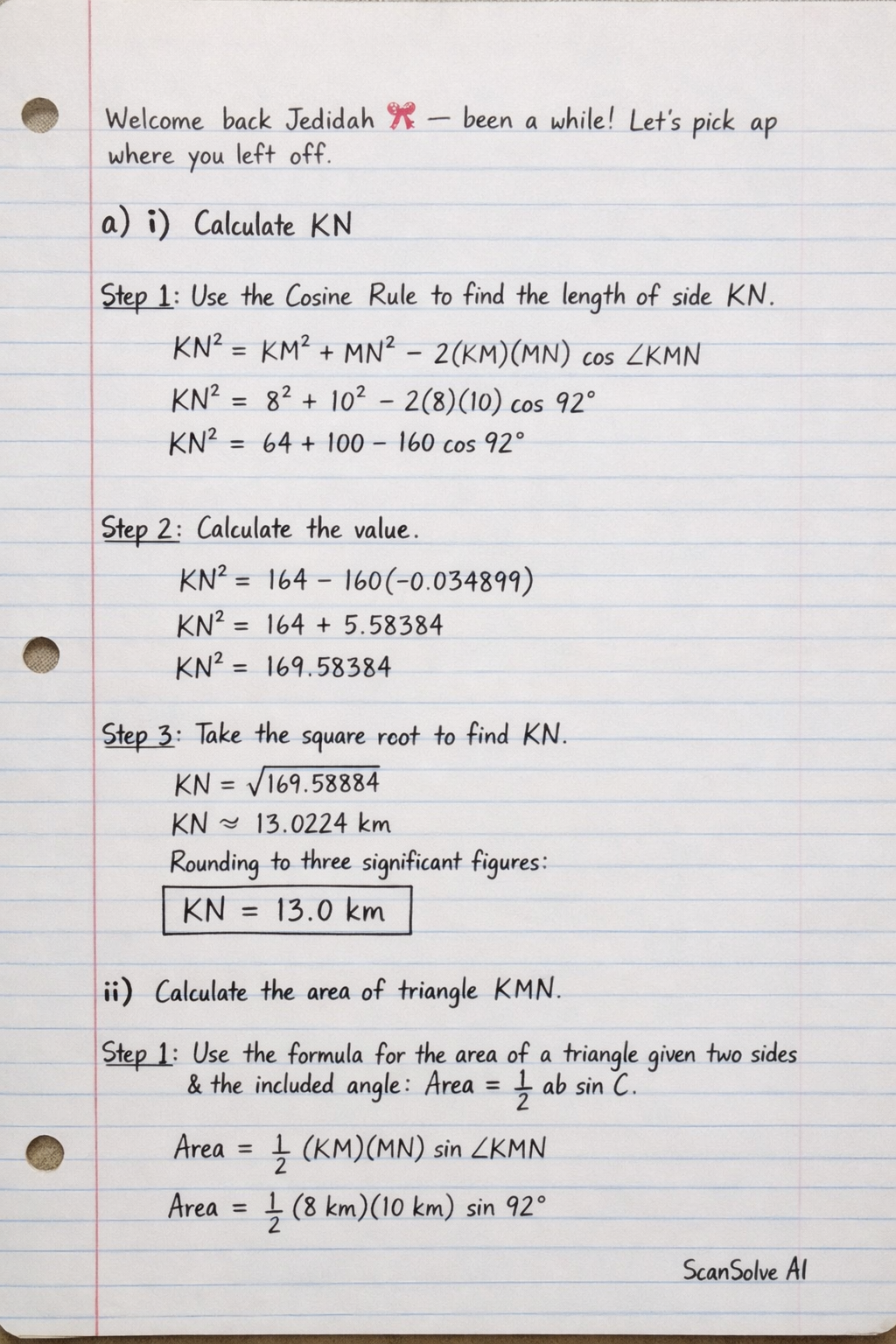
Calculate KN

  1. Use the Cosine Rule to find the length of side KN.

    The Cosine Rule states c2=a2+b2−2abcos⁡Cc^2 = a^2 + b^2 - 2ab \cos C.

    KN2=KM2+MN2−2(KM)(MN)cos⁡(∠KMN)KN^2 = KM^2 + MN^2 - 2(KM)(MN) \cos(\angle KMN) KN2=82+102−2(8)(10)cos⁡(92∘)KN^2 = 8^2 + 10^2 - 2(8)(10) \cos(92^\circ) KN2=64+100−160cos⁡(92∘)KN^2 = 64 + 100 - 160 \cos(92^\circ)
  2. Calculate the value.

    KN2=164−160(−0.034899)KN^2 = 164 - 160(-0.034899) KN2=164+5.58384KN^2 = 164 + 5.58384 KN2=169.58384KN^2 = 169.58384
  3. Take the square root to find KN.

    KN=169.58384KN = \sqrt{169.58384} KN≈13.0224 kmKN \approx 13.0224 \text{ km}

    Rounding to three significant figures:

    KN=13.0 km\boxed{\text{KN} = 13.0 \text{ km}}

Part a(ii)

Area=40.0 km2\text{Area} = 40.0 \text{ km}^2

Calculate the area of triangle KMN

  1. Use the formula for the area of a triangle given two sides and the included angle

    Area =12absin⁡C= \frac{1}{2}ab \sin C.

    Area=12(KM)(MN)sin⁡(∠KMN)\text{Area} = \frac{1}{2} (KM)(MN) \sin(\angle KMN) Area=12(8 km)(10 km)sin⁡(92∘)\text{Area} = \frac{1}{2} (8 \text{ km})(10 \text{ km}) \sin(92^\circ)
  2. Calculate the area.

    Area=40sin⁡(92∘)\text{Area} = 40 \sin(92^\circ) Area=40×0.99939\text{Area} = 40 \times 0.99939 Area≈39.9756 km2\text{Area} \approx 39.9756 \text{ km}^2

    Rounding to three significant figures:

    Area=40.0 km2\boxed{\text{Area} = 40.0 \text{ km}^2}

Part a(iii)

h=6.14 kmh = 6.14 \text{ km}

Calculate the shortest distance from M to KN

  1. The shortest distance from a point to a line is the perpendicular height.

    Use the area formula: Area =12×base×height= \frac{1}{2} \times \text{base} \times \text{height}.

    Area=12×KN×h\text{Area} = \frac{1}{2} \times KN \times h 39.9756 km2=12×13.0224 km×h39.9756 \text{ km}^2 = \frac{1}{2} \times 13.0224 \text{ km} \times h
  2. Solve for hh.

    h=2×39.975613.0224h = \frac{2 \times 39.9756}{13.0224} h≈6.1394 kmh \approx 6.1394 \text{ km}

    Rounding to three significant figures:

    h=6.14 km\boxed{h = 6.14 \text{ km}}

Part b

θ=123.7∘\theta = 123.7^\circ

Solve the equation 2tan⁡θ=−32 \tan \theta = -3 for 0∘≤θ≤180∘0^\circ \le \theta \le 180^\circ

  1. Isolate tan⁡θ\tan \theta.

    2tan⁡θ=−32 \tan \theta = -3 tan⁡θ=−32\tan \theta = -\frac{3}{2} tan⁡θ=−1.5\tan \theta = -1.5
  2. Find the reference angle, α\alpha, using the absolute value of tan⁡θ\tan \theta.

    α=arctan⁡(1.5)\alpha = \arctan(1.5) α≈56.3099∘\alpha \approx 56.3099^\circ
  3. Determine the quadrant for θ\theta.

    Since tan⁡θ\tan \theta is negative and the range is 0∘≤θ≤180∘0^\circ \le \theta \le 180^\circ, θ\theta must be in the second quadrant.

  4. Calculate θ\theta in the second quadrant.

    θ=180∘−α\theta = 180^\circ - \alpha θ=180∘−56.3099∘\theta = 180^\circ - 56.3099^\circ θ=123.6901∘\theta = 123.6901^\circ

    Rounding to one decimal place:

    θ=123.7∘\boxed{\theta = 123.7^\circ}
Was this helpful?

Try one yourself

A new problem that tests the same skill.

Still stuck on this one?

Ask a follow-up, and the answer starts from this question.

Got a different question?Ask your own question
Handwritten step-by-step solution preview

Handwritten Step-by-Step Solution

Get this as a handwritten image on WhatsApp — like a tutor wrote it for you.

Try on WhatsApp