
We read your photo as:
The diagram shows two angles on a straight line. a) Find the value of a. b) Find the perimeter of the following triangle. c) The area of this trapezium is 6000 cm², find the second parallel length.
ScanSolve AI Answer
Answers
2 partsStep-by-step solution
10 stepsStep 1: Set up the equation for angles on a straight line.
Angles on a straight line sum to .
Step 2: Combine like terms.
Step 3: Isolate the term with .
Step 4: Solve for .
The value of is .
Part b· 4 steps
Find the perimeter of the following triangle.
Identify the properties of the triangle.
The triangle is isosceles, with a base of and a height of . The height bisects the base, forming two right-angled triangles.
Calculate the base of one right-angled triangle.
The base of each right-angled triangle is .
Use the Pythagorean theorem to find the length of the equal sides.
Let be the length of the equal sides.
Calculate the perimeter of the triangle.
Perimeter = base + side + side
Perimeter =
Perimeter =
The perimeter of the triangle is .
Part c
The area of this trapezium is , find the second parallel length.
Identify the given values for the trapezium.
Area () =
One parallel length () =
Height () =
Let the second parallel length be .Write the formula for the area of a trapezium.
Substitute the known values into the formula.
Simplify the equation.
Isolate the term with .
Solve for .
The calculated second parallel length is .
Note: A physical length cannot be negative. This indicates a potential inconsistency in the problem's given values.
Try one yourself
A new problem that tests the same skill.
Still stuck on this one?
Ask a follow-up, and the answer starts from this question.
More Mathematics Questions
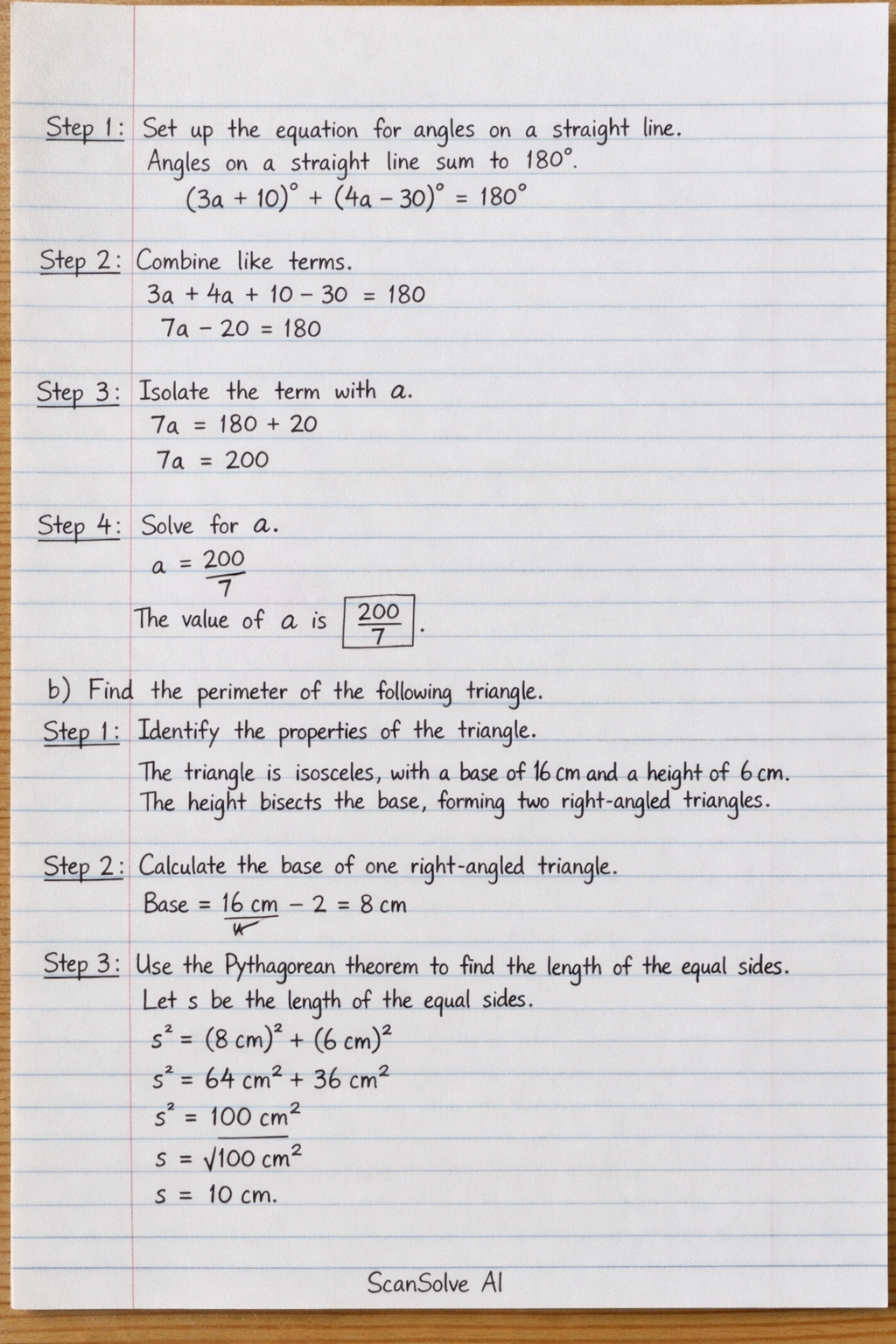
Handwritten Step-by-Step Solution
Get this as a handwritten image on WhatsApp — like a tutor wrote it for you.
Try on WhatsApp