We read your photo as:

The equations of two sides of a square are y = 3x−1 and x+3y−6=0. If (0,-1) is one vertex of the square find the coordinates of the other vertices.

Mathematics

ScanSolve AI Answer

Answer

Q=(910,1710)Q = \left(\frac{9}{10}, \frac{17}{10}\right)

R=(−95,135)R = \left(-\frac{9}{5}, \frac{13}{5}\right)

S=(−2710,−110)S = \left(-\frac{27}{10}, -\frac{1}{10}\right)

Graph of y = 3x − 1

Use the left and right arrow keys to trace the curve, up and down to jump between key points, and plus and minus to zoom.

Key points of y = 3x − 1
Pointxy
y-intercept0−1
x-intercept0.330

Step-by-step solution

5 steps
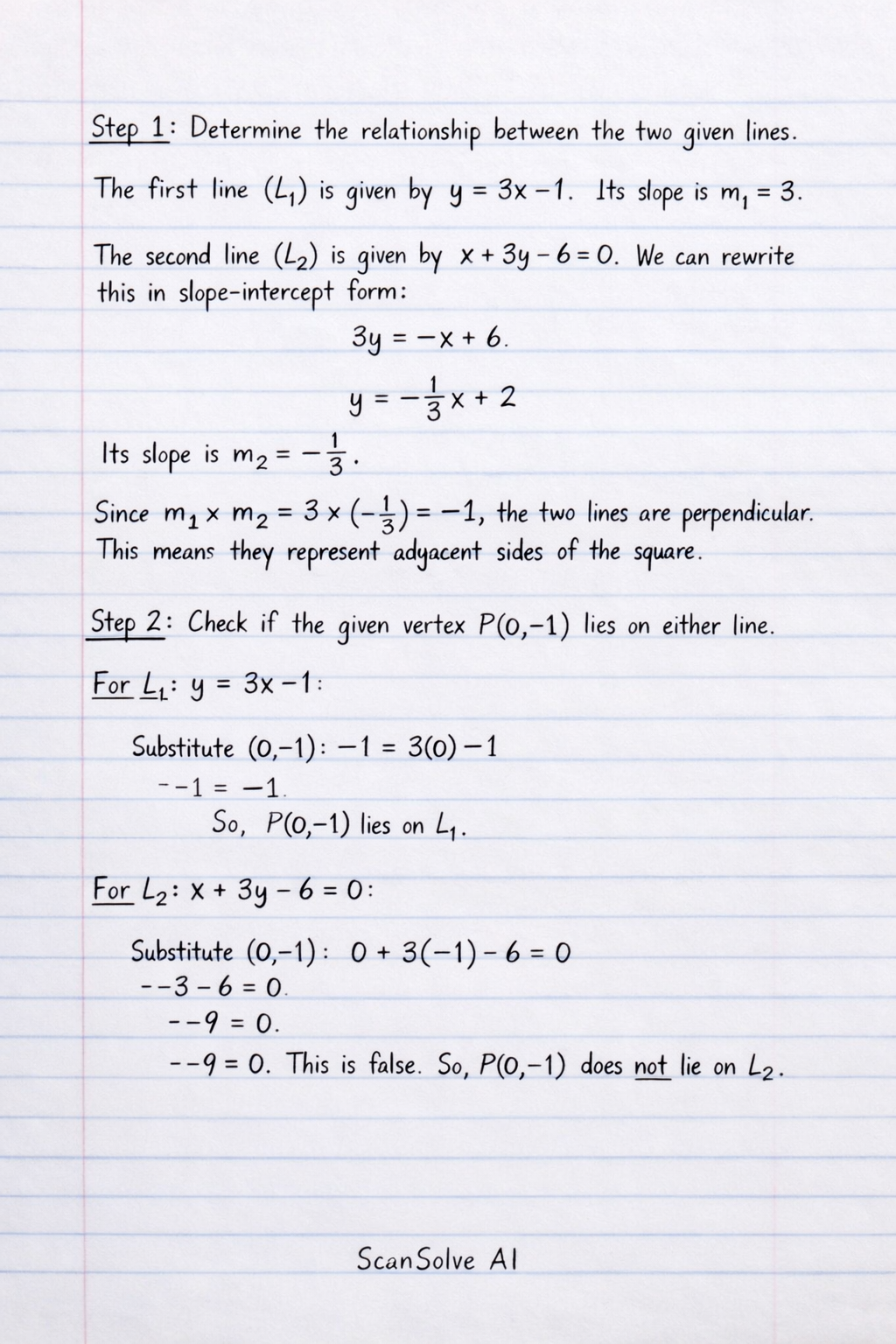
  1. Determine the relationship between the two given lines.

    The first line (L1L_1) is given by y=3x−1y = 3x - 1. Its slope is m1=3m_1 = 3.
    The second line (L2L_2) is given by x+3y−6=0x + 3y - 6 = 0. We can rewrite this in slope-intercept form:

    3y=−x+63y = -x + 6 y=−13x+2y = -\frac{1}{3}x + 2

    Its slope is m2=−13m_2 = -\frac{1}{3}.
    Since m1×m2=3×(−13)=−1m_1 \times m_2 = 3 \times \left(-\frac{1}{3}\right) = -1, the two lines are perpendicular. This means they represent adjacent sides of the square.

  2. Check if the given vertex P(0,−1)P(0, -1) lies on either line.

    For L1:y=3x−1L_1: y = 3x - 1:
    Substitute (0,−1)(0, -1): −1=3(0)−1  ⟹  −1=−1-1 = 3(0) - 1 \implies -1 = -1. So, P(0,−1)P(0, -1) lies on L1L_1.
    For L2:x+3y−6=0L_2: x + 3y - 6 = 0:
    Substitute (0,−1)(0, -1): 0+3(−1)−6=0  ⟹  −3−6=0  ⟹  −9=00 + 3(-1) - 6 = 0 \implies -3 - 6 = 0 \implies -9 = 0. This is false. So, P(0,−1)P(0, -1) does not lie on L2L_2.

  3. Find the intersection point of L1L_1 and L2L_2.

    This point, let's call it QQ, is another vertex of the square.
    Substitute y=3x−1y = 3x - 1 from L1L_1 into the equation for L2L_2:

    x+3(3x−1)−6=0x + 3(3x - 1) - 6 = 0 x+9x−3−6=0x + 9x - 3 - 6 = 0 10x−9=010x - 9 = 0 10x=9  ⟹  x=91010x = 9 \implies x = \frac{9}{10}

    Now substitute x=910x = \frac{9}{10} back into y=3x−1y = 3x - 1:

    y=3(910)−1=2710−1010=1710y = 3\left(\frac{9}{10}\right) - 1 = \frac{27}{10} - \frac{10}{10} = \frac{17}{10}

    So, the second vertex is Q=(910,1710)Q = \left(\frac{9}{10}, \frac{17}{10}\right).
    Since PP lies on L1L_1 and QQ is the intersection of L1L_1 and L2L_2, PP and QQ are adjacent vertices, and the side PQPQ lies on L1L_1.

  4. Calculate the side length of the square.

    The side length ss is the distance between P(0,−1)P(0, -1) and Q(910,1710)Q\left(\frac{9}{10}, \frac{17}{10}\right).

    s=(910−0)2+(1710−(−1))2s = \sqrt{\left(\frac{9}{10} - 0\right)^2 + \left(\frac{17}{10} - (-1)\right)^2} s=(910)2+(1710+1010)2s = \sqrt{\left(\frac{9}{10}\right)^2 + \left(\frac{17}{10} + \frac{10}{10}\right)^2} s=(910)2+(2710)2s = \sqrt{\left(\frac{9}{10}\right)^2 + \left(\frac{27}{10}\right)^2} s=81100+729100s = \sqrt{\frac{81}{100} + \frac{729}{100}} s=810100=8110=910s = \sqrt{\frac{810}{100}} = \sqrt{\frac{81}{10}} = \frac{9}{\sqrt{10}}
  5. Find the coordinates of the other two vertices, RR and SS.

    Let the vertices of the square be P,Q,R,SP, Q, R, S in counter-clockwise order.
    We have P=(0,−1)P = (0, -1) and Q=(910,1710)Q = \left(\frac{9}{10}, \frac{17}{10}\right).
    The vector PQ⃗=Q−P=(910−0,1710−(−1))=(910,2710)\vec{PQ} = Q - P = \left(\frac{9}{10} - 0, \frac{17}{10} - (-1)\right) = \left(\frac{9}{10}, \frac{27}{10}\right).
    The side QRQR is perpendicular to PQPQ and lies on L2L_2. A vector perpendicular to (a,b)(a, b) is (−b,a)(-b, a) (for counter-clockwise rotation).
    So, QR⃗=(−2710,910)\vec{QR} = \left(-\frac{27}{10}, \frac{9}{10}\right). (The slope of this vector is 9/10−27/10=−13\frac{9/10}{-27/10} = -\frac{1}{3}, which matches L2L_2).

    The third vertex RR is Q+QR⃗Q + \vec{QR}:

    R=(910,1710)+(−2710,910)R = \left(\frac{9}{10}, \frac{17}{10}\right) + \left(-\frac{27}{10}, \frac{9}{10}\right) R=(9−2710,17+910)R = \left(\frac{9 - 27}{10}, \frac{17 + 9}{10}\right) R=(−1810,2610)=(−95,135)R = \left(-\frac{18}{10}, \frac{26}{10}\right) = \left(-\frac{9}{5}, \frac{13}{5}\right)

    The fourth vertex SS can be found by adding QR⃗\vec{QR} to PP, since PS⃗=QR⃗\vec{PS} = \vec{QR} (opposite sides of a square are parallel and equal in length).

    S=P+QR⃗S = P + \vec{QR} S=(0,−1)+(−2710,910)S = (0, -1) + \left(-\frac{27}{10}, \frac{9}{10}\right) S=(−2710,−1+910)S = \left(-\frac{27}{10}, -1 + \frac{9}{10}\right) S=(−2710,−1010+910)=(−2710,−110)S = \left(-\frac{27}{10}, -\frac{10}{10} + \frac{9}{10}\right) = \left(-\frac{27}{10}, -\frac{1}{10}\right)

    The coordinates of the other vertices are:
    Q=(910,1710)Q = \boxed{\left(\frac{9}{10}, \frac{17}{10}\right)}
    R=(−95,135)R = \boxed{\left(-\frac{9}{5}, \frac{13}{5}\right)}
    S=(−2710,−110)S = \boxed{\left(-\frac{27}{10}, -\frac{1}{10}\right)}

Was this helpful?

Try one yourself

A new problem that tests the same skill.

Still stuck on this one?

Ask a follow-up, and the answer starts from this question.

Got a different question?Ask your own question
Handwritten step-by-step solution preview

Handwritten Step-by-Step Solution

Get this as a handwritten image on WhatsApp — like a tutor wrote it for you.

Try on WhatsApp