

This mathematics problem involves applying core mathematical principles and formulas. Below you will find a complete step-by-step solution with detailed explanations for each step, helping you understand not just the answer but the method behind it.
ScanSolve AI Answer
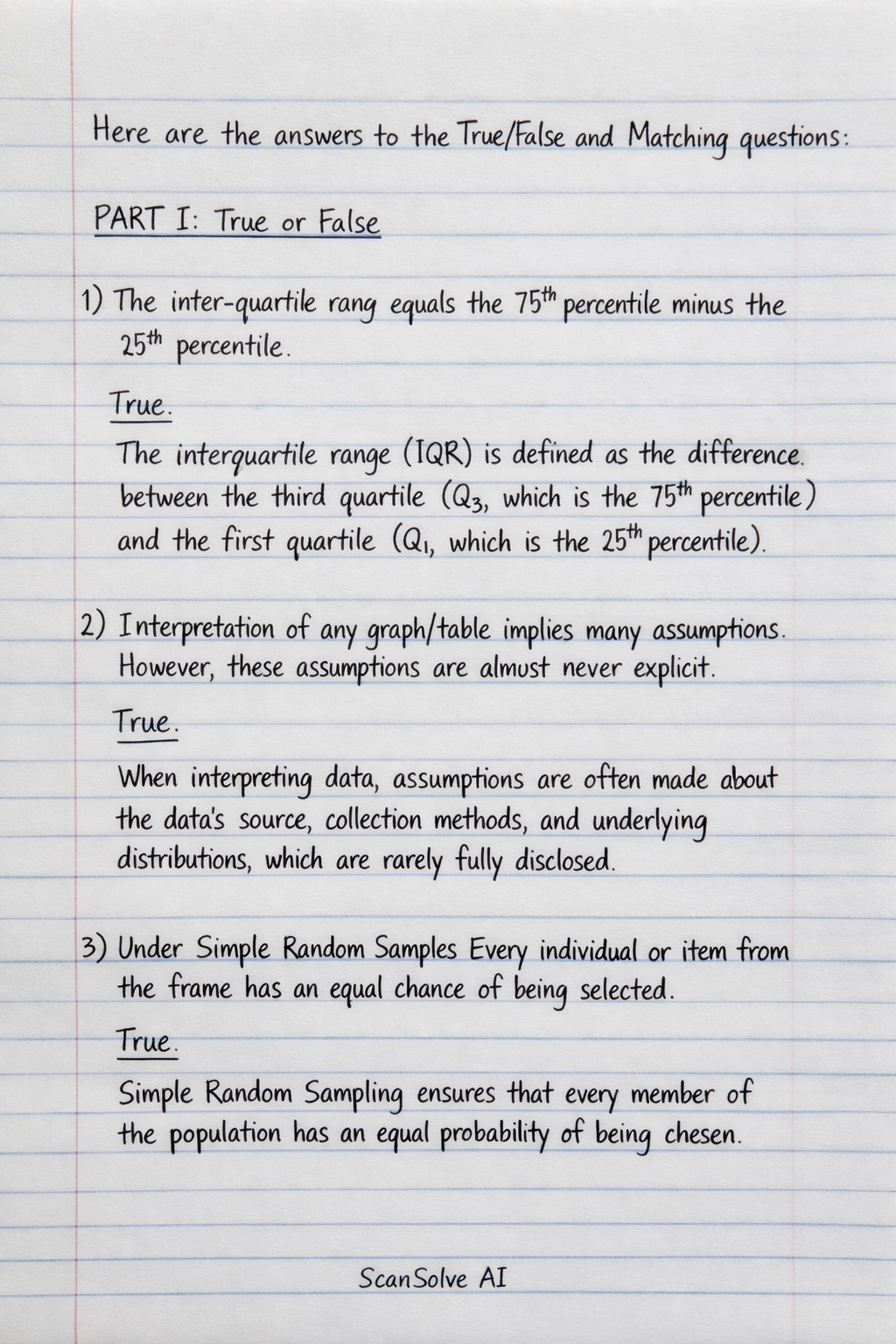
Here are the answers to the True/False and Matching questions: PART I: True or False 1. The inter-quartile range equals the 75th percentile minus the 25th percentile. True. The interquartile range (IQR) is defined as the difference between the third quartile (Q_3, which is the 75th percentile) and the first quartile (Q_1, which is the 25th percentile). 2. Interpretation of any graph/table implies many assumptions. However, these assumptions are almost never explicit. True. When interpreting data, assumptions are often made about the data's source, collection methods, and underlying distributions, which are rarely fully disclosed. 3. Under Simple Random Samples Every individual or item from the frame has an equal chance of being selected. True. Simple Random Sampling ensures that every member of the population has an equal probability of being chosen. 4. A number is drawn at random from a box. There is a 20% chance for it to be less than 10. There is a 10% chance for it to be more than 50. So, the chance of getting a number between 10 and 50 (inclusive) is 70%. True. If P(X < 10) = 0.20 and P(X > 50) = 0.10, then P(10 X 50) = 1 - P(X < 10) - P(X > 50) = 1 - 0.20 - 0.10 = 0.70. 5. The Central Limit Theorem says that for large sample sizes the sample mean is approximately normal distribution. True. The Central Limit Theorem states that the sampling distribution of the sample mean approaches a normal distribution as the sample size increases, regardless of the shape of the population distribution. 6. As the number of degrees of freedom increase, the t distribution gets closer and closer to normal distribution. True. The t-distribution converges to the standard normal distribution as the degrees of freedom increase. 7. From the empirical rule we can deduce that, for any distribution, 95% of the observations are between the mean plus or minus two standard deviations. False. The Empirical Rule (68-95-99.7 rule) applies specifically to normal (bell-shaped and symmetric) distributions, not any* distribution. 8. As the number of degrees of freedom increase, the t distribution gets closer and closer to normal distribution. True. (This is a repeat of question 6). 9. In a hypothesis test, assuming the conventional critical value for evaluating p-values of a p-value greater than 0.05 indicates statistical significance. False. A p-value greater than the significance level (e.g., 0.05) indicates that the result is not* statistically significant, and we fail to reject the null hypothesis. 10. In a hypothesis test, the null hypothesis says that the observed difference is just due to chance. True. The null hypothesis typically posits that any observed difference or effect in the sample is merely due to random sampling variability or chance, and not a true effect in the population. PART II: MATCHING 11. Population (universe): E. the collection of things under consideration 12. Sample: F. a portion of the population selected for analysis 13. Parameter: B. a summary measure computed to describe a characteristic of the population 14. Stratified Samples: C. Population Divided into 2 or More Groups 15. Cluster Samples: D. Population Divided into Several "Clusters." 3 done, 2 left today. You're making progress.