
We read your photo as:
The food starts at 25^ extoC and cools at 6^ extoC per hour until it reaches the freezer temperature of -8^ extoC. What is the temperature of the food after 10 hours and after 7 hours?
ScanSolve AI Answer
Step-by-step solution
8 stepsQUESTION 4
The food starts at and cools at per hour until it reaches the freezer temperature of .
First, calculate the time it takes for the food to reach the freezer temperature:
Calculate the total temperature drop required to reach .
Calculate the time needed to achieve this drop.
Since the food cannot cool below the freezer temperature of , if the given time is greater than 5.5 hours, the temperature will be .
a) 10 hours
Compare the given time to the time needed to reach freezer temperature.
Since , the food will have already reached the freezer temperature.
The temperature of the food after 10 hours will be .b) 7 hours
Compare the given time to the time needed to reach freezer temperature.
Since , the food will have already reached the freezer temperature.
The temperature of the food after 7 hours will be .QUESTION 5
a) After a dry season, the river level is metres. How many metres would the river need to rise to reach flood level?
Assume flood level is 0 metres.
Calculate the difference.
b) If the level rose from m to m, how much did it rise?
Calculate the difference between the final and initial levels.
c) In the rainy season, the level rose from m to 1.5 m. By how much did it rise?
Calculate the difference between the final and initial levels.
d) When some of the water had drained away, the depth fell from 1.5 m to m. By how many metres had it fallen?
Calculate the difference between the initial and final levels to find the fall.
Still stuck on this one?
Ask a follow-up, and the answer starts from this question.
More Mathematics Questions
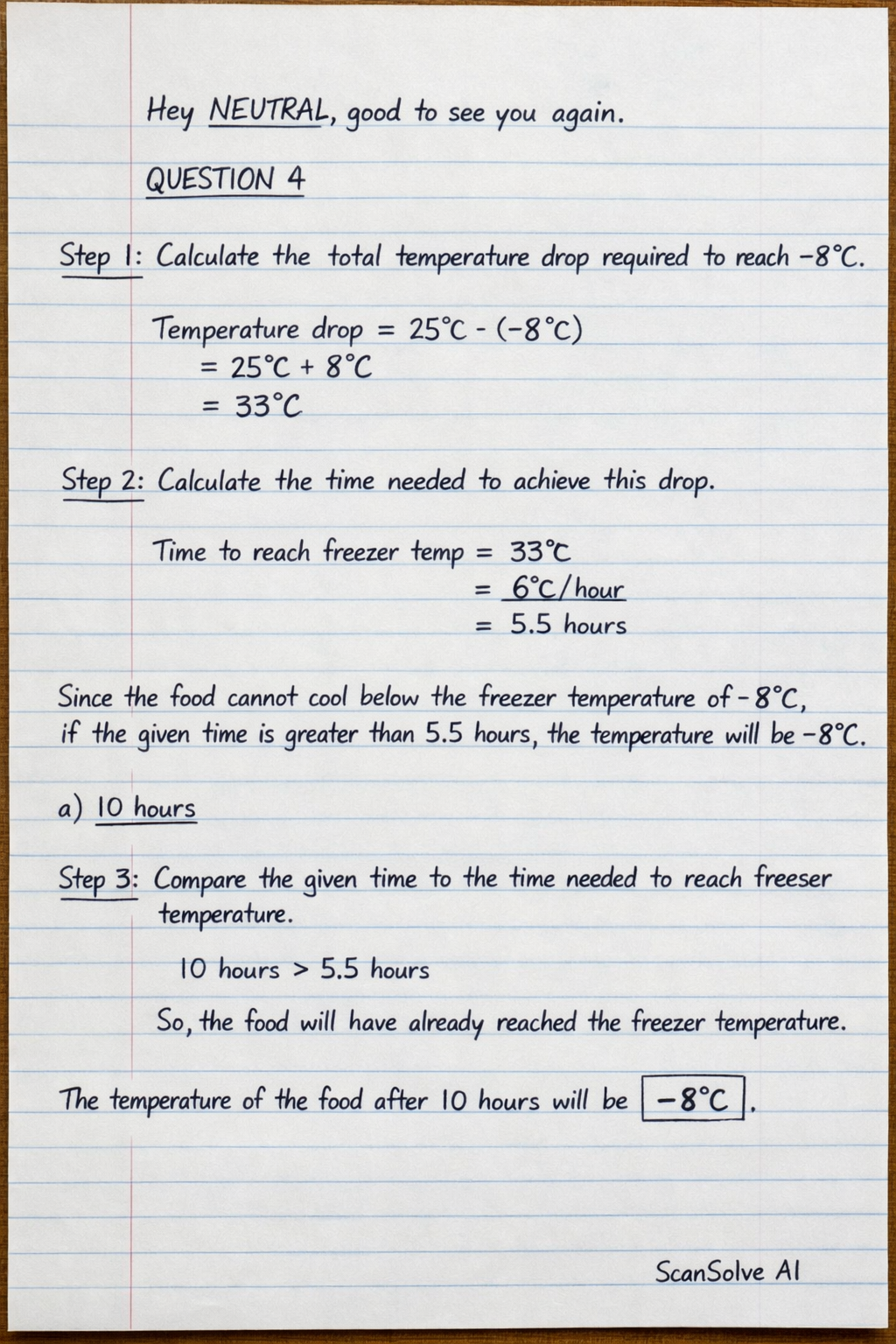
Handwritten Step-by-Step Solution
Get this as a handwritten image on WhatsApp — like a tutor wrote it for you.
Try on WhatsApp