
We read your photo as:
The temperature of a solution was recorded as 24^ exto extC. The solution was cooled by 12^ exto extC then warmed by 3^ exto extC. By what temperature was the solution warmed?
ScanSolve AI Answer
Step-by-step solution
19 stepsHere are the solutions to the problems:
1. The temperature of a solution was recorded as . The solution was cooled by then warmed by . By what temperature was the solution warmed? (2mk)
Identify the initial temperature and changes.
Initial temperature
Cooled by
Warmed byCalculate the temperature after cooling.
Calculate the final temperature after warming.
Determine the total warming.
The question asks "By what temperature was the solution warmed?". This refers to the net change from the initial temperature to the final temperature, if the final temperature is higher than the initial. However, the wording "warmed by " already states the warming amount. If the question implies the net change in temperature, we calculate the difference between the final and initial temperatures.
Net change in temperatureThis means the solution was effectively cooled by from its initial state.
If the question is asking for the amount of warming that occurred, it is explicitly stated as . Given the context of temperature changes, it's more likely asking for the final temperature or the net change. Assuming it asks for the net change from the initial temperature:The solution was effectively cooled by . If the question is asking for the final temperature, it is . If it's asking for the net change from the initial temperature, it's . The phrasing "By what temperature was the solution warmed?" is ambiguous. If it means the net warming, then it's (i.e., it was cooled). If it means the specific warming step, it's . Given the context of a multi-step problem, it's likely asking for the final temperature or the net change. Let's assume it asks for the final temperature.
Final temperature:
2. Without using a scientific calculator, evaluate: (2mk)
Evaluate the expressions inside the parentheses.
Substitute these values back into the expression.
Perform the multiplication.
Perform the division.
Perform the subtraction.
The evaluated expression is .
3. In a science competition, a student receives 5 points for every correct answer and -2 points for every incorrect answer. If a student answers 10 questions correctly and 6 incorrectly, find the total score. (2mk)
Calculate points from correct answers.
Points per correct answer
Number of correct answers
Points from correct answersCalculate points from incorrect answers.
Points per incorrect answer
Number of incorrect answers
Points from incorrect answersCalculate the total score.
Total score
Total scoreThe total score is .
4. A grade nine learner formed a number by arranging the first four composite numbers in ascending order. What is the number formed? (2mk)
Identify composite numbers.
A composite number is a positive integer that has at least one divisor other than 1 and itself.
The first few positive integers are 1, 2, 3, 4, 5, 6, 7, 8, 9, 10...- 1 is neither prime nor composite.
- 2 is prime (divisors: 1, 2).
- 3 is prime (divisors: 1, 3).
- 4 is composite (divisors: 1, 2, 4).
- 5 is prime (divisors: 1, 5).
- 6 is composite (divisors: 1, 2, 3, 6).
- 7 is prime (divisors: 1, 7).
- 8 is composite (divisors: 1, 2, 4, 8).
- 9 is composite (divisors: 1, 3, 9).
List the first four composite numbers in ascending order.
The first composite number is 4.
The second composite number is 6.
The third composite number is 8.
The fourth composite number is 9.
So, the first four composite numbers in ascending order are 4, 6, 8, 9.Form the number by arranging them in ascending order.
Arranging 4, 6, 8, 9 in ascending order forms the number 4689.
The number formed is .
5. Work out (3mk)
Evaluate the numerator.
Follow the order of operations (PEMDAS/BODMAS). First, perform the division.
Substitute the result back into the numerator.
Evaluate the denominator.
Divide the numerator by the denominator.
The value of the expression is .
Still stuck on this one?
Ask a follow-up, and the answer starts from this question.
More Mathematics Questions
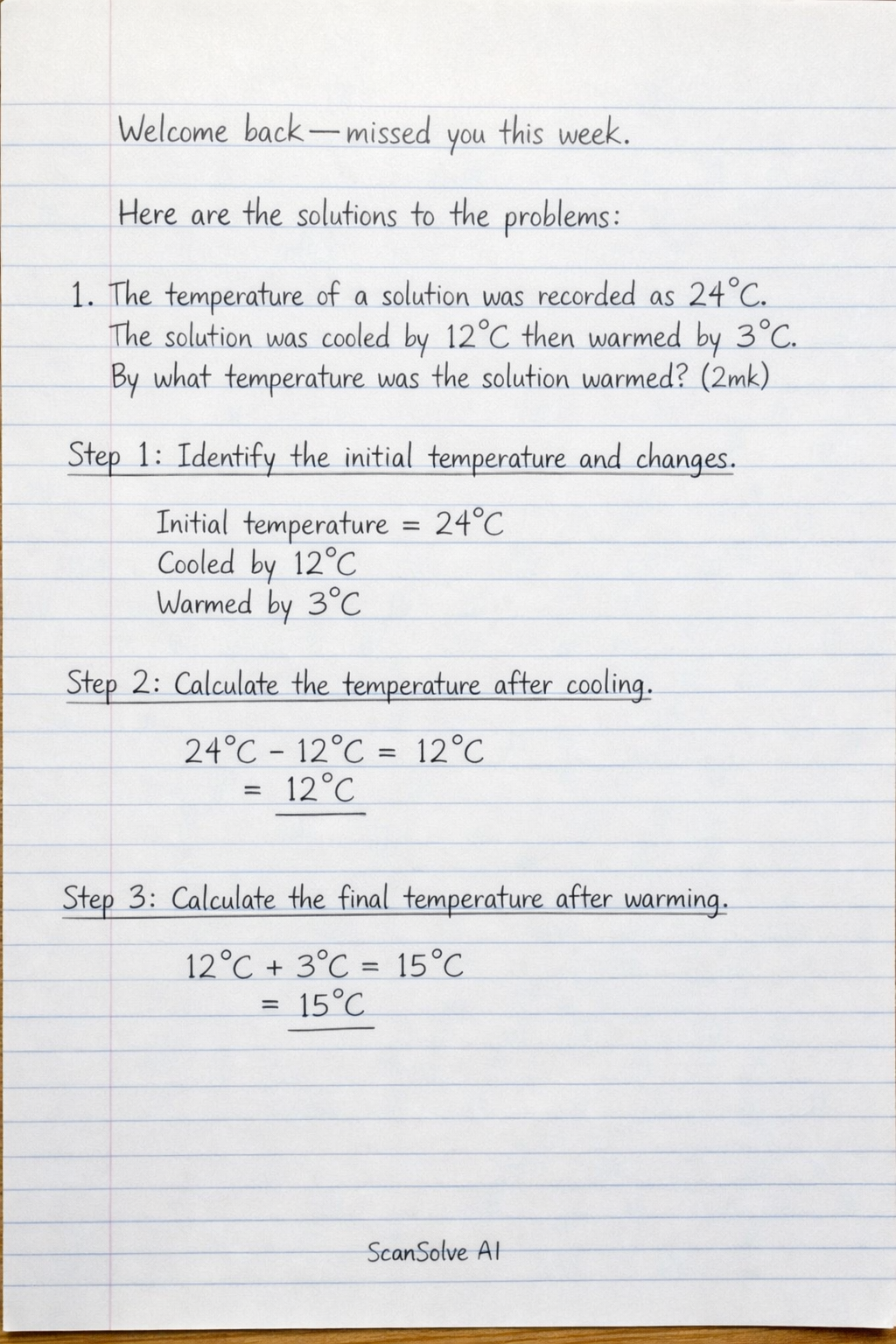
Handwritten Step-by-Step Solution
Get this as a handwritten image on WhatsApp — like a tutor wrote it for you.
Try on WhatsApp