
We read your photo as:
A 2.0 imes 10⁻² ext kg ice at 0^ exto extC is dropped into a vacuum bottle originally holding 0.4 ext kg of water at 35^ exto extC. Assuming negligible heat loss or gain by the bottle, determine (a)
ScanSolve AI Answer
Step-by-step solution
13 stepshere are the solutions to questions 6, 7, 8, and 9.
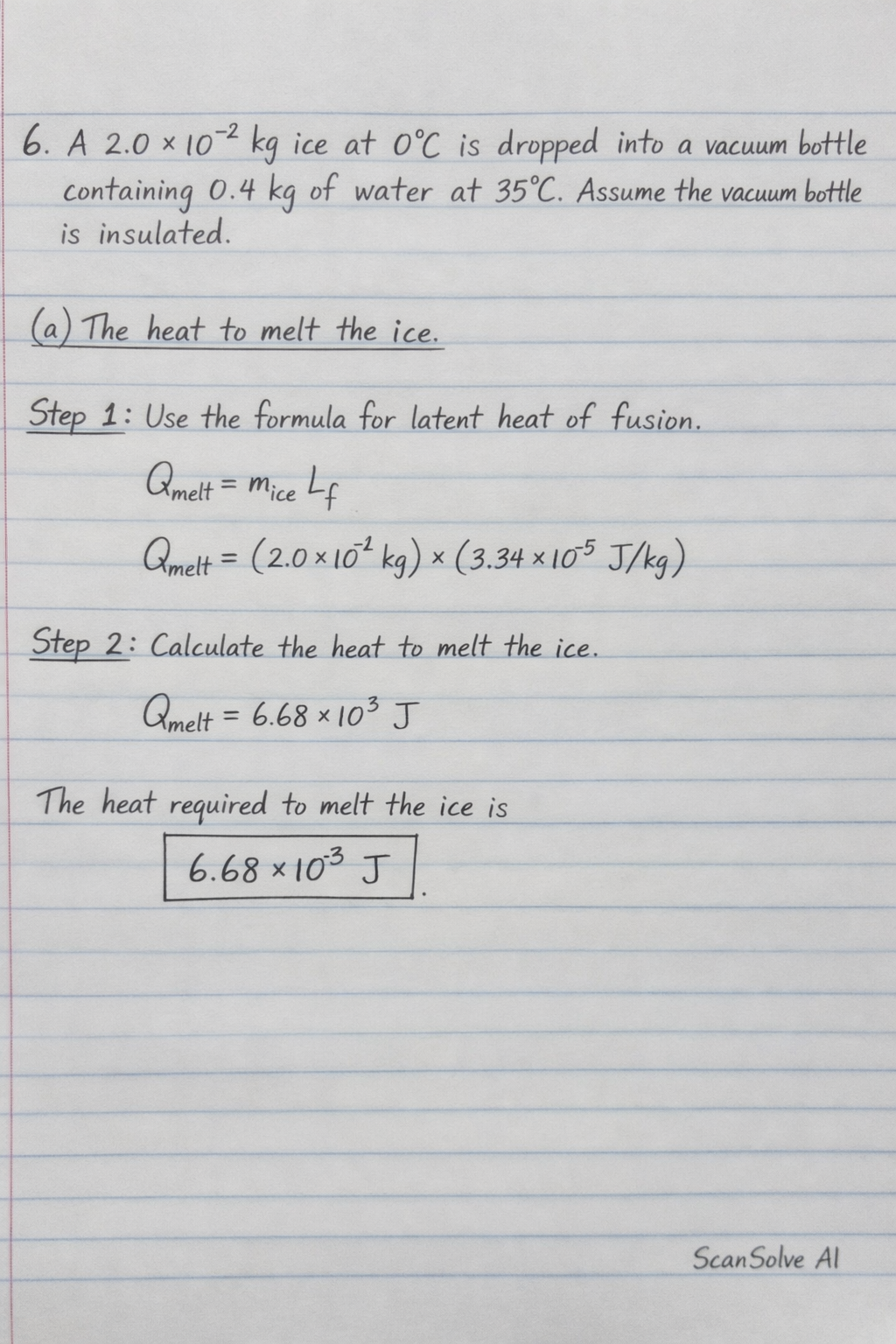
6. A ice at is dropped into a vacuum bottle originally holding of water at . Assuming that any loss or gain of heat by the vacuum bottle is negligible, determine (a) the heat to melt the ice and (b) the final temperature after thermal equilibrium is attained.
Given constants:
- Latent heat of fusion of ice,
- Specific heat capacity of water,
Part a· 2 steps
The heat to melt the ice
Use the formula for latent heat of fusion.
The heat required to melt the ice is given by .
Calculate the heat to melt the ice.
The heat required to melt the ice is .
Part b· 11 steps
The final temperature after thermal equilibrium is attained
Set up the heat exchange equation.
Heat gained by ice (to melt and then warm up as water) = Heat lost by initial water.
Let be the final equilibrium temperature.
Heat gained by ice:
Heat lost by water:Simplify and solve for .
Combine terms with :
The final temperature after thermal equilibrium is attained is approximately .
7. What is the absolute temperature of boiling water and melting ice?
Recall the conversion formula from Celsius to Kelvin.
The absolute temperature (in Kelvin) is found by adding 273.15 to the Celsius temperature: .
Calculate the absolute temperature for melting ice.
Melting ice is at .
Calculate the absolute temperature for boiling water.
Boiling water is at .
The absolute temperature of melting ice is and boiling water is .
8. Determine the temperature whose Fahrenheit and Kelvin scales have the same reading.
Set up the equations for Fahrenheit and Kelvin in terms of Celsius.
Let the temperature be . So, and .
The conversion from Celsius to Fahrenheit is .
The conversion from Celsius to Kelvin is , which means .Substitute into the Fahrenheit equation and set .
Solve for .
Subtract from both sides:
The temperature at which Fahrenheit and Kelvin scales have the same reading is approximately .
9. A scientist uses a scale for measuring temperature. In this scale water melts at , and boils at . The scientist measures the temperature at which sodium melts to be . Express this temperature in Kelvin.
Establish the relationship between the scale and the Kelvin scale using the reference points.
Water melts at or .
Water boils at or .
For the scale: , .
For the Kelvin scale: , .The general formula for converting between two linear temperature scales is:
So, we can write:
Substitute the known values into the conversion formula.
The temperature of sodium melting is .
Solve for .
Multiply both sides by 100:
Add 273.15 to both sides:
The melting temperature of sodium in Kelvin is .
Still stuck on this one?
Ask a follow-up, and the answer starts from this question.
More Physics Questions
Handwritten Step-by-Step Solution
Get this as a handwritten image on WhatsApp — like a tutor wrote it for you.
Try on WhatsApp