
We read your photo as:
Draw a table showing the times of high tide at a beach and then change it into a column graph.
Mathematics
ScanSolve AI Answer
Step-by-step solution
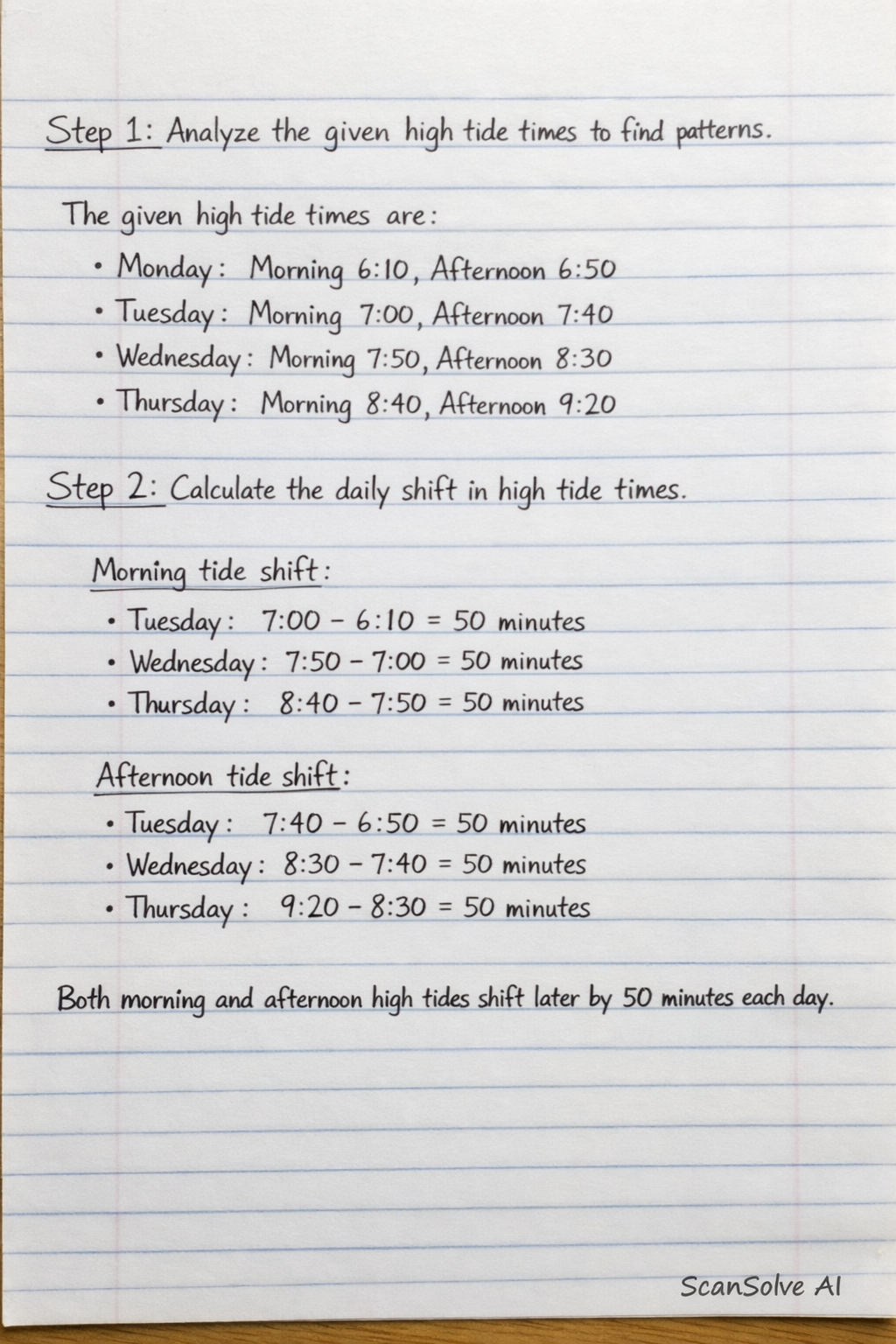
3 stepsAnalyze the given high tide times to find patterns.
The given high tide times are:
- Monday: Morning 6:10, Afternoon 6:50
- Tuesday: Morning 7:00, Afternoon 7:40
- Wednesday: Morning 7:50, Afternoon 8:30
- Thursday: Morning 8:40, Afternoon 9:20
Calculate the daily shift in high tide times.
- Morning tide shift:
- Tuesday (7:00) - Monday (6:10) = 50 minutes
- Wednesday (7:50) - Tuesday (7:00) = 50 minutes
- Thursday (8:40) - Wednesday (7:50) = 50 minutes
- Afternoon tide shift:
- Tuesday (7:40) - Monday (6:50) = 50 minutes
- Wednesday (8:30) - Tuesday (7:40) = 50 minutes
- Thursday (9:20) - Wednesday (8:30) = 50 minutes Both morning and afternoon high tides shift later by 50 minutes each day.
- Morning tide shift:
Calculate the time difference between morning and afternoon tides on the same day.
- Monday: 6:50 - 6:10 = 40 minutes
- Tuesday: 7:40 - 7:00 = 40 minutes
- Wednesday: 8:30 - 7:50 = 40 minutes
- Thursday: 9:20 - 8:40 = 40 minutes The afternoon high tide occurs 40 minutes after the morning high tide on the same day.
A. Completed Table:
Day Morning Afternoon Monday 6:10 6:50 Tuesday 7:00 7:40 Wednesday 7:50 8:30 Thursday 8:40 9:20 Friday 9:30 10:10 A. i) What patterns can you see linking the times of the high tides?
- The high tide times (both morning and afternoon) occur 50 minutes later each consecutive day.
- On any given day, the afternoon high tide occurs 40 minutes after the morning high tide.
A. ii) Predict the times of the two high tides on Friday?
- Friday Morning tide: Thursday Morning (8:40) + 50 minutes = 9:30
- Friday Afternoon tide: Friday Morning (9:30) + 40 minutes = 10:10
The predicted times for Friday are:
- Morning:
- Afternoon:
B. Change the table above into a column graph.
To create the column graph, follow these steps:
- Title: Give the graph a main title: "Times of High Tide at a Beach".
- Axes:
- Horizontal Axis (x-axis): Label this axis "Day of the Week". Mark and label the days: Monday, Tuesday, Wednesday, Thursday, Friday. Ensure even spacing between each day.
- Vertical Axis (y-axis): Label this axis "Time (hours)". The scale should start at 0 at the bottom and go up to 11. Mark major intervals at 0, 1, 2, 3, 4, 5, 6, 7, 8, 9, 10, 11. Between each major hour interval, include five (5) small divisions. Each small division will represent 12 minutes ().
- Data Conversion (to decimal hours for plotting):
- Monday: 6:10 (6.17), 6:50 (6.83)
- Tuesday: 7:00 (7.00), 7:40 (7.67)
- Wednesday: 7:50 (7.83), 8:30 (8.50)
- Thursday: 8:40 (8.67), 9:20 (9.33)
- Friday: 9:30 (9.50), 10:10 (10.17)
- Columns: For each day, draw two columns:
- One column representing the morning high tide time, extending from the x-axis up to the corresponding time on the y-axis.
- An adjacent column representing the afternoon high tide time for the same day, also extending from the x-axis up to its corresponding time.
- Ensure all columns are of the same thickness and that the groups of columns for each day are evenly spaced from each other.
- Legend: Use different colors or shading for the morning tide columns and the afternoon tide columns, and include a legend to distinguish them (e.g., "Morning Tide" and "Afternoon Tide").
- Neatness: Use a ruler to draw straight lines and ensure the graph is neat and clear.
Was this helpful?
Still stuck on this one?
Ask a follow-up, and the answer starts from this question.
Got a different question?Ask your own question
More Mathematics Questions
QDraw a distance-time graph using the provided table data, with appropriate scales for the axes.QDraw a line graph using the given information on the table below:QUse the tally chart (table) to draw a concrete graph. (Note: use square [ ] to represent colour.)QCreate a line chart showing temperature variations over time with appropriate titles and legend.QDraw a bar graph to represent the data in the table. Label the axes of your graph.
Handwritten Step-by-Step Solution
Get this as a handwritten image on WhatsApp — like a tutor wrote it for you.
Try on WhatsApp