We read your photo as:

The image contains multiple questions related to a cyclist and their bike. The main question is "QUESTION 3". Specific sub-questions ask to calculate wheel radius, rotations, handlebar size, bottle volume, temperature conversion, and probability.

Mathematics

ScanSolve AI Answer

Step-by-step solution

14 steps

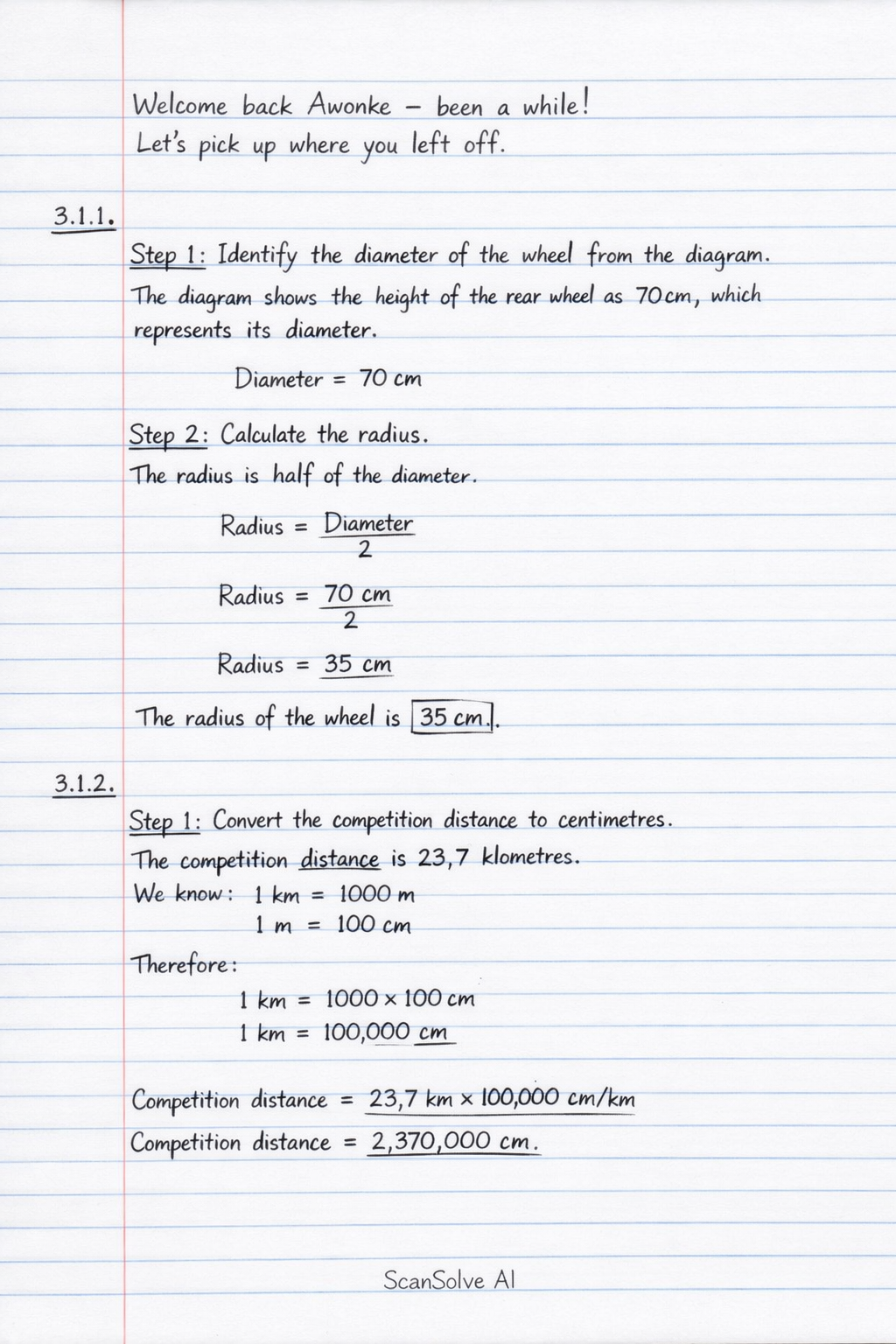
3.1.1

  1. Identify the diameter of the wheel from the diagram.

    The diagram shows the height of the rear wheel as 70 cm, which represents its diameter.

    Diameter=70 cm\text{Diameter} = 70 \text{ cm}
  2. Calculate the radius.

    The radius is half of the diameter.

    Radius=Diameter2=70 cm2=35 cm\text{Radius} = \frac{\text{Diameter}}{2} = \frac{70 \text{ cm}}{2} = 35 \text{ cm}

    The radius of the wheel is 35 cm\boxed{\text{35 cm}}.

    3.1.2

  3. Convert the competition distance to centimetres.

    The competition distance is 23,7 kilometres.
    We know that 1 km=1000 m1 \text{ km} = 1000 \text{ m} and 1 m=100 cm1 \text{ m} = 100 \text{ cm}.
    Therefore, 1 km=1000×100 cm=100 000 cm1 \text{ km} = 1000 \times 100 \text{ cm} = 100\,000 \text{ cm}.

    Competition distance=23,7 km×100 000cmkm=2 370 000 cm\text{Competition distance} = 23,7 \text{ km} \times 100\,000 \frac{\text{cm}}{\text{km}} = 2\,370\,000 \text{ cm}
  4. Calculate the distance of one rotation using the given formula and the radius from 3.1.1.

    The radius is 35 cm.

    Distance of one rotation=2×3,142×radius\text{Distance of one rotation} = 2 \times 3,142 \times \text{radius} Distance of one rotation=2×3,142×35 cm\text{Distance of one rotation} = 2 \times 3,142 \times 35 \text{ cm} Distance of one rotation=219,94 cm\text{Distance of one rotation} = 219,94 \text{ cm}
  5. Determine the number of rotations.

    Number of rotations=Total distanceDistance of one rotation\text{Number of rotations} = \frac{\text{Total distance}}{\text{Distance of one rotation}} Number of rotations=2 370 000 cm219,94 cm\text{Number of rotations} = \frac{2\,370\,000 \text{ cm}}{219,94 \text{ cm}} Number of rotations≈10 775,666\text{Number of rotations} \approx 10\,775,666

    The wheel would have to rotate approximately 10 775,67 times\boxed{10\,775,67 \text{ times}}.

    3.1.3

  6. Interpret the given information from the diagram and question.

    The diagram shows an arrow spanning the entire length of the bike, labeled "Handle bar width 185 cm". The question states, "The size of the handlebar is roughly the distance between the two wheels." Given the diagram's label and the arrow indicating the overall length of the bike (from the front of the front wheel to the back of the rear wheel), it is most reasonable to interpret the 185 cm as the overall length of the bike, and thus, the approximate "size of the handlebar" as referred to in the question.

    The size of the handlebar is 185 cm\boxed{\text{185 cm}}.

    3.1.4

  7. Calculate the radius of the bottle.

    The bottle has a diameter of 8 cm.

    Radius=Diameter2=8 cm2=4 cm\text{Radius} = \frac{\text{Diameter}}{2} = \frac{8 \text{ cm}}{2} = 4 \text{ cm}
  8. Calculate the volume of the bottle using the given formula.

    The height of the bottle is 22 cm.

    Volume=3,142×radius2×height\text{Volume} = 3,142 \times \text{radius}^2 \times \text{height} Volume=3,142×(4 cm)2×22 cm\text{Volume} = 3,142 \times (4 \text{ cm})^2 \times 22 \text{ cm} Volume=3,142×16 cm2×22 cm\text{Volume} = 3,142 \times 16 \text{ cm}^2 \times 22 \text{ cm} Volume=3,142×352 cm3\text{Volume} = 3,142 \times 352 \text{ cm}^3 Volume=1105,984 cm3\text{Volume} = 1105,984 \text{ cm}^3
  9. Convert 1 litre to cubic centimetres and compare.

    We are given that 1 mL=1 cm31 \text{ mL} = 1 \text{ cm}^3.
    Since 1 litre=1000 mL1 \text{ litre} = 1000 \text{ mL}, then 1 litre=1000 cm31 \text{ litre} = 1000 \text{ cm}^3.
    The bottle's volume is 1105,984 cm31105,984 \text{ cm}^3.
    Since 1105,984 cm3>1000 cm31105,984 \text{ cm}^3 > 1000 \text{ cm}^3, the bottle is big enough.

    The bottle's volume is 1105,984 cm31105,984 \text{ cm}^3, which is greater than 1 litre (1000 cm31000 \text{ cm}^3). Therefore, the bottle will be big enough\boxed{\text{will be big enough}}.

    3.1.5

  10. Substitute the given Fahrenheit temperature into the formula.

    The formula is: ∘F=(1,8×∘C)+32∘^\circ\text{F} = (1,8 \times ^\circ\text{C}) + 32^\circ.
    Given ∘F=90∘^\circ\text{F} = 90^\circ.

    90=(1,8×∘C)+3290 = (1,8 \times ^\circ\text{C}) + 32
  11. Solve for degrees Celsius.

    Subtract 32 from both sides:

    90−32=1,8×∘C90 - 32 = 1,8 \times ^\circ\text{C} 58=1,8×∘C58 = 1,8 \times ^\circ\text{C}

    Divide by 1,8:

    ∘C=581,8^\circ\text{C} = \frac{58}{1,8} ∘C≈32,22^\circ\text{C} \approx 32,22

    The temperature in degrees Celsius is approximately 32,22∘C\boxed{32,22^\circ\text{C}}.

    3.1.6

  12. Identify the total number of bikes sold.

    The company sold seventeen bikes in total.

    Total number of bikes=17\text{Total number of bikes} = 17
  13. Identify the number of green bikes.

    There are four green bikes.

    Number of green bikes=4\text{Number of green bikes} = 4
  14. Calculate the probability of selecting a green bike.

    Probability (Green bike)=Number of green bikesTotal number of bikes\text{Probability (Green bike)} = \frac{\text{Number of green bikes}}{\text{Total number of bikes}} Probability (Green bike)=417\text{Probability (Green bike)} = \frac{4}{17}

    The probability of selecting a green bike is 417\boxed{\frac{4}{17}}.

Was this helpful?

Still stuck on this one?

Ask a follow-up, and the answer starts from this question.

Got a different question?Ask your own question
Handwritten step-by-step solution preview

Handwritten Step-by-Step Solution

Get this as a handwritten image on WhatsApp — like a tutor wrote it for you.

Try on WhatsApp