We read your photo as:

The pie chart below shows the major expenditure from Mr Kataala's income for a month in 2019. Study it carefully and answer the questions that follow. (a) Calculate the value of x. (b) If he spent sh. 272000 on masks, find his monthly income.

Mathematics

ScanSolve AI Answer

Answers

2 parts
a
45
b

sh.1,152,000\text{sh.1,152,000}

20∘20^\circ

120∘120^\circ

Step-by-step solution

10 steps

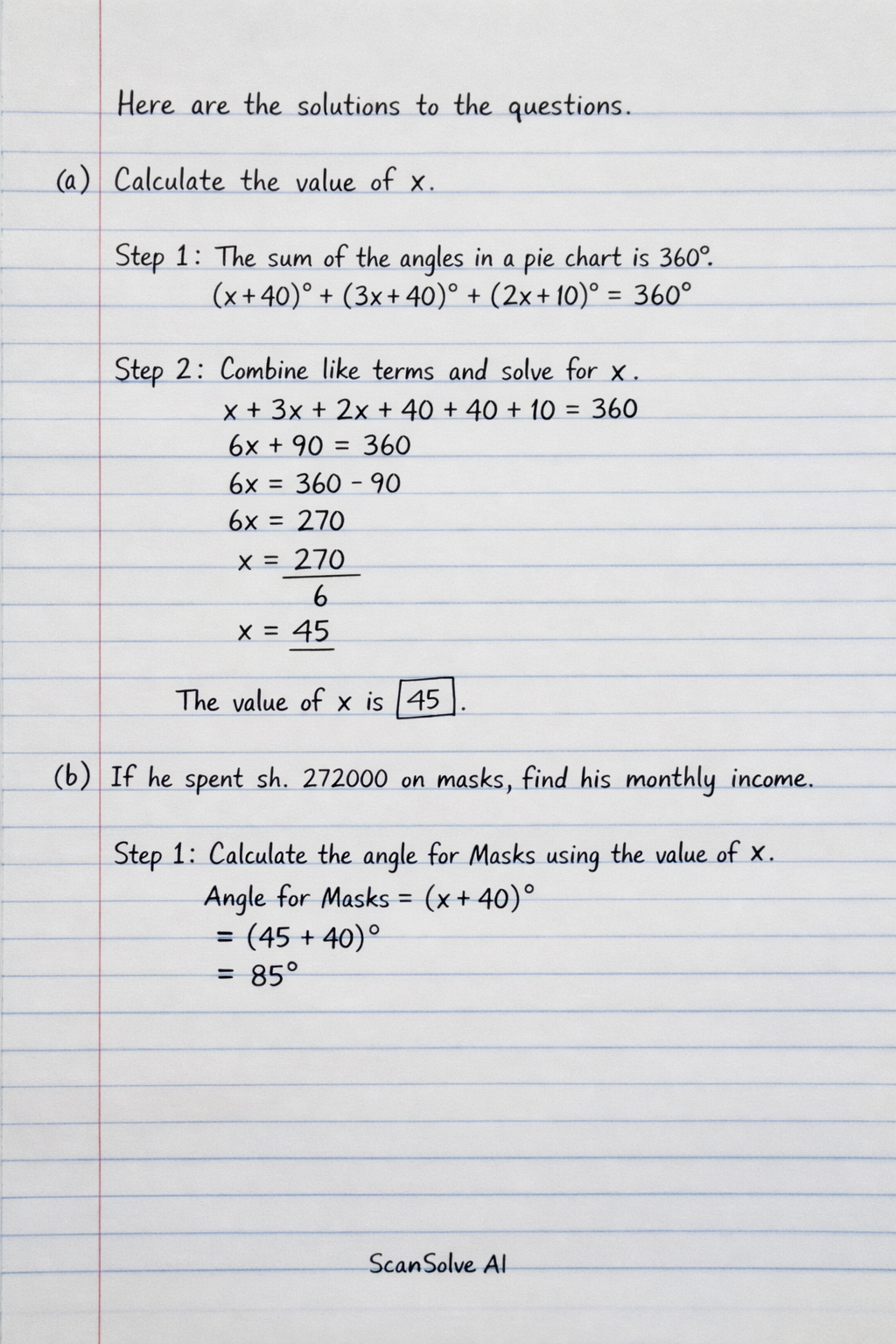
Here are the solutions to the questions.

30. The pie chart below shows the major expenditure from Mr Kataala's income for a month in 2019. Study it carefully and answer the questions that follow.

Part a· 2 steps

Calculate the value of xx.

  1. The sum of the angles in a pie chart is 360∘360^\circ.

    Add the given angles for Masks, Sanitizers, and Gloves:

    (x+40)∘+(3x+40)∘+(2x+10)∘=360∘(x+40)^\circ + (3x+40)^\circ + (2x+10)^\circ = 360^\circ
  2. Combine like terms and solve for xx.

    x+3x+2x+40+40+10=360x + 3x + 2x + 40 + 40 + 10 = 360 6x+90=3606x + 90 = 360 6x=360−906x = 360 - 90 6x=2706x = 270 x=2706x = \frac{270}{6} x=45x = 45

    The value of xx is 45\boxed{45}.

Part b

sh.1,152,000\text{sh.1,152,000}

If he spent sh. 272000 on masks, find his monthly income.

  1. Calculate the angle corresponding to Masks using the value of xx.

    Angle for Masks =(x+40)∘=(45+40)∘=85∘= (x+40)^\circ = (45+40)^\circ = 85^\circ.

  2. Set up a proportion to find the total monthly income.

    The expenditure on Masks (sh. 272000) corresponds to 85∘85^\circ of the total 360∘360^\circ income.
    Let MM be the total monthly income.

    Expenditure on MasksTotal Monthly Income=Angle for MasksTotal Angle\frac{\text{Expenditure on Masks}}{\text{Total Monthly Income}} = \frac{\text{Angle for Masks}}{\text{Total Angle}} 272000M=85360\frac{272000}{M} = \frac{85}{360}
  3. Solve for MM.

    M=272000×36085M = \frac{272000 \times 360}{85} M=272000×7217M = 272000 \times \frac{72}{17} M=16000×72M = 16000 \times 72 M=1,152,000M = 1,152,000

    His monthly income is sh.1,152,000\boxed{\text{sh.1,152,000}}.

    31. Study the figure below and answer the questions that follow.
    (Assuming the question asks for the values of xx and kk.)

  4. Identify properties from the given markings.

    The single dash marks on AD and DB indicate that AD=DBAD = DB. Therefore, △ADB\triangle ADB is an isosceles triangle, which means ∠DAB=∠DBA\angle DAB = \angle DBA. Let's call this angle α\alpha. So, ∠DAB=α\angle DAB = \alpha and ∠DBA=α\angle DBA = \alpha.
    The double dash marks on AB and BC indicate that AB=BCAB = BC. Therefore, △ABC\triangle ABC is an isosceles triangle, which means ∠BAC=∠BCA\angle BAC = \angle BCA.

  5. Relate angles using the isosceles triangles.

    From Step 1, ∠BAC=∠DAB=α\angle BAC = \angle DAB = \alpha.
    Since ∠BAC=∠BCA\angle BAC = \angle BCA, we have ∠BCA=α\angle BCA = \alpha.
    From the diagram, ∠BCA=x\angle BCA = x. Therefore, x=αx = \alpha.
    So, in △ADB\triangle ADB, ∠DAB=x\angle DAB = x and ∠DBA=x\angle DBA = x.

  6. Apply the sum of angles in △DBC\triangle DBC.

    The sum of angles in △DBC\triangle DBC is 180∘180^\circ.

    ∠BDC+∠DBC+∠BCD=180∘\angle BDC + \angle DBC + \angle BCD = 180^\circ 40∘+k+x=180∘40^\circ + k + x = 180^\circ k+x=140∘(1)k + x = 140^\circ \quad (1)
  7. Express ∠ABC\angle ABC in two ways.

    From △ABC\triangle ABC being isosceles with ∠BAC=x\angle BAC = x and ∠BCA=x\angle BCA = x:

    ∠ABC=180∘−(∠BAC+∠BCA)\angle ABC = 180^\circ - (\angle BAC + \angle BCA) ∠ABC=180∘−(x+x)\angle ABC = 180^\circ - (x + x) ∠ABC=180∘−2x\angle ABC = 180^\circ - 2x

    Also, from the diagram, ∠ABC\angle ABC is the sum of ∠DBA\angle DBA and ∠DBC\angle DBC:

    ∠ABC=∠DBA+∠DBC\angle ABC = \angle DBA + \angle DBC

    Since ∠DBA=x\angle DBA = x (from Step 2) and ∠DBC=k\angle DBC = k:

    ∠ABC=x+k\angle ABC = x + k
  8. Equate the two expressions for ∠ABC\angle ABC and solve the system of equations.

    x+k=180∘−2xx + k = 180^\circ - 2x k=180∘−3x(2)k = 180^\circ - 3x \quad (2)

    Substitute equation (2) into equation (1):

    (180∘−3x)+x=140∘(180^\circ - 3x) + x = 140^\circ 180∘−2x=140∘180^\circ - 2x = 140^\circ 180∘−140∘=2x180^\circ - 140^\circ = 2x 40∘=2x40^\circ = 2x x=40∘2x = \frac{40^\circ}{2} x=20∘x = 20^\circ

    Now substitute x=20∘x = 20^\circ back into equation (1) to find kk:

    k+20∘=140∘k + 20^\circ = 140^\circ k=140∘−20∘k = 140^\circ - 20^\circ k=120∘k = 120^\circ

    The value of xx is 20∘\boxed{20^\circ} and the value of kk is 120∘\boxed{120^\circ}.

Was this helpful?

Try one yourself

A new problem that tests the same skill.

Still stuck on this one?

Ask a follow-up, and the answer starts from this question.

Got a different question?Ask your own question
Handwritten step-by-step solution preview

Handwritten Step-by-Step Solution

Get this as a handwritten image on WhatsApp — like a tutor wrote it for you.

Try on WhatsApp